The Kaspa 2026 roadmap reported on February 26 targeted a Covenants++ hard fork around early May and a DagKnight-plus-higher-BPS upgrade near the end of Q3. Both windows were explicitly presented as aggressive targets, not activation commitments. TN12 programmability and proof-of-concept rollups were development evidence, while mainnet dates, final throughput, and production readiness remained provisional.
Key takeaways
- KASmedia attributed a two-hard-fork 2026 outline to Kaspa researcher Yonatan Sompolinsky: Covenants++ first, then DagKnight with increased blocks per second.
- The source called both timelines aggressive and said DagKnight performance benchmarking was still pending.
- KIP-2 described DagKnight as a proposed consensus hard fork with research, implementation, wallet-policy API, and documentation work still listed as deliverables.
- Covenant, lineage, and zero-knowledge primitives discussed in the report were running on Testnet 12, not evidence of mainnet activation.
- A roadmap can guide engineering attention, but it cannot establish delivery, adoption, network revenue, or a future KAS price.
What did the February Kaspa 2026 roadmap say?
The assigned KASmedia report summarized a public X discussion by Yonatan Sompolinsky. It reported an aim for two hard forks in 2026: Covenants++ around the beginning of May, followed by DagKnight and higher BPS near the end of Q3. Sompolinsky characterized both as aggressive timelines.
That wording is the central evidence boundary. An aim is not a scheduled activation. The report did not provide a mainnet DAA score, signed release artifact, node-upgrade deadline, or completed benchmark for either target. This article therefore preserves what was knowable on February 26 rather than treating later events as if they were already certain.
What was expected from the Covenants++ track?
KASmedia described transaction-introspection covenants, lineage through covenant IDs, and zero-knowledge verification opcodes as active on TN12. Together, those primitives were intended to let UTXO scripts constrain future outputs, distinguish an authentic state-machine lineage from look-alikes, and verify succinct proofs without executing the whole computation in a script.
The report also covered a proof-of-concept based zk rollup with canonical KAS entry and exit on TN12. A proof of concept demonstrates that components can be connected under test conditions; it does not prove production security, decentralized operation, wallet support, or mainnet availability. Economic and application behavior still required testing.
For another protocol-cost dimension, Kaspa multidimensional mass explains why resource accounting work should be evaluated independently from a proposed activation calendar.
What was DagKnight supposed to change?
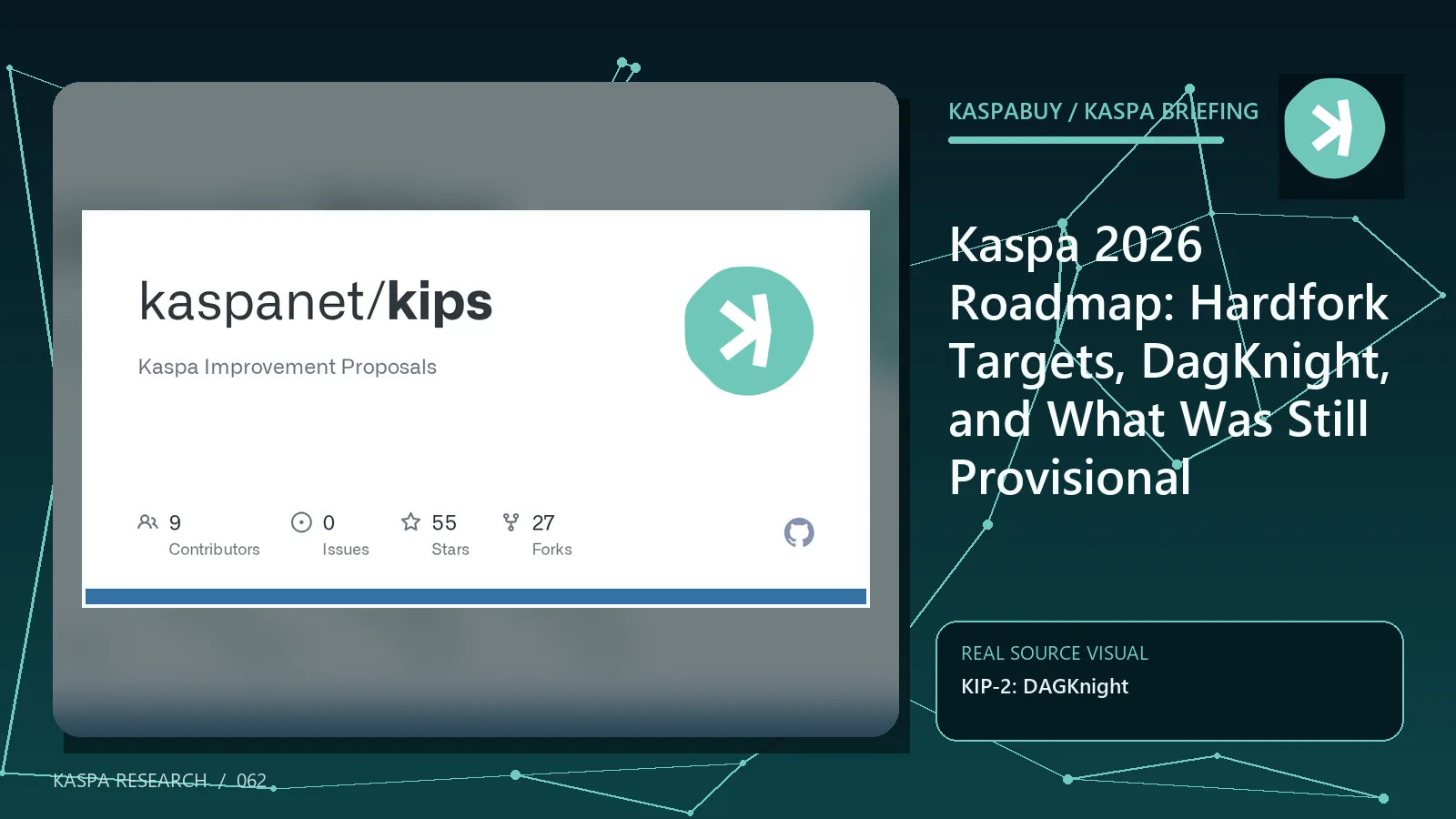
DagKnight is a consensus design intended to adapt confirmation behavior to observed network conditions rather than rely on GHOSTDAG’s fixed k parameter. The DAGKnight paper supplies the research basis, while the official KIP-2 proposal lists the Kaspa-specific upgrade work.
KIP-2 was marked Proposed. Its deliverables included further applied research, efficient algorithms, a Rust implementation, a transaction-confirmation policy API, and documentation. It also stated that the change breaks consensus rules and requires a hard fork. Those entries are a stronger status signal than a generalized claim that DagKnight was already deployed.
Were higher BPS figures final?
No. KASmedia reported discussion of 40- to 25-millisecond block intervals for the DagKnight hard fork and a 10-millisecond objective associated with later work. It also said benchmarking was pending. Block interval is not a complete throughput, confirmation, latency, decentralization, or hardware-requirement metric.
Any final BPS choice would need implementation evidence under realistic bandwidth, propagation, CPU, storage, mining, and adversarial conditions. A simulation or target can narrow engineering questions, but it cannot guarantee identical results across the public network. The earlier Rusty Kaspa v1.1.0 RC3 analysis shows why candidate software and final releases must also be distinguished.
How should node operators and builders read the roadmap?
Operators should wait for official release notes, activation parameters, compatibility instructions, and stable binaries before treating a hard fork as scheduled. Builders can use testnets to validate transaction formats and application assumptions, but should isolate test-only code and expect interfaces to change.
A useful readiness checklist is: specification status, reviewed implementation, test-network activation, reproducible benchmarks, stable release, mainnet activation parameters, and ecosystem compatibility. In February, the source provided meaningful progress on several early stages but not all of them.
What remained unfinished or unverified?
The report said vProgs work still needed reliable state synchronization and settlement back to Kaspa Layer 1. The rollup implementation was described by its builder as mature, but remained a TN12 proof of concept. DagKnight benchmarking and implementation milestones were not final. None of those limitations invalidate the work; they define what the evidence could support.
Did the roadmap determine KAS price direction?
No. Technical milestones may affect expectations, but token price also reflects liquidity, macro conditions, market structure, execution risk, and actual usage. The sources offer no validated price model. Dates, testnet demonstrations, and proposed BPS figures should not be converted into a guaranteed price forecast.
Frequently asked questions
Were two Kaspa hard forks guaranteed for 2026?
No. The February source reported two aggressive targets. It did not publish binding activation parameters for both upgrades.
Was DagKnight already live on mainnet?
No evidence in the cited February sources supports that claim. KIP-2 was marked Proposed and described required research and implementation work.
Were Covenants++ features already working anywhere?
KASmedia reported relevant primitives and prototypes on Testnet 12. Testnet operation is not the same as mainnet activation or a production audit.
Did the roadmap promise a specific BPS level?
No final benchmark-backed level was committed in the source. Performance intervals were targets under discussion, with benchmarking still pending.
Source and verification note
This article uses the February 26, 2026 KASmedia report as the assigned source and links its underlying Sompolinsky roadmap post. DagKnight status and deliverables are checked against official KIP-2. These sources support attributed targets and testnet progress; they do not prove final mainnet dates, production security, measured public-network performance, adoption, or future KAS price.