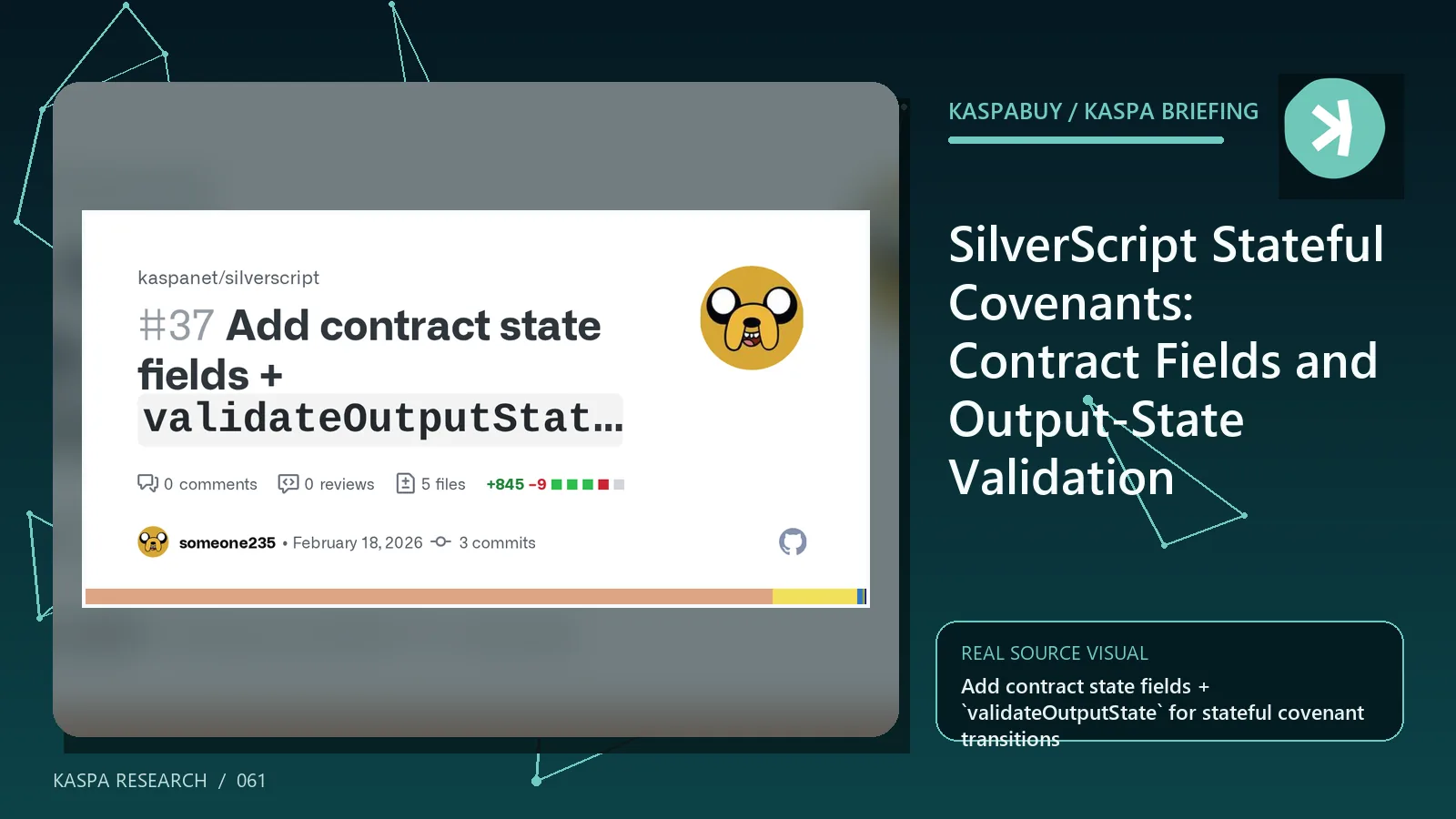
SilverScript stateful covenants gained first-class contract fields and validateOutputState when PR #37 merged into SilverScript’s master branch on February 18, 2026. The compiler can encode state inside a redeem script and verify that a chosen output carries the expected next state. This is compiler tooling, not proof of mainnet activation or audited contract safety.
Key takeaways
- Contract-level fields let a SilverScript program declare values that become part of the contract’s redeem-script representation.
- Field reads are compiled as runtime stack accesses, so they refer to the state carried by the UTXO being spent rather than a compile-time constant.
validateOutputState(outputIndex, newState)reconstructs the expected next redeem script and checks the selected output’s P2SH locking script.- Integer fields use fixed-width eight-byte encoding, and new state is serialized in declaration order to keep field boundaries deterministic.
- The merge changed the SilverScript compiler and tests; it did not itself activate a Kaspa mainnet hard fork, audit an application, or establish KAS demand.
What did SilverScript PR #37 merge?
The official SilverScript PR #37 records three commits, 845 additions, nine deletions, and five changed files. It merged into the repository’s master branch after six repository checks passed. The changes covered the grammar, abstract syntax tree, compiler, tutorial, and a substantial compiler-test expansion.
That scope matters. The merge made state transitions expressible in this compiler revision; it was not a Kaspa consensus release. SilverScript produces scripts for a broader experimental covenant toolchain, while network acceptance still depends on the transaction and opcode rules active on the selected Kaspa network.
How do contract fields carry state in a UTXO model?
A UTXO is consumed once, so a stateful application cannot mutate an old output in place. It instead spends the current state UTXO and creates a replacement output that encodes the next state. The contract must constrain that replacement or anyone satisfying the spend path could create an unauthorized continuation.
PR #37 added contract-level declarations such as an integer counter or byte tag. The compiler emits their encoded values as a prefix before the reusable contract-logic tail in the redeem script. Reads become stack operations rather than constant folding, which allows the same logic to observe values supplied by the current instance.
This compiler feature complements the transport layer described in Kaspa covenant RPC serialization, where covenant-related data must survive conversion between RPC and transaction representations.
What does validateOutputState actually check?
The new statement-level builtin takes an output index and a state object. According to the PR description, the compiler encodes the proposed field values in contract declaration order, appends the existing redeem-script tail, derives the corresponding P2SH locking script, and compares it with the script on the selected transaction output.
For a counter, an increment function can require a next output whose encoded count equals the current count plus one while retaining another field unchanged. The check is local to the transaction: it validates the output at the supplied index against the reconstructed script. It does not search for an output automatically, prove uniqueness across the whole application, or replace application-specific authorization rules.
Why is deterministic field encoding important?
Two implementations must derive the same byte sequence from the same logical state or they will calculate different locking scripts. PR #37 therefore encoded contract integers as fixed-size eight-byte values and applied the same layout during transition validation. Field order follows the contract declaration rather than an arbitrary map iteration order.
Determinism prevents ambiguity at this compiler boundary, but it does not solve every schema problem. Developers still need stable types, explicit upgrade rules, overflow handling, and tests for malformed or missing fields. Changing a field layout can change the redeem script and therefore the identity of the expected locking condition.
What evidence did the merge provide?
The changed test file added 432 lines, while the PR page reports six passing checks. Those are concrete signs that parsing, compilation, state encoding, and transition cases were exercised in the repository. They are not equivalent to an independent security review, adversarial economic analysis, or production monitoring.
Developers should reproduce the compiler tests, inspect generated scripts, test invalid next states, and verify behavior against the intended node and test network. The related Kaspa Python SDK v1.1.0 guide explains an integration layer, but an SDK cannot make an unsafe covenant design safe.
What did this change not establish?
PR #37 did not announce a mainnet activation height, final covenant standard, audited token protocol, or production wallet support. Merging to a language repository’s default branch means the code was accepted there; it does not mean every Kaspa node would accept the generated transaction at that date. Deployment claims require a matching node release, network parameters, and observed activation evidence.
Did this have a measurable KAS price impact?
The source contains no market data or valuation model. Better contract tooling can reduce development friction, but it does not prove usage, fees, liquidity, or demand. A price prediction based only on this compiler merge would exceed the evidence.
Frequently asked questions
Is SilverScript itself a Kaspa hard fork?
No. SilverScript is developer tooling. Consensus changes and their activation are governed by node code and network parameters, not by merging a compiler PR.
Does validateOutputState update an existing UTXO?
No. It verifies that the spending transaction creates a selected output with the expected next-state locking script. The old UTXO is still consumed.
Are contract integers variable length?
In the PR #37 state-field implementation, integer fields use fixed-size eight-byte encoding to make the state layout deterministic.
Did passing checks prove the feature secure?
No. Repository checks support implementation confidence, but they are not a contract audit or proof that every application built with the feature is secure.
Source and verification note
This article is based on merged kaspanet/silverscript PR #37, including its merge target, commit and file counts, compiler design, encoding description, example, and test changes. Claims describe the February 18, 2026 repository revision. The source does not establish Kaspa mainnet activation, a final application standard, independent audit results, production adoption, or KAS price performance.