Kaspa PR #1011 clarified a subtle Toccata rule: sequencing-commitment scripts must be evaluated against the correct selected-parent and DAA-score context. The patch aligned block-template validation, chain qualification, replay checks, and mainnet pruning-proof handling, while adding a focused integration test for a spend that is valid at one boundary but not when replayed later.
Key takeaways
- Script validity can depend on the chain context in which a transaction is evaluated.
- The selected parent supplies the relevant sequencing-commitment view for normal chain-block qualification.
- Replaying a transaction later with a different context can produce the wrong answer.
- Mainnet pruning proofs were aligned with the same selected-parent rule.
- Non-mainnet proof application retained a legacy compatibility path for already deployed testnet and devnet peers.
What problem did Kaspa PR #1011 solve?
The merged rusty-kaspa pull request #1011 says its purpose was to clarify and test contextual validation rules for Toccata sequencing-commitment scripts. This is not a cosmetic change. A sequencing commitment exposes information tied to a particular point in Kaspa’s ordered history, so a validator must ask the script’s question using the same historical view the consensus rule intends.
The patch documents choices across three related operations: validating a block template, deciding whether a chain block qualifies, and replaying the selected-parent chain. It also updates pruning-point proof logic so mainnet proof segments are built and applied against the pruning point’s selected parent.
The result is a more consistent rule: when qualification depends on sequencing-commitment access, use the selected-parent context defined for that block rather than an accidentally later or otherwise misaligned view.
GitHub records the merge into rusty-kaspa’s toccata development branch. A merged development PR was evidence that the code had passed its project checks; it was not, on its own, evidence that Toccata had activated on mainnet.
Why does the selected-parent context matter in a BlockDAG?
Kaspa’s BlockDAG can contain parallel blocks, but consensus still needs an ordered context for state transitions and script evaluation. The selected parent is part of that ordering process. If a script reads sequencing information, evaluating it against a different point can expose commitments that were not available—or hide commitments that were available—at the original validation boundary.
PR #1011 describes a specific integration-test case: a sequencing-commitment spend is valid against the block’s selected parent, yet it would fail if replayed later with full script checks. The transaction itself has not changed. The observable context has.
That is why “run the same script again” is not always a valid reproduction method unless the test also restores the same DAA score and sequencing-commitment view. Context is part of the input, even when it is not serialized as an ordinary transaction field.
What changed in the code and tests?
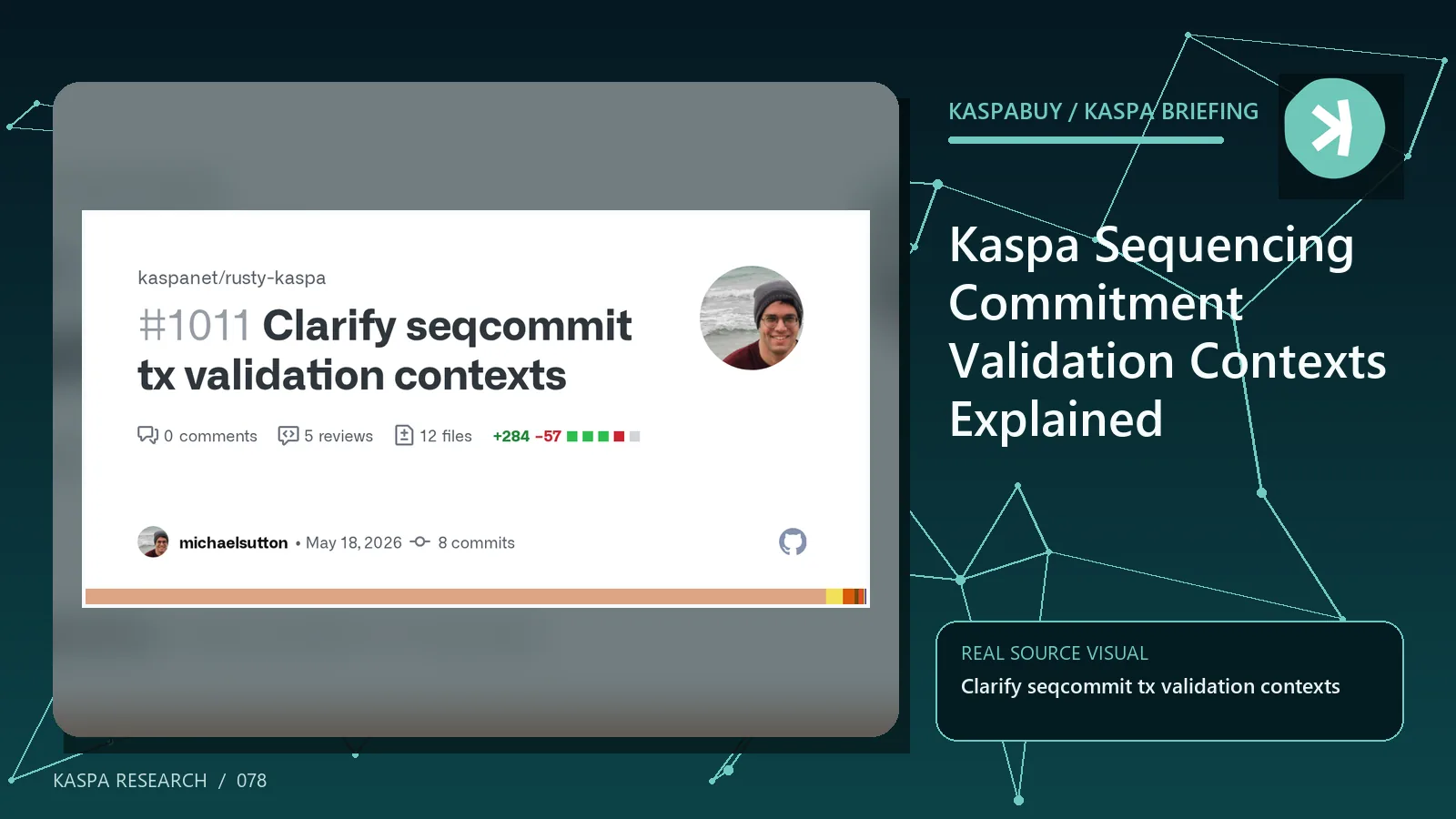
The merged change touched 12 files, with 284 additions and 57 deletions. The affected areas included the consensus service interface, sequencing-commitment accessor, virtual processing, UTXO validation, pruning-proof application, protocol flows, and consensus integration tests.
The public PR description identifies four concrete outcomes:
- It documents the intended DAA-score and sequencing context for block templates, qualification, and replay.
- It adds a targeted integration test for the selected-parent replay boundary.
- It validates pruning-point transactions using the pruning point’s selected parent.
- It builds and applies mainnet pruning-proof chain segments against that same context.
The tests matter as much as the comments. Consensus behavior that depends on historical context is vulnerable to regression if a future refactor silently substitutes a convenient “current” view. A boundary-focused test preserves the intended distinction.
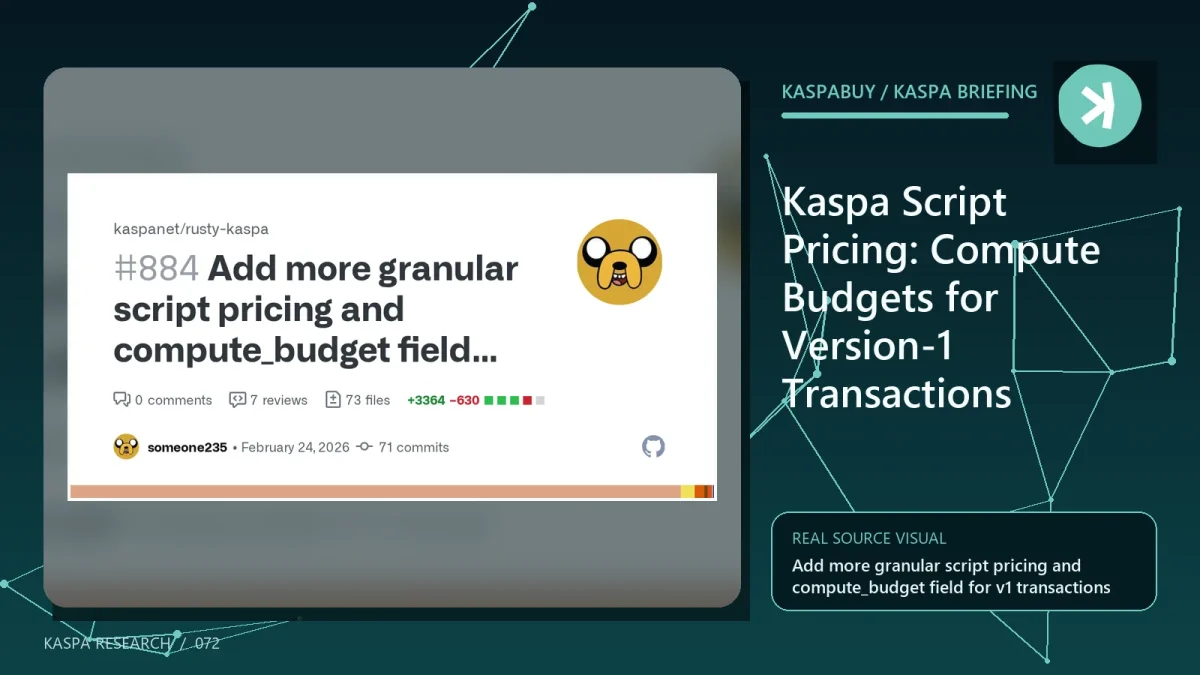
Context selection was also separate from other Toccata work such as version-1 transaction script pricing and CHECKSIGFROMSTACK signature opcodes. Grouping them under one hardfork does not make their consensus responsibilities interchangeable.
Why keep a legacy rule outside mainnet?
The PR states that non-mainnet proof application intentionally continues to accept the older pruning-point-context segment rule. That choice protects compatibility with testnet and devnet peers already deployed under the legacy assumption.
This does not mean mainnet correctness is optional. It means compatibility risk is different across environments. Before a mainnet release, developers can align the production rule without forcing every experimental network to rebuild history or coordinate an immediate breaking transition.
For implementers, the lesson is to avoid assuming that all networks share identical historical proof behavior. Network parameters and compatibility branches are relevant when reproducing a result.
What should wallet, indexer, and node developers do?
Most application developers will not call these consensus internals directly, but the change still affects testing strategy. If software constructs or observes sequencing-commitment transactions, test vectors should record the network, activation state, selected parent, and DAA score. A transaction ID alone is not enough to explain why a context-sensitive script passed.
Node and bridge developers should also avoid reimplementing consensus-context selection from an informal description. Use the maintained rusty-kaspa interfaces and follow the upstream behavior. The related guide to KIP-21 partitioned sequencing commitments explains the broader proving architecture behind these validation paths.
These consensus-internal rules are also distinct from the ordinary address and UTXO payment flow introduced in our KaspaBuy instant-payments overview. A merchant integration should rely on maintained node or API results rather than trying to reproduce sequencing-context logic in checkout code.
For implementation-level context, our article on KIP-21 entering rusty-kaspa follows how the proposal moved from protocol design into maintained node code.
Frequently asked questions
Is a sequencing commitment the same as a transaction confirmation?
No. A sequencing commitment is authenticated protocol data a script can use when reasoning about selected chain blocks in Kaspa’s ordered history. Confirmation describes whether a transaction has been accepted and ordered by the network.
Why can replay produce a different script result?
Because the script may access context tied to a specific selected parent and DAA score. Replaying against a later view changes that input.
Did PR #1011 change all testnet proof rules?
No. Its description explicitly says non-mainnet proof application keeps a legacy segment rule for compatibility with deployed peers, while mainnet handling is aligned before release.
Source and verification note
This article is based on kaspanet/rusty-kaspa PR #1011, merged into the toccata branch on May 19, 2026. The source includes the rationale, file-level diff, merge commit, and integration-test changes. Interpretations here explain the published development patch; they do not replace the consensus code or establish mainnet activation status.