
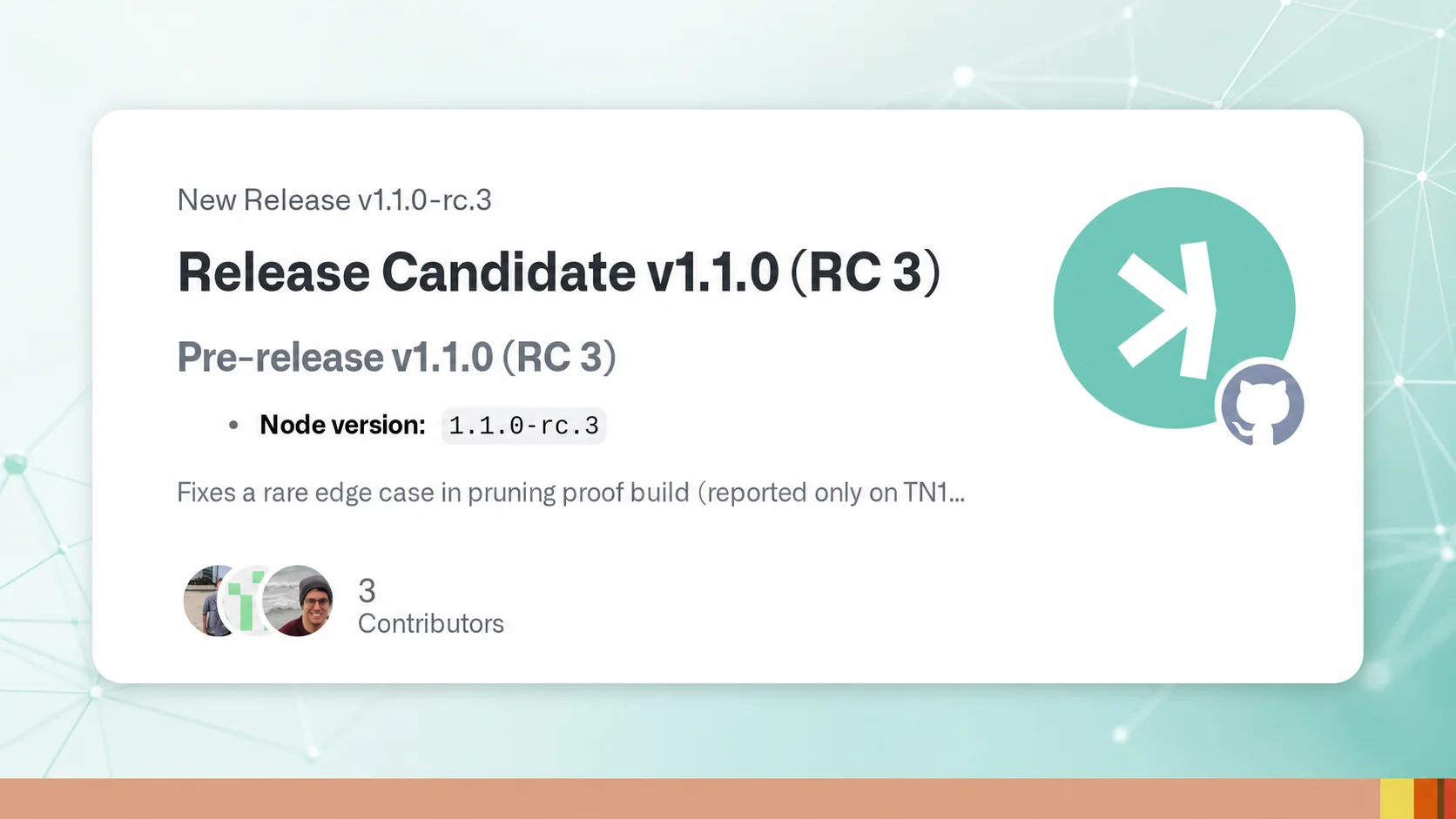
Rusty Kaspa v1.1.0 RC3 was a pre-release node build published on February 8, 2026. Its headline change fixed a rare pruning-proof construction edge case observed on Testnet 12, while the package also improved optional RPC decoding and build tooling. It was a candidate for validation, not a new mainnet consensus activation.
Key takeaways
- The official release labels node version
1.1.0-rc.3as a pre-release, so operators still needed to treat it as candidate software. - The principal runtime fix addressed pruning-proof reachability at individual BlockDAG levels after a failure was reported on TN12.
- Optional RPC structures became more forward-compatible, reducing the chance that older decoders would reject newly added optional data.
- Rust edition, minimum compiler, lint, CI, and packaging changes prepared the codebase for a stable release without changing Kaspa’s monetary rules.
- RC3 did not activate covenants, ZK verification, or any other hardfork on mainnet, and the source provides no basis for a KAS price forecast.
What was included in Rusty Kaspa v1.1.0 RC3?
The official Rusty Kaspa v1.1.0 RC3 release lists six merged pull requests between RC2 and RC3. They cover the pruning-proof fix, forward-compatible RPC deserialization, a move to the Rust 2024 edition, a higher minimum supported Rust version, a GitHub Actions installer change, and a Linux multilib installation correction.
That mix matters because a node release is more than consensus algorithms. Nodes must deserialize messages from other versions, build reproducibly on supported platforms, and produce pruning proofs that peers can validate. RC3 therefore combined one narrow BlockDAG correctness fix with compatibility and release-engineering work.
The release page does not describe a new block rate, transaction format, emission rule, or activation point. Readers looking for the already-active speed transition should use the separate overview of Kaspa’s move to 10 BPS.
What pruning-proof edge case did RC3 address?
Pruning lets a node discard old data while retaining the information needed to validate the current state and synchronize securely. A pruning proof summarizes enough history across BlockDAG levels for another node to assess that state without downloading everything ever produced.
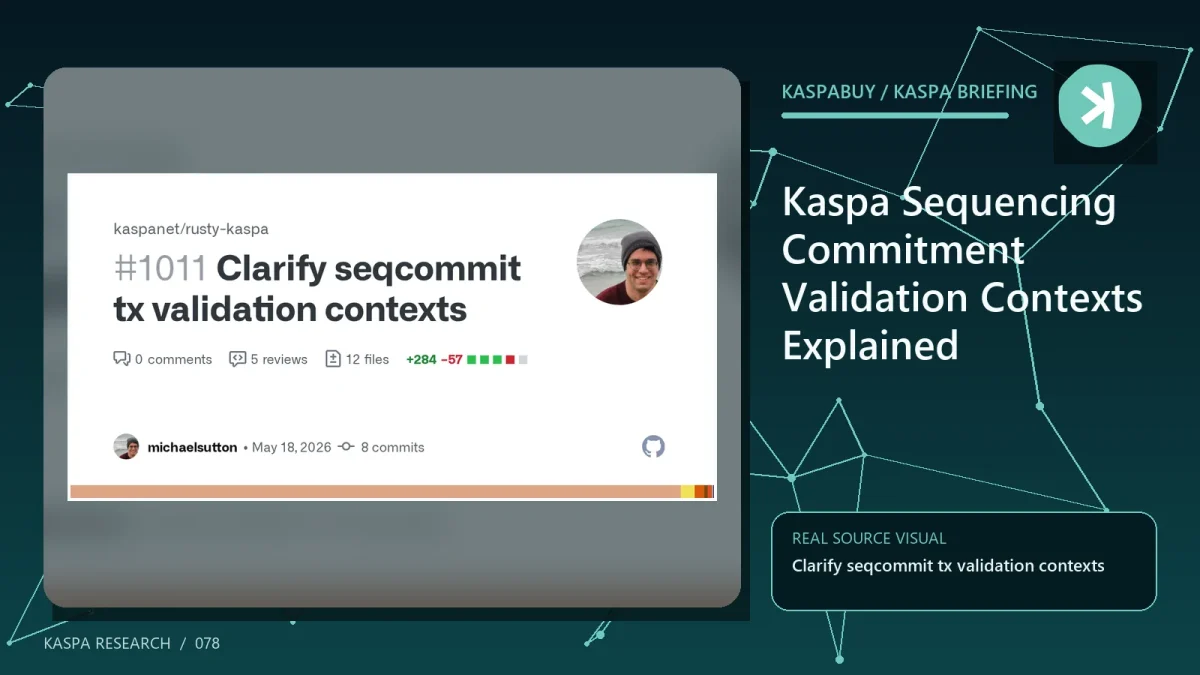
In Rusty Kaspa PR #857, the maintainer explained that level-relation subDAGs can lose intermediate links after pruning even when the global reachability service still knows that two surviving blocks are reachable. A search could consequently cross into a pruned area or encounter a partially pruned anticone.
The merged fix built reachability stores per level while populating the proof and constrained root selection to the future of the previous root. The PR explicitly called this the current solution and documented a more involved long-term invariant that would require a staged rollout. That distinction is important: RC3 corrected the reported TN12 failure path, but its own source did not claim that pruning research was permanently finished.
Why did forward-compatible RPC decoding matter?
RPC is the boundary used by wallets, explorers, miners, indexers, and operational tooling to exchange structured node data. During active development, an optional structure can gain fields that an earlier client does not recognize.
PR #838 changed deserialization of optional RPC structures to be forward-compatible. In practical terms, optional additions should be less likely to turn a valid newer message into a hard failure for an older decoder. This is compatibility plumbing, not a consensus feature, but it lowers integration friction while adjacent software is upgraded.
It does not guarantee that every old client understands the meaning of every new field. Application developers still have to test mixed versions, handle absent values, and update their schemas when they need the new semantics.
Was RC3 the same as the stable v1.1.0 release?
No. GitHub marked RC3 as a pre-release. The phrase “final candidate” describes its position at the end of the release-candidate sequence, not an assurance that candidate binaries were equivalent to a generally released build on February 8.
A release candidate is intended to expose near-final code to broader testing. A stable release still requires maintainers to assess reports, decide whether more code changes are necessary, finalize packaging, and publish a separate tag. Operators should follow the tag and release channel their environment requires rather than inferring stability from a title.
The later-facing Kaspa 2026 roadmap guide also separates targets from activation evidence, a useful rule for reading any pre-release milestone.
What should node operators and integrators have tested?
TN12 participants could reproduce pruning-proof construction and synchronization around the reported edge case, while RPC users tested newer optional payloads against generated clients and strict schema validators. Candidate-node testers should keep recoverable backups, verify the official release and signed commit, check startup and database reopening, and avoid exposing administrative RPC endpoints. A passing workflow cannot model every host or integration.
How did RC3 relate to multidimensional mass work?
RC3 came from the main Rusty Kaspa release line. Separate Covenant++ development included Kaspa multidimensional mass in covpp-reset1. A merge into that experimental branch was not automatically part of RC3 or another tagged mainline release.
What were the roadmap and price implications?
RC3 showed TN12 finding a rare synchronization edge case before stable release. That is useful engineering evidence, not a valuation model. Neither the release note nor its pull requests state a KAS price target or guarantee adoption.
Frequently asked questions
Did RC3 activate a hardfork on Kaspa mainnet?
No. The release was a pre-release node build, and its headline fix was reported on TN12. A mainnet hardfork requires separate activation logic, parameters, operator guidance, and network coordination.
Was the pruning-proof problem a mainnet failure?
The official release says the rare edge case was reported only on TN12. It does not document a corresponding mainnet incident.
Did every operator need to install RC3 immediately?
The source does not issue a universal mainnet upgrade mandate. Testnet participants and integrators evaluating the candidate had the clearest reason to run it; production operators needed to follow official release guidance.
Did RC3 guarantee that v1.1.0 would need no further changes?
No. A release candidate is evidence of late-stage testing, not a guarantee. Maintainers can still revise code or packaging if testing finds a problem.
Source and verification note
This article is based primarily on the official v1.1.0 RC3 release record, with implementation context from merged PR #857 and PR #838. GitHub identifies RC3 as a pre-release and the pruning issue as TN12-reported. The sources do not establish a mainnet activation, independent security audit, universal upgrade requirement, adoption outcome, or KAS price effect.