
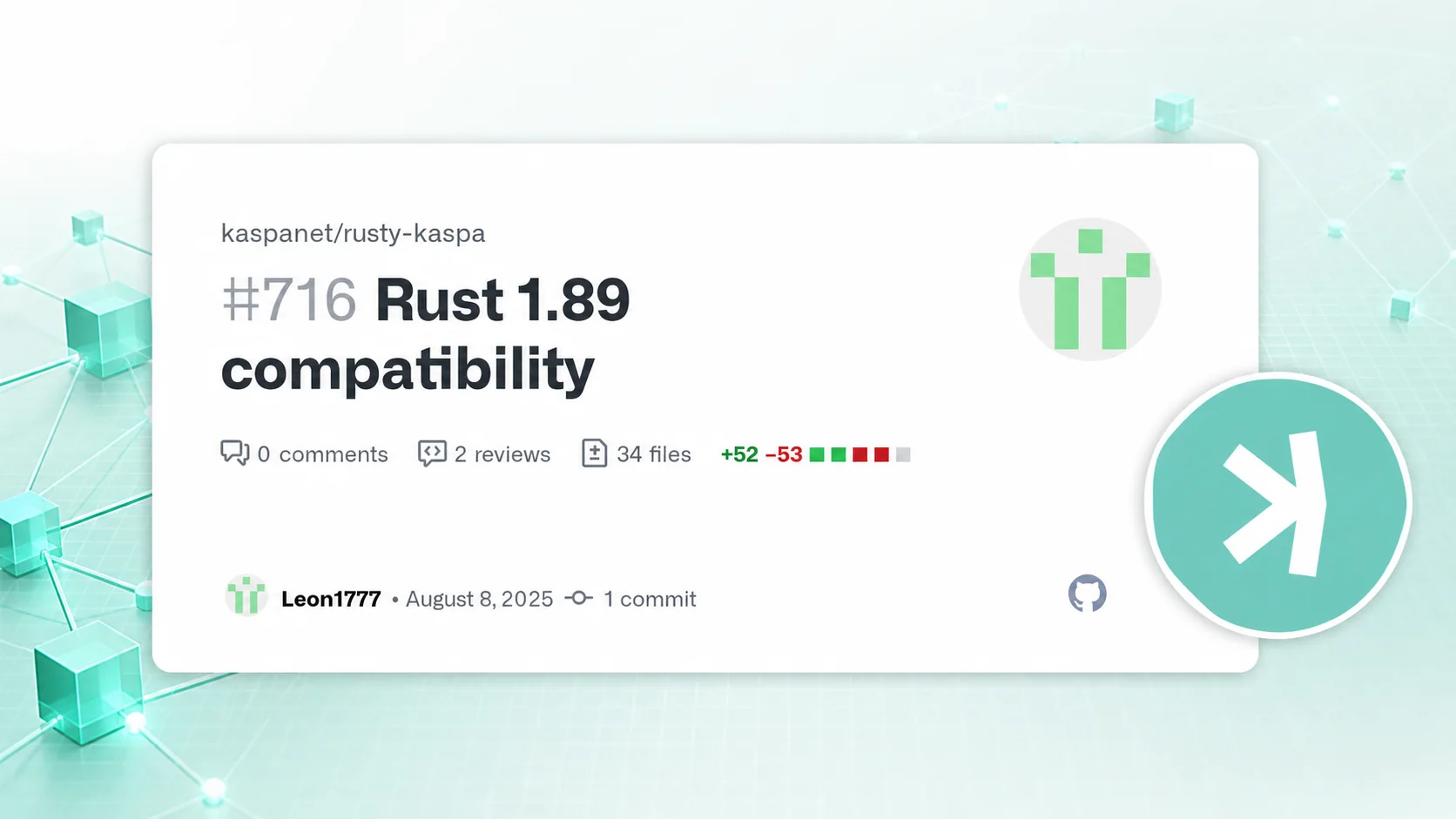
Rusty Kaspa and Rust 1.89 remained build-compatible after an August 15, 2025 maintenance pull request updated lifetime syntax, lint-driven idioms, iterator signatures, and saturating arithmetic. The change was broad across 34 files but small in net size, showing toolchain upkeep rather than a consensus upgrade or a new network feature.
Key takeaways
- Rust 1.89 made
mismatched_lifetime_syntaxesa warn-by-default lint. - Rusty Kaspa pull request 716 added explicit inferred lifetimes such as
'_to many returned guard and iterator types. - Other edits followed compiler or Clippy guidance, including
from_ref, direct pattern matching, and reusable comparison implementations. - The patch changed 34 files with 52 additions and 53 deletions.
- It did not schedule a hardfork, alter Kaspa monetary rules, or promise a performance increase.
Why did Rusty Kaspa need a Rust 1.89 update?
The Rust project released version 1.89.0 on August 7, 2025. Its official release announcement introduced a default warning for mismatched lifetime syntaxes. The lint flags signatures where an input visibly carries a lifetime but the returned generic type hides the related lifetime, making ownership relationships less obvious to readers.
Rusty Kaspa is a large Rust workspace spanning consensus, networking, RPC, mining, storage, cryptography, wallet, WASM, and supporting utilities. A new compiler warning can therefore surface in many modules even when the underlying Rust lifetime inference remains valid. Projects that enforce clean lint output need coordinated source updates when the toolchain changes.
Merged pull request 716 described its purpose simply: “updates RK for Rust 1.89 compatibility.” The diff provides the detail needed to understand what that meant.
What changed in lifetime signatures?
Many functions returned lock guards or iterators whose lifetime was inferred from a borrowed receiver. Before the patch, a signature could return MutexGuard<Inner> or std::slice::Iter<PSKTInner> without showing the lifetime parameter. The update wrote those types as MutexGuard<'_, Inner> and std::slice::Iter<'_, PSKTInner>.
The '_ marker tells readers that a lifetime exists and should be inferred; it does not create a new ownership model or extend how long a lock is held. Similar edits appeared in consensus sessions, database access, mining caches, notification subscriptions, wallet account state, UTXO contexts, key derivation, and PSKT bundles.
This is a maintainability improvement. Explicit syntax helps reviewers see that a returned guard or iterator remains tied to borrowed data, while leaving the compiler to infer the exact lifetime.
Which lint-driven idioms were cleaned up?
The patch replaced small one-element slices built from cloned values with std::slice::from_ref. In wallet address registration, for example, that avoids spelling a temporary array containing address.clone() when only a borrowed one-item slice is required.
Several comparison implementations changed from manually comparing IDs to calling the type’s own cmp implementation. Other edits replaced “check result, then unwrap reference” patterns with if let Ok(ref index), removed needless return expressions, simplified a constant string passed to a formatter, and aligned a trailing comma in WASM configuration.
These are not user-facing features. They reduce lint noise and keep one canonical implementation of an operation, which makes future review easier and lowers the chance that equivalent code paths drift apart.
Did the update change runtime behavior?
Most edits were type annotations or equivalent idioms. One notable area rewrote timestamp estimation from checked_mul and checked_add with a maximum-value fallback to saturating_mul and saturating_add. Both approaches cap an overflowed result instead of wrapping it; the saturating form states that intent more directly.
The patch also used self.cmp(other) inside PartialOrd implementations, delegating to the existing total ordering. Those edits should be understood as consistency and defensive-maintenance work, not a new consensus rule.
The pull request did not include benchmark results, so it would be unsupported to claim a measurable speedup. It also did not change block rate, proof of work, transaction validity, emission, or network activation parameters.
Why toolchain maintenance matters for a node project
Reproducible node software depends on more than protocol algorithms. Maintainers also have to track compiler diagnostics, target support, dependencies, operating systems, and build automation. Ignoring toolchain changes can leave contributors on inconsistent environments or force later upgrades to absorb many warnings and compatibility fixes at once.
Small compatibility patches make the maintenance boundary visible. Reviewers can inspect a focused diff, test the workspace, and separate language-tooling changes from protocol development. That separation is especially valuable in a consensus codebase, where vague “upgrade” language could otherwise be mistaken for a network rule change.
Rust 1.89 also began the process of moving the Intel macOS target to a lower support tier, according to the Rust announcement. Pull request 716 did not claim to resolve every platform-support question, so operators should continue reading both Rust and Rusty Kaspa release notes for their exact build target.
What should builders and operators do?
Contributors building from source should record their Rust version, run the project’s prescribed formatting and lint checks, and test the relevant native and WASM targets. A clean build on one workstation is not evidence that every target and feature combination works.
Production node operators should prefer supported tagged releases or the repository’s documented stable branch rather than treating every merged master commit as a deployment instruction. They should stage upgrades, preserve configuration, monitor startup and sync, and retain a rollback procedure compatible with any database changes in the selected release.
For adjacent August 2025 work, read how Kaspa VSPC confirmations reduced virtual-tip churn for integrators and how Rusty Kaspa overflow protection addressed an unusual UTXO-index startup failure.
What this update says about the roadmap
The evidence supports a modest conclusion: Rusty Kaspa was being kept current with its implementation language while feature and protocol work continued separately. It does not support a KAS price forecast or a claim that compiler compatibility creates adoption by itself.
For technical due diligence, routine maintenance is still meaningful. Healthy open-source infrastructure needs contributors willing to fix warnings, improve clarity, and keep a multi-crate workspace buildable, even when the result is not a headline feature.
Frequently asked questions
Did Rust 1.89 change Kaspa consensus?
No. Rust is the implementation toolchain. Pull request 716 updated source compatibility and idioms; it did not activate new network rules.
Does '_ make a lock live longer?
No. It makes an inferred lifetime visible in the return type. The borrow relationship already existed.
Did the pull request prove Rusty Kaspa became faster?
No. It supplied no benchmark evidence. The defensible benefits are compatibility, clearer signatures, and cleaner maintenance.
Source and verification note
The primary Kaspa source is merged rusty-kaspa pull request 716, including its 34-file diff and August 15, 2025 merge record. The cause of the major signature cleanup was checked against the Rust team’s Rust 1.89 announcement. No claim here implies a hardfork, price outcome, or universal platform compatibility.