
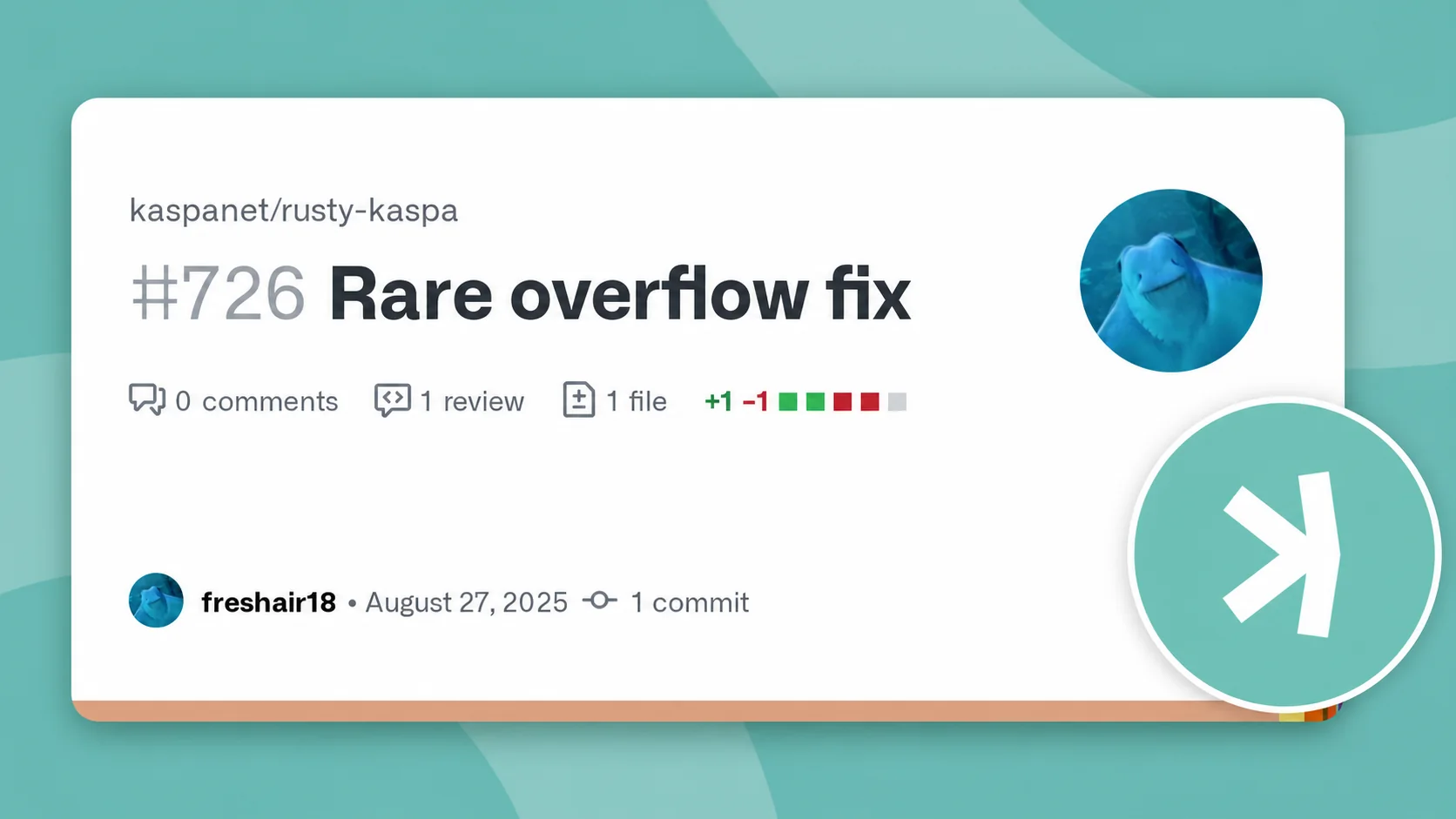
Rusty Kaspa overflow protection improved with a one-line arithmetic rewrite merged on August 27, 2025. The old UTXO-index startup calculation multiplied a file-descriptor budget before dividing it, so an unusually large value could overflow. Dividing directly preserved the intended ten-percent allocation while avoiding that intermediate multiplication.
Key takeaways
- GitHub issue 696 documented a startup panic when
kaspadran with--utxoindexunder an unusual file-descriptor budget. - The failing expression calculated ten percent as
fd_remaining * 10 / 100. - Pull request 726 changed it to
fd_remaining / 10, eliminating the risky intermediate product. - The patch added one line and deleted one line in
kaspad/src/daemon.rs. - It was a narrow startup robustness fix, not a consensus, transaction, mining, or monetary-policy change.
What was the Rusty Kaspa overflow edge case?
The original GitHub issue 696 reported that a node could not start with the UTXO index enabled. The posted error was a Rust panic: an attempt to multiply with overflow in kaspad/src/daemon.rs. The report included the relevant calculation and showed that failure occurred while the daemon was allocating part of its file-descriptor budget to UTXO-index files.
The affected code began with a remaining descriptor budget represented as a signed 32-bit integer. When --utxoindex was active, it intended to reserve ten percent. The mathematical result could fit, yet the temporary multiplication by ten could exceed the integer’s maximum before the later division reduced it.
This is an intermediate-overflow problem. It says nothing about a KAS balance, transaction amount, block score, or supply calculation.
Why can multiply-then-divide overflow?
Consider the intended proportion: ten percent. Writing it as value * 10 / 100 creates an intermediate value ten times larger than the input. Fixed-width integer arithmetic must represent that intermediate result. If it cannot, a checked debug-style Rust build can panic rather than silently continue with a wrapped number.
For a nonnegative integer budget, value / 10 produces the same whole-number allocation intended by that particular expression, while every intermediate stays no larger than the original value. Pull request 726 described the replacement as equivalent except that it avoids the possible overflow.
The lesson is broader than this line: algebraically equivalent formulas can have different safety properties on bounded machine integers. Reviewers need to consider the order of operations, maximum inputs, signedness, and rounding—not only the final mathematical value.
What exactly did pull request 726 change?
Merged Rusty Kaspa pull request 726 replaced:
let utxo_files_limit = fd_remaining * 10 / 100;
with:
let utxo_files_limit = fd_remaining / 10;
The diff touched one file, with one addition and one deletion. It merged on August 27, 2025. Its author characterized the crash as extremely specific and non-urgent, possibly related to unusual system settings, while noting that the fix itself was simple.
That wording should be preserved. The evidence supports a rare configuration-sensitive startup failure; it does not establish remote exploitation, widespread node crashes, database corruption, or loss of funds.
What is the file-descriptor budget used for?
Operating systems represent open files and sockets with file descriptors or equivalent handles. A full node needs them for network connections and database files. Rusty Kaspa’s daemon apportions an available budget so one subsystem does not consume every descriptor needed by the process.
The optional UTXO index provides address-oriented lookup state used by wallet-related services. The Rusty Kaspa repository’s running-node instructions show --utxoindex as the mode needed when using wallets. Enabling that index increases the database resources the daemon must plan for, which is why the startup path calculated a dedicated file limit.
A source-code fix does not remove the need for sound operating-system limits. Operators still need reasonable descriptor settings, storage capacity, memory, and monitoring appropriate to their workload.
Who was affected, and who was not?
The reported path required UTXO indexing and a descriptor budget large enough for the intermediate multiplication to overflow. The pull request did not publish a population estimate, reproducible platform matrix, or common default that triggered it. Calling the problem “all Kaspa nodes are vulnerable” would therefore exceed the evidence.
Nodes that started normally were not shown by this issue to be calculating consensus incorrectly. Users of wallets connected to healthy, indexed nodes were not asked in the source to move funds or rotate keys. The fix simply made startup arithmetic tolerate a wider input range.
Operators who saw the exact panic could compare their version and configuration with the issue, preserve logs, and move to a supported release containing the fix after normal staging. They should avoid editing production binaries ad hoc without tests and provenance.
Why a one-line fix still deserves review
Small diffs can be easy to understand, but their surrounding assumptions still matter. Reviewers should confirm that the budget is nonnegative, integer rounding remains intended, the remaining budget is decremented consistently, and tests cover boundary values. They should also ensure the change reaches the supported release and build artifacts operators actually install.
The pull request itself did not add a boundary test. That is a limitation of the available evidence, not proof that the fix is wrong. The direct division removes the reported multiplication overflow by inspection, while broader startup testing remains good engineering practice.
For nearby maintenance context, see Rusty Kaspa and Rust 1.89. Integrators processing chain state can also review Kaspa VSPC confirmations.
What did the fix not change?
It did not alter the UTXO model, output ownership, signature verification, DAG ordering, block rate, pruning rules, coin emission, or mining reward. It also did not make high resource limits inherently desirable. A larger descriptor ceiling can support more open resources, but capacity planning should reflect the machine and workload rather than maximizing one number without bounds.
There is likewise no defensible KAS price conclusion to draw from this patch. It is evidence of open-source maintenance and issue resolution, not a demand forecast.
Frequently asked questions
Was this an overflow in a transaction value?
No. It occurred in a daemon startup calculation for file descriptors when the UTXO index was enabled.
Did the patch change the intended ten-percent allocation?
For the nonnegative integer budget in this context, direct division by ten preserves the intended whole-number proportion without the intermediate multiplication.
Should every node enable --utxoindex?
Not automatically. It is needed for wallet-related indexed queries, but it adds resource requirements. Operators should enable features their service needs.
Source and verification note
The primary source is merged kaspanet/rusty-kaspa pull request 726, including its one-line diff and August 27, 2025 merge record. The failure report and exact panic were verified in issue 696. Scope statements are deliberately narrow because neither record demonstrates a consensus fault, exploit, or fund loss.