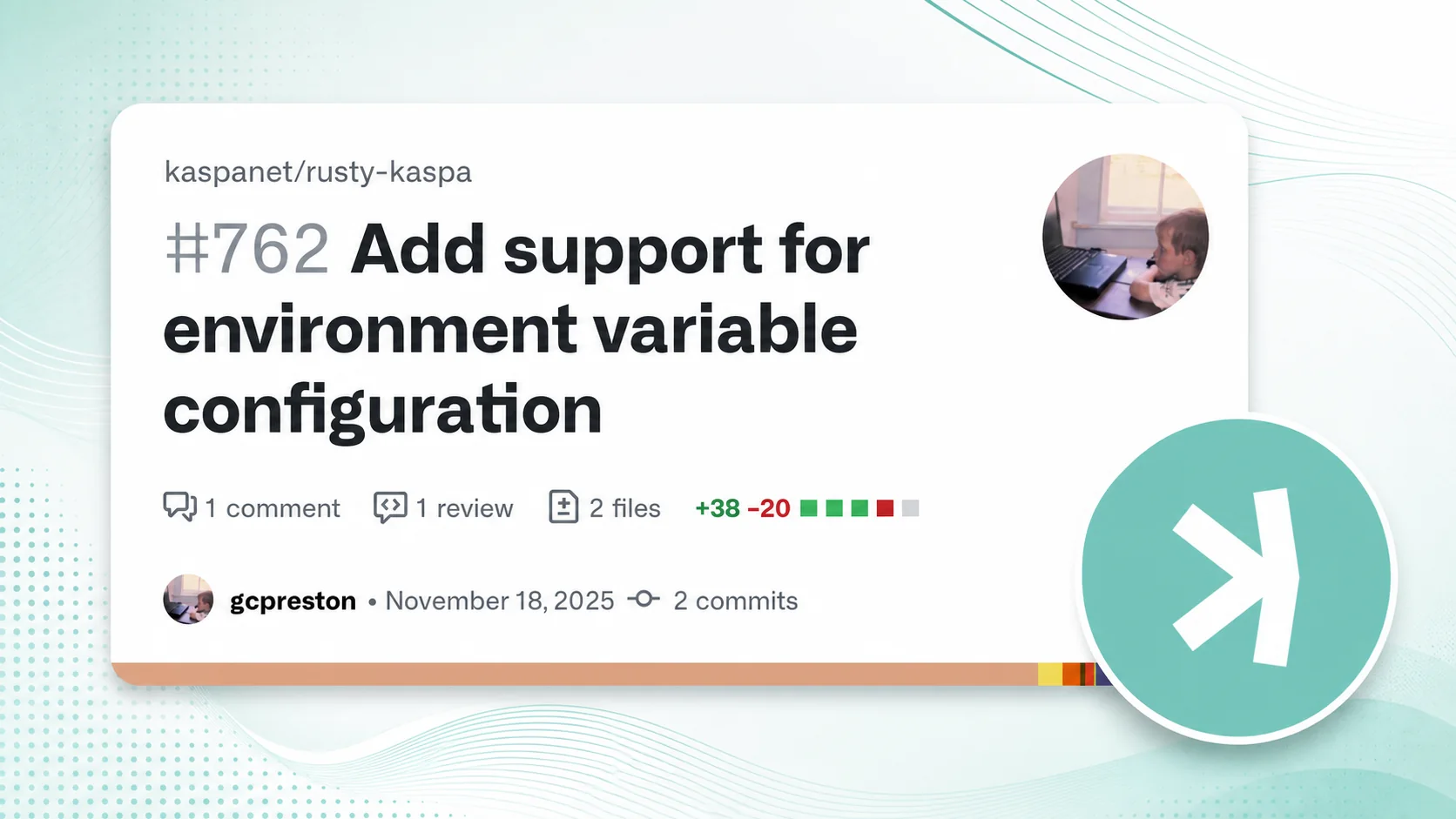
Rusty Kaspa environment variables became a supported configuration path when PR #762 was merged on November 18, 2025. The change maps kaspad command-line options to named KASPAD_* variables, making service, container and orchestration deployments easier to reproduce without constructing one long command for every node instance.
Key takeaways
- The patch enables Clap’s environment-variable feature and attaches
KASPAD_*names to existingkaspadarguments. - It covers paths, logging, peer limits, network selection, RPC listeners, indexes, performance metrics and other operational switches.
- This is an input method for existing settings; it does not introduce new consensus rules or a new official Docker image.
- Operators must still protect RPC endpoints, validate boolean values and keep sensitive material out of logs and ordinary environment dumps.
- Configuration convenience can improve deployment discipline, but it does not guarantee uptime, mining revenue or a KAS price outcome.
What changed in rusty-kaspa?
The merged rusty-kaspa PR #762 modifies two files. It enables the env feature on the workspace’s Clap dependency for the kaspad binary, then adds an environment-variable name to the node’s argument definitions. GitHub records 38 additions, 20 deletions and six passing checks.
The change originated from an older proposal, PR #511. The contributor explicitly removed that proposal’s Docker portions at maintainer request while preserving the relevant authorship. Therefore, #762 supports environment-driven configuration; it should not be cited as evidence that kaspanet published or maintains a particular container image.
Operationally, the same typed parsers and argument definitions remain involved. A peer-count variable still has to parse as a number, and a network address still has to match the expected address format. Environment variables do not turn arbitrary text into valid node configuration.
Which KASPAD variables are available?
The public diff maps a broad set of command options. Representative groups include:
- Paths and logs:
KASPAD_CONFIGFILE,KASPAD_APPDIR,KASPAD_LOGDIR,KASPAD_NOLOGFILESandKASPAD_LOG_LEVEL. - RPC and network listeners:
KASPAD_RPCLISTEN,KASPAD_RPCLISTEN_BORSH,KASPAD_RPCLISTEN_JSON,KASPAD_LISTENandKASPAD_EXTERNALIP. - Peering:
KASPAD_CONNECTPEERS,KASPAD_ADDPEERS,KASPAD_OUTPEERS,KASPAD_MAXINPEERSandKASPAD_RPCMAXCLIENTS. - Network modes:
KASPAD_TESTNET,KASPAD_NETSUFFIX,KASPAD_DEVNETandKASPAD_SIMNET. - Node behavior:
KASPAD_UTXOINDEX,KASPAD_ARCHIVAL,KASPAD_SANITY,KASPAD_RAM_SCALEandKASPAD_PERF_METRICS.
The patch also maps specialized or potentially risky switches such as KASPAD_UNSAFERPC, KASPAD_RESET_DB, KASPAD_ENABLE_UNSYNCED_MINING and KASPAD_NONINTERACTIVE. Do not enable them simply because they are easy to express. Read the current kaspad --help text and release documentation for the exact binary you deploy.
Why are environment variables useful in production?
Service managers and orchestrators generally separate a program image from instance-specific configuration. An operator can use one tested kaspad build while assigning a data directory, listener, network and resource profile per host. Configuration templates become reviewable, and an intended setting does not disappear inside an improvised shell command.
They also reduce quoting problems for long commands and make automated rollouts more consistent. A deployment system can compare a desired set of variables across nodes before restarting them. That supports reproducibility: incident notes can record the binary version and a redacted configuration snapshot.
However, the environment is only one layer. Firewall policy, file ownership, storage capacity, service restart behavior, monitoring and release procedures remain separate responsibilities. The Kaspa IBD and pruning movement guide explains why preserving database state and logs can matter when a node resumes an interrupted synchronization.
How should a safe configuration be designed?
Start with the minimum settings required for the intended network and role. Pin a tested rusty-kaspa release or commit, read its help output, and keep a versioned configuration template outside the live data directory. Use explicit data and log paths so upgrades do not accidentally point at the wrong database.
Keep RPC listeners on loopback or a trusted private interface unless remote access is deliberately designed. A value such as KASPAD_RPCLISTEN=127.0.0.1 can help express that intent, but the actual ports, firewall rules and exposed protocols still require verification. Never enable unsafe RPC on a public interface as a troubleshooting shortcut.
Treat destructive flags as change-controlled operations. KASPAD_RESET_DB can reset node state; KASPAD_ENABLE_UNSYNCED_MINING is described by the source as mainly for testing. Separate mainnet, testnet, devnet and simnet data directories, and label service units so an operator cannot mistake one network for another.
What about secrets and precedence?
The merged patch concerns node arguments, not wallet seed phrases or private keys. Do not put a seed phrase, spending key or exchange credential into a KASPAD_* variable. Environment data may be visible to service tooling, diagnostic bundles, crash handlers or administrators with process access.
When both command-line and environment values are present, verify the precedence behavior for the exact Clap and rusty-kaspa versions in use. Upstream Clap environment documentation describes the library facility, while the node’s current help output is the operational authority for a deployed build.
Boolean variables deserve a staging test. A string that appears “false” to a human may not behave as expected for every flag action and library version. Launch first on a non-production network, inspect the startup log and query the node only through a trusted local endpoint.
How do you verify a deployment?
Record the binary version, network, service account and redacted variable names before starting. Confirm that the process uses the intended data directory, binds only the expected interfaces, connects to the desired peer network and reports no parser or database error. Test restart behavior, because a configuration that works interactively may fail under a service manager with a different working directory or environment.
Monitor synchronization, peer count, disk growth and resource use. If the node rejects peers after an upgrade, compare supported protocol versions rather than changing unrelated settings. Our Kaspa P2P compatibility guide covers the later removal of protocol versions 5 and 6.
Environment-variable support is an operational building block. High availability still requires redundancy, alerting, tested recovery and a controlled update window.
Frequently asked questions
Do environment variables replace command-line flags?
They provide another input path for mapped arguments. Keep using the method that your deployment system can validate and audit, and confirm behavior with the exact version’s help output.
Did PR #762 add an official rusty-kaspa Docker image?
No. The pull request description says Docker portions from the older proposal were removed. The merged change adds environment-variable configuration to kaspad.
Can I store a wallet seed in a KASPAD variable?
No seed variable is part of this change, and ordinary process environments are not an appropriate wallet-secret store. Keep signing keys outside the node configuration and use a purpose-built secret-management process.
Source and verification note
This guide is based on kaspanet’s merged rusty-kaspa PR #762, merged November 18, 2025. Its public diff enables Clap’s env feature and maps existing arguments to named variables in kaspad/src/args.rs; the PR explicitly excludes Docker-image work. Variable examples above are taken from that diff. Always verify names, accepted values and security behavior against the current release you operate.