
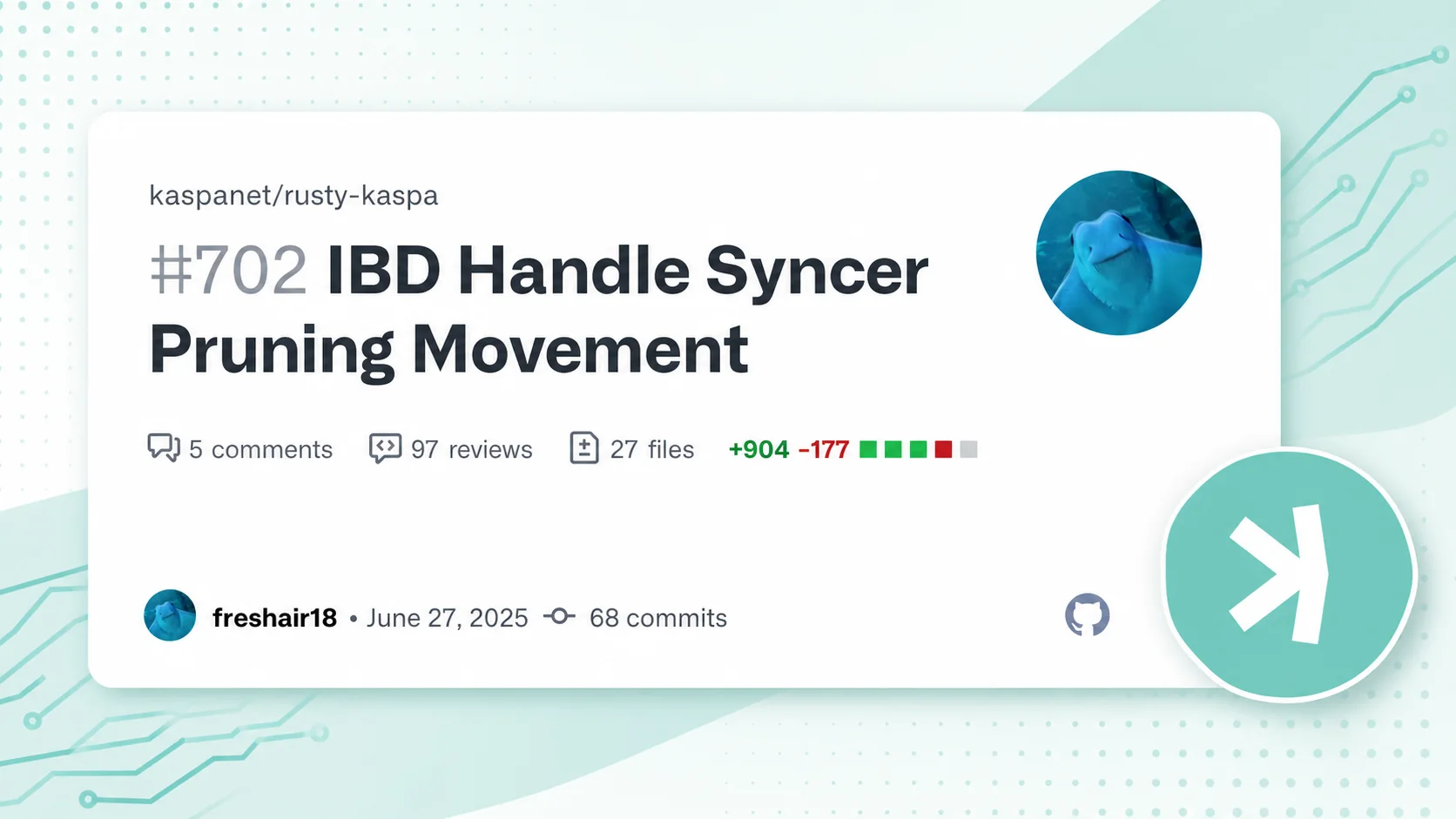
Kaspa IBD and pruning movement gained a dedicated catch-up path when rusty-kaspa merged pull request #702 on November 13, 2025. The change lets a node validate a peer’s newer pruning point, move its local consensus state, download the matching UTXO set, and resume synchronization without automatically rebuilding everything from zero.
Key takeaways
- Initial block download, or IBD, now recognizes a specific “pruning catch-up” situation instead of treating every pruning-point mismatch as a full restart.
- Before moving state, the node validates the peer’s headers, pruning sample, accumulated blue score, selected-chain position, and declared pruning-point history.
- Catch-up separates pruning-point movement, UTXO-set download, and anticone body synchronization into explicit stages.
- Persistent transition markers let later synchronization attempts recognize unfinished work after an interruption.
- This is node-resilience engineering, not evidence of higher throughput, a price catalyst, or a guarantee that every stalled node will recover faster.
What problem did the Kaspa IBD change address?
A pruned node deliberately discards old block data after it is no longer required for normal operation. Its pruning point marks the historical boundary around which the retained state is organized. A node that remains offline can return after peers have advanced beyond its local pruning point and no longer carry every old block body it would need for ordinary synchronization.
The merged rusty-kaspa PR #702 addresses that gap. It identifies pruning catch-up when three conditions coincide: the local and peer pruning points differ; the local node knows the peer’s pruning-point header and can establish that it is ahead; and the peer’s pruning-point block body is absent locally. If that body is still available, normal synchronization can continue and natural pruning can follow later.
What is validated before a pruning point moves?
Moving a pruning point changes consensus-related stores, so the implementation first downloads and validates headers through the syncing peer’s declared sink. The PR says intrusive changes proceed only after the proposed point qualifies as a valid pruning sample, sufficient validated blue score has accumulated above it, and the point lies on the selected chain derived from the peer’s sink.
The node also checks that pruning points declared along that path are consistent with history it already knows. These checks are the core trust boundary: the peer supplies data, but the local node evaluates structural evidence before committing a new boundary.
The design still depends on Kaspa’s stated security assumption of an honest majority during each pruning period. The pull request explains this assumption explicitly; it does not claim that an arbitrary peer’s declaration should be accepted on reputation alone.
How does pruning catch-up proceed?
The source description separates catch-up into three operational stages:
- Move the pruning point and update related stores, including virtual state, past pruning points, selected-chain data and body tips.
- Download the pruning-point UTXO set from a peer and verify that it matches the commitment in the header.
- Download required block bodies for the new pruning point and its anticone, using the specialized validation path needed when older parent bodies have already been pruned.
Earlier headers-proof synchronization could perform comparable work inside a discardable staging consensus and commit it atomically. Pruning catch-up instead builds on the node’s existing consensus. PR #702 therefore introduced persistent flags for the intervals in which the pruning point has moved but the new UTXO set or required anticone bodies are not yet complete.
Those markers are not a shortcut around verification. They describe exactly which recovery work remains, allowing a subsequent session to continue safely rather than misreading an intermediate database as fully synchronized.
Why does this improve recoverability?
The PR decouples UTXO download from pruning-point movement. Its author notes that this also allows a headers-proof synchronization to commit before a potentially long UTXO transfer. A user who disconnects during that transfer should no longer have to repeat all earlier synchronization work solely because the final state download was interrupted.
GitHub records 904 additions, 177 deletions and 27 changed files spanning consensus storage, pruning, IBD, RPC and tests.
For operators, the practical lesson is to preserve the node database and logs when investigating an interrupted IBD. Repeatedly deleting data can erase the transition evidence the recovery path was designed to use. Our guide to Rusty Kaspa environment variables explains how to make deployment configuration reproducible around the node process.
What safeguards apply during a transitional state?
PR #702 adds checks around operations that assume stable consensus state. Natural pruning is held back while the pruning UTXO set is unstable. Block relay can redirect the node toward IBD, and requests that would require an unavailable sink body are avoided. The required anticone set is retained until its bodies are synchronized.
These safeguards reduce the chance that ordinary relay or pruning activity treats partial recovery as normal operation. They do not make interruption costless: a node still needs network access, storage, time and at least one suitable peer from which to obtain the required state.
Node health should be evaluated with current logs and release documentation. Public reachability does not prove that every node completed IBD; see Kaspa node count and price fundamentals.
What are the limits and market implications?
This pull request does not change Kaspa’s block rate, monetary policy, transaction capacity or proof-of-work rules. It improves how rusty-kaspa handles a difficult synchronization state. Better recovery can support operator reliability and lower avoidable maintenance friction, but those are engineering fundamentals rather than a short-term market forecast.
The source publishes no controlled benchmark. Peer quality, storage and the interruption point affect recovery, so a fixed speedup claim would exceed the evidence.
Frequently asked questions
Is IBD the same as downloading every historical block forever?
No. IBD is the process of bringing a node to a validated current state. Pruning allows a non-archival node to discard historical data outside its required retention boundary, so recovery may rely on headers, commitments, a UTXO snapshot and selected supporting bodies rather than every old body.
Does pruning catch-up trust one peer’s UTXO set?
The peer supplies the data, but the node first validates the proposed pruning context and then checks the downloaded UTXO set against the commitment represented in the accepted header. The design relies on the protocol security assumptions documented in the PR.
Should I delete the database when synchronization pauses?
Not as a first response. Preserve logs, identify the exact node version and inspect whether the process reports a transitional IBD state. Follow current official release guidance before deleting data, because a restart may be able to continue the recorded catch-up.
Source and verification note
This article is based on kaspanet’s merged rusty-kaspa pull request #702, merged into master on November 13, 2025. The PR description documents the detection conditions, pre-movement validation, three catch-up stages and transitional-state safeguards; its public diff records 27 changed files. Interpretations about operational significance are labeled as analysis. Verify behavior against the exact rusty-kaspa release and current documentation you run.