Kaspa Tokenization Roadmap is best read as a capability map, not an official promise that securities, stablecoins or real-world assets will move to Kaspa. Toccata supplies covenants, covenant IDs, ZK verification and partitioned sequencing commitments; regulated issuance, reliable data, liquidity, custody and compliant distribution still require separate systems.
Key takeaways
- Toccata’s protocol work can support programmable UTXO state, persistent covenant lineage and verification of off-chain computation.
- Those primitives can be assembled into token systems, but Kaspa consensus does not provide an issuer, legal wrapper, oracle or secondary market.
- The June 18 Kasmedia tokenization article is useful industry context and advocacy, not an official Kaspa adoption agreement.
- A credible roadmap moves from protocol activation to audited standards, wallets, indexers, issuance controls, compliance integrations and measurable use.
- Institutional tokenization activity shows a market category exists; it does not show that those institutions have selected Kaspa.
- This analysis makes no KAS price prediction and is not investment advice.
What can Toccata contribute to tokenization?
Tokenization turns a claim—such as ownership, access, a financial entitlement or an application balance—into a digitally transferable representation. The chain can enforce the representation’s on-chain rules, but it cannot make an off-chain claim true by itself.
Four Toccata proposals form a plausible technical stack. KIP-17 adds transaction introspection and byte-manipulation opcodes, allowing a script to constrain how a UTXO may transition. KIP-20 adds consensus-tracked covenant IDs so an application instance can preserve a stable lineage as one UTXO is spent and another is created.
KIP-16 adds OpZkPrecompile, an interface for verifying supported zero-knowledge proofs. That can let an application verify complex work performed off-chain instead of re-executing all of it in script. KIP-21 partitions sequencing commitments into activity lanes so a prover focused on one application can work from lane-relevant activity rather than the entire global sequence.
Together, these are lower-level capabilities. They make token rules more expressive, lineage easier to index and proof-based systems more practical. They are not a built-in token standard comparable to a finished wallet contract, audited issuer framework or regulated settlement service.
What would a responsible Kaspa tokenization roadmap include?
As of this article’s June 24, 2026 publication date, Toccata was scheduled to activate at DAA score 474,165,565 around June 30. The next steps therefore depended first on a safe network upgrade, then on application delivery.
1. Stable protocol and tooling
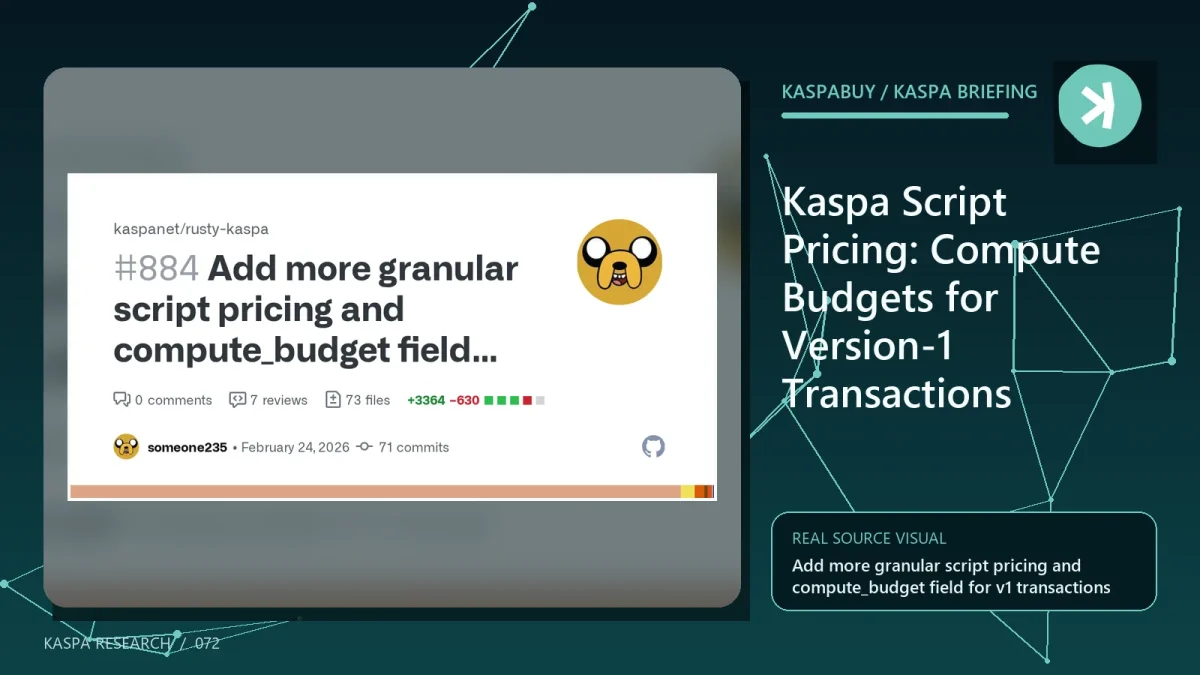
Nodes, RPC clients and SDKs must preserve version-1 transaction fields, covenant bindings, compute budgets and storageMass. A token application cannot be dependable if a wallet or indexer silently drops its lineage metadata. Compute costs also need predictable handling through the Kaspa script-pricing model.
2. Open token standards
Developers need documented rules for genesis, minting, transfer, burning, freezing where applicable, metadata, divisibility and recovery. A standard should state which properties are enforced by consensus, which are enforced by covenant script and which depend on an issuer or service.
3. Independent review and test vectors
Reference implementations need adversarial tests, negative test cases and independent security review. Wallets and explorers should be able to verify the same valid and invalid transitions from shared fixtures. An attractive demo is not a substitute for a reviewed asset lifecycle.
4. Usable wallets, indexers and custody
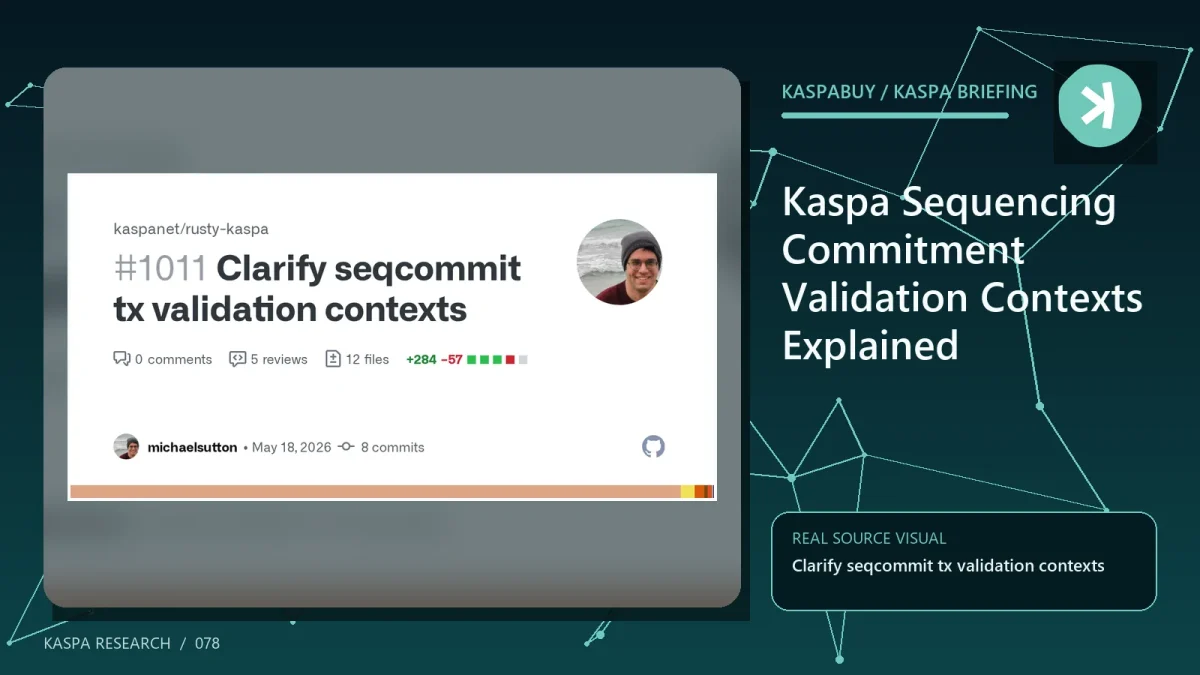
Users need balances and history reconstructed from live UTXOs, while institutions need policy controls, key management, audit trails and operational recovery. Covenant IDs help identify continuity, but software must still resolve reorganizations and present current state accurately. The sequencing-commitment validation context is similarly important when applications rely on committed ordering or proofs.
5. Issuance, redemption and compliance
A token representing a dollar, Treasury bill or physical collectible needs a legally accountable party or trust-minimized mechanism for the off-chain side. Redemption terms, reserve attestations, transfer restrictions, sanctions controls, investor eligibility and jurisdictional disclosures are business and legal layers, not opcode features.
Why is institutional tokenization relevant but not proof of Kaspa adoption?
Kasmedia connected Kaspa’s programmability work with a wider tokenization trend. That context is real. For example, a May 2026 DTCC announcement said its DTC subsidiary planned limited production trades of tokenized DTC-custodied assets in July and a service launch in October, with more than 50 firms participating in an industry working group.
The same announcement says the service is intended to preserve the ownership rights, protections and entitlements of assets held in traditional form and to interoperate across many chains. That wording highlights the hard part: regulated tokenization connects ledger records to existing legal and market infrastructure. It does not identify Kaspa as a selected chain.
Similarly, a June 11 SEC proposal concerned possible rescission of two Regulation NMS rules. A proposal is not an adopted rule, and a market-structure change would not automatically approve any specific blockchain or tokenized security design.
These developments establish demand for experimentation and interoperability. Kaspa still has to compete on audited software, integration cost, reliability, liquidity, governance clarity and the ability to meet each issuer’s requirements.
What are the market implications for Kaspa and KAS?
The strongest near-term implication is a larger developer opportunity set. Native covenant state, lineage and proof verification allow teams to test designs that previously required more trust or external execution. More credible applications could increase demand for block space, node services, wallets and developer tooling.
That chain of possibilities contains several unproven links. Protocol capacity does not guarantee applications. Applications do not guarantee users or liquidity. Usage does not map mechanically to the market price of KAS. Crypto-asset prices also respond to broader risk appetite, exchange liquidity, emissions, leverage, regulation and news unrelated to one upgrade.
For that reason, a useful adoption dashboard would track deployed audited standards, active covenant UTXOs, unique users, settled value with a disclosed methodology, proof-verification use, wallet support and failure rates. Price alone cannot tell observers whether tokenization infrastructure is working.
What this roadmap does not prove
This article does not claim that Kaspa has an official, date-bound tokenization roadmap. It organizes public protocol capabilities into an editorial sequence of dependencies. Project teams and maintainers may choose different priorities.
It also does not prove that tokenized assets are legally enforceable, decentralized or safer than conventional records. A token may still depend on an issuer, custodian, oracle, administrator or legal venue. ZK verification proves a defined computation under specified cryptographic assumptions; it does not verify the truth of an untrusted real-world input.
Finally, institutional interest in tokenization is not evidence of institutional demand for KAS. Any statement that jumps from a DTCC or SEC announcement to a guaranteed Kaspa partnership, adoption figure or price outcome exceeds the cited evidence.
Frequently asked questions
Does Toccata create a native Kaspa token standard?
It creates protocol primitives that developers can use to build token systems. A complete standard still needs application rules, tooling, tests, documentation and adoption by wallets and indexers.
Can covenant IDs prevent counterfeit real-world assets?
They prevent arbitrary creation of a valid on-chain covenant lineage under KIP-20’s rules. They cannot prove that an off-chain asset exists or that an issuer will honor redemption.
Will tokenization increase the price of KAS?
There is no reliable causal basis for such a promise. Adoption may affect network demand, but price formation depends on many variables and can move independently of technical progress.
Source and verification note
The primary editorial trigger is Kasmedia’s June 18, 2026 analysis, “Kaspa Must Prepare for the Tokenization of Everything”. Its Kaspa thesis was checked against KIPs 16, 17, 20 and 21; its market context was checked against DTCC and SEC primary announcements. The capability roadmap and market interpretation are KaspaBuy editorial analysis, not an official Kaspa schedule, partnership disclosure, legal opinion or investment recommendation.