Rusty Kaspa v2.0.1 was the first maintenance release after the v2.0.0 Toccata package. Published June 15, 2026, it combined new sequencing-commitment RPC support and SMT sync tooling with stricter pruning-proof, mempool, P2P, and transitional-IBD error handling. Operators could use it as a drop-in v2.0.0 update or upgrade directly from pre-Toccata 1.x software.
Key takeaways
- The official v2.0.1 release encouraged mainnet operators to upgrade.
- Release highlights included Toccata sequencing-state and lane-proof RPC, SMT sync notifications, database inspection tools, and user-lane transaction tooling.
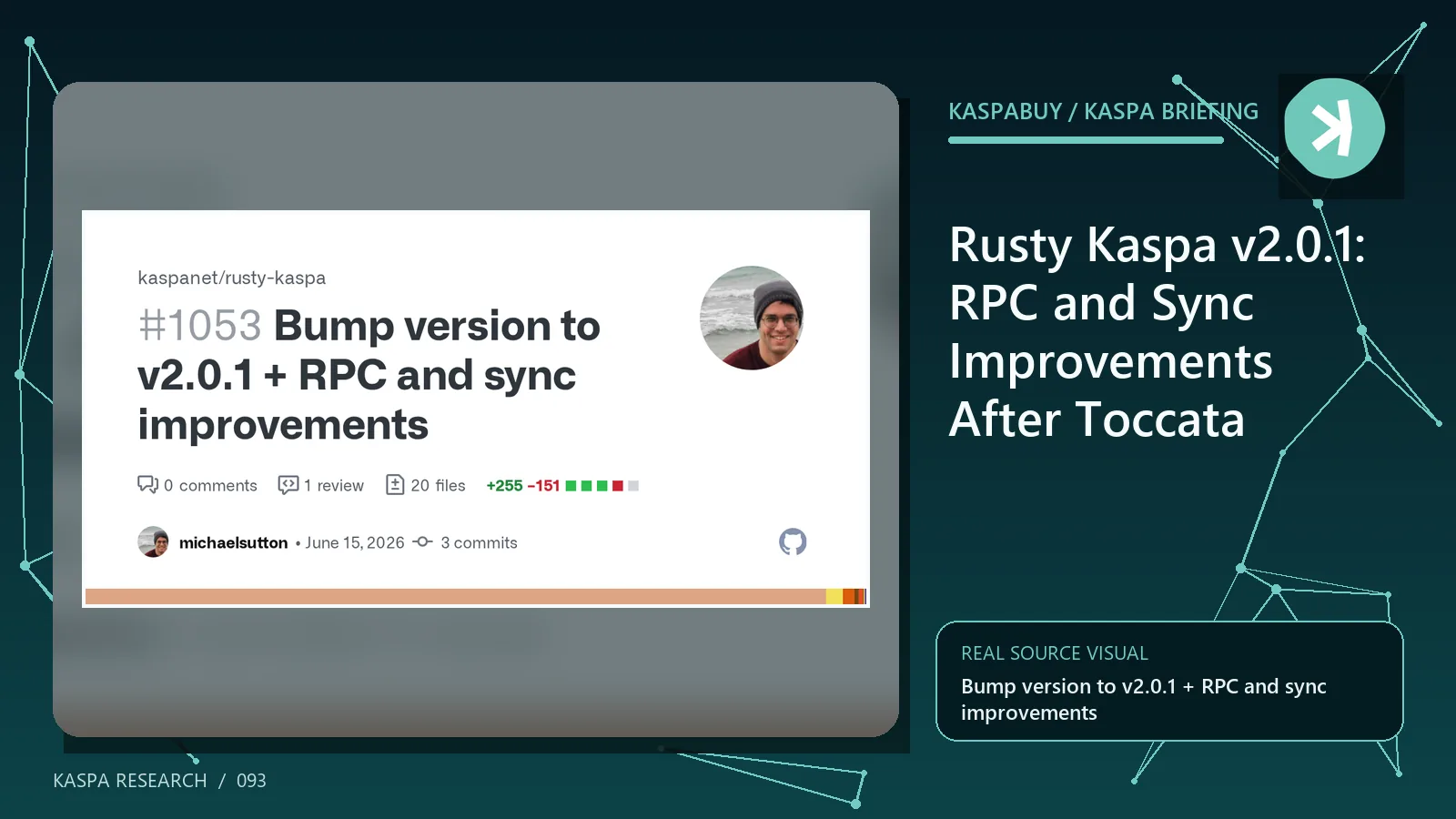
- PR #1053 bundled focused hardening and error-handling changes, then bumped the workspace from 2.0.0 to 2.0.1.
- Several fixes reject malformed or impossible data earlier instead of allowing ambiguous missing-data errors downstream.
- v2.0.1 refined the software package; it did not define a new hardfork or prove that every external integration was ready.
What did the Rusty Kaspa v2.0.1 release add?
The release notes describe a maintenance package built on v2.0.0. Its top-level additions were new RPC support for Toccata sequencing-commitment state and lane proofs, wallet/core and WASM notifications for sparse-Merkle-tree synchronization, SMT database inspection tooling, improved transaction generation for user-lane workflows, node sync and error-reporting refinements, and covenant-binding handling across client and wallet components.
This scope is broader than one version-bump pull request. The v2.0.1 tag collected changes merged after v2.0.0, while PR #1053 finalized error-handling work, set the workspace version, and fixed an isolated log feature dependency. Keeping release-level and PR-level evidence separate prevents attributing every feature in the tag to three commits.
The release shipped Linux AMD64, Windows 64-bit, macOS, and WASM SDK archives.
Which RPC and SMT improvements mattered?
Toccata’s KIP-21 sequencing model maintains sparse-Merkle state for active lanes. Integrators need both data access and visibility into synchronization before treating a node as ready.
The release exposed sequencing-state and lane-proof queries and added SMT sync progress notifications to wallet/core and WASM surfaces. Operator inspection tooling made it easier to examine the corresponding database rather than infer state solely from generic node progress.
The dedicated Kaspa sequencing commitment lane-proof RPC guide explains how GetSeqCommitLaneProof returns inclusion or non-inclusion evidence for one lane. An available endpoint is not enough: clients need compatible serialization, proof verification, header anchoring, and reorganization policy.
The same principle applies to Kaspa covenant binding. RPC fields make programmable UTXOs observable, but wallets must preserve and interpret them throughout storage, transaction construction, signing, and display.
How did pruning-proof and IBD error handling improve?
PR #1053’s first commit, titled “improved error handling,” made several consensus and synchronization boundaries explicit.
Pruning-proof validation now checks that each proof level’s computed selected tip is actually the final header supplied for that level. During Toccata pruning-state import, the code builds the expected selected-parent chain segment and rejects unexpected header-only blocks rather than accepting unrelated extras.
The IBD flow also bounds the downloaded header-only pruning-point segment using finality depth plus a GHOSTDAG safety allowance. Without an upper bound, a malformed peer response could consume unnecessary memory or processing before failing later. Trusted block bodies still receive coinbase blue-score and subsidy checks, even where other contextual checks follow the trusted import path.
These changes do not make every peer honest. They narrow accepted input shapes and provide specific errors, helping a node fail earlier and making logs more useful during diagnosis.
What changed in mempool and P2P handling?
The mempool now distinguishes a merely missing outpoint from an impossible outpoint index into a known parent transaction. Previously, indexing directly into the parent’s output vector could reach an invalid assumption. The new path uses checked access and maps the impossible case to its own rejection error.
Transaction inventory and request handlers check message ID counts before converting untrusted protobuf data into internal vectors. Reject-reason strings are truncated to a 2,048-byte maximum before they are retained and logged. Orphan and progress arithmetic uses saturating addition to avoid overflow at extreme counter values.
Storage-mass calculation also guards the mean input amount with a minimum of one, avoiding division by zero in an edge case, and updates plurality tests for the 32 bytes carried by covenant UTXO identity. These are small code changes with clear invariants: bounded input, checked indexing, and defined arithmetic behavior.
Why did transitional IBD get a dedicated RPC error?
GetVirtualChainFromBlockV2 can request transactions along the route from a historical block to the virtual chain. During a transitional IBD state, the current sink may temporarily lack a block body required for a complete response.
PR #1053 makes the RPC return ConsensusInTransitionalIbdState in that condition. This is more actionable than a generic conversion or missing-data failure. A client can back off, wait for synchronization, and retry rather than marking the requested block corrupt.
Robust integrations should still cap retries, surface node-sync status, and avoid advancing their own durable checkpoint until the response is complete. A named error enables a correct policy but does not implement that policy in every exchange, explorer, or merchant service.
What did the version bump itself do?
One commit changed the workspace and internal crate versions from 2.0.0 to 2.0.1 across Cargo.toml and Cargo.lock. This keeps the many Rusty Kaspa crates on one coherent release version. Another one-line dependency fix explicitly enabled the kv feature of the log crate for kaspa-core, so cargo check -p kaspa-core did not accidentally depend on feature unification elsewhere in the workspace.
The merged PR metadata reports three commits, 20 changed files, 255 additions, and 151 deletions. Much of the apparent version-change volume is mechanical lockfile and workspace editing. The operational value lies in the behavior changes and a reproducible tagged package, not the line total.
What should operators and integrators have done?
The project said v2.0.1 could replace v2.0.0 directly and could also serve as the Toccata upgrade for pre-Toccata 1.x nodes. Operators therefore did not need to install v2.0.0 first. They did need to follow the Toccata database and compatibility guidance, monitor synchronization, and test their surrounding infrastructure.
An exchange or indexer should verify that the new SDK or generated bindings preserve transaction version 1, compute budgets, covenant data, storage mass, and sequencing RPC response types. A node reporting 2.0.1 does not prove the service’s custom database or message bus retained those fields.
Pin the release tag, verify release provenance, stage the update, inspect the new explicit errors, and test failure recovery. Public RPC operators should apply appropriate authentication and rate limits.
What does v2.0.1 not prove?
The release shows that software changes were packaged and published. It is not evidence that all nodes upgraded, that a third-party SDK used the correct types, or that every IBD history and database layout was exhaustively tested.
It also was not a second protocol activation. Toccata’s consensus boundary remained the configured mainnet DAA score. Maintenance work can improve reliability around a hardfork without introducing another fork.
Finally, no release version establishes application adoption or a KAS price effect. Those require independently defined usage and market evidence.
Frequently asked questions
Did a v2.0.0 operator need to resync for v2.0.1?
The release described v2.0.1 as a drop-in update for v2.0.0. Operators should still follow the maintained guide, stop services cleanly, and retain recovery plans.
Could a 1.x node upgrade directly to v2.0.1?
Yes, the official notes say v2.0.1 can serve as the Toccata upgrade version for pre-Toccata 1.x nodes.
Was every v2.0.1 highlight implemented in PR #1053?
No. PR #1053 finalized error handling, versioning, and a build-feature fix. The release tag also included other post-v2.0.0 pull requests.
Why is a specific transitional-IBD error useful?
It tells an RPC client that required state is temporarily incomplete during synchronization, allowing a controlled retry instead of misclassifying the data as permanently invalid.
Source and verification note
Release scope and upgrade guidance come from the official Rusty Kaspa v2.0.1 release, published June 15, 2026. Specific pruning, IBD, mempool, P2P, RPC, arithmetic, version, and build-feature claims were checked against merged PR #1053 and its three commits. The distinction between the aggregate release and the finalizing PR is intentional. These sources prove public code and package status; they do not prove universal deployment, third-party correctness, exhaustive security, adoption, or price impact.