Kaspa Sequencing Commitment Lane Proofs became remotely queryable through get_seq_commit_lane_proof(block_hash, lane_key). Rusty Kaspa PR #961 wired the method through consensus, gRPC, and wRPC so a light client can obtain an inclusion or non-inclusion witness for one KIP-21 lane and verify it against a block’s sequencing commitment without running a full node.
Key takeaways
- The request identifies a point-of-view block and a 32-byte KIP-21 lane key.
- The response returns a sparse-Merkle proof plus lane state when present, or an explicit absence shape when not present.
- Additional digests let a client connect the active-lanes root to the block header’s sequencing commitment.
- PR #961 added both gRPC and wRPC support, serialization tests, service wiring, and cross-transport integration coverage.
- The RPC serves evidence; a client must still validate the proof, header, network, block context, and application meaning.
What problem does GetSeqCommitLaneProof solve?
KIP-21 maintains a sparse-Merkle commitment to recently active application lanes and folds that root into the sequencing commitment stored in a block header. A full node has the state stores needed to prove whether a lane existed at a selected point of view. A light client normally does not.
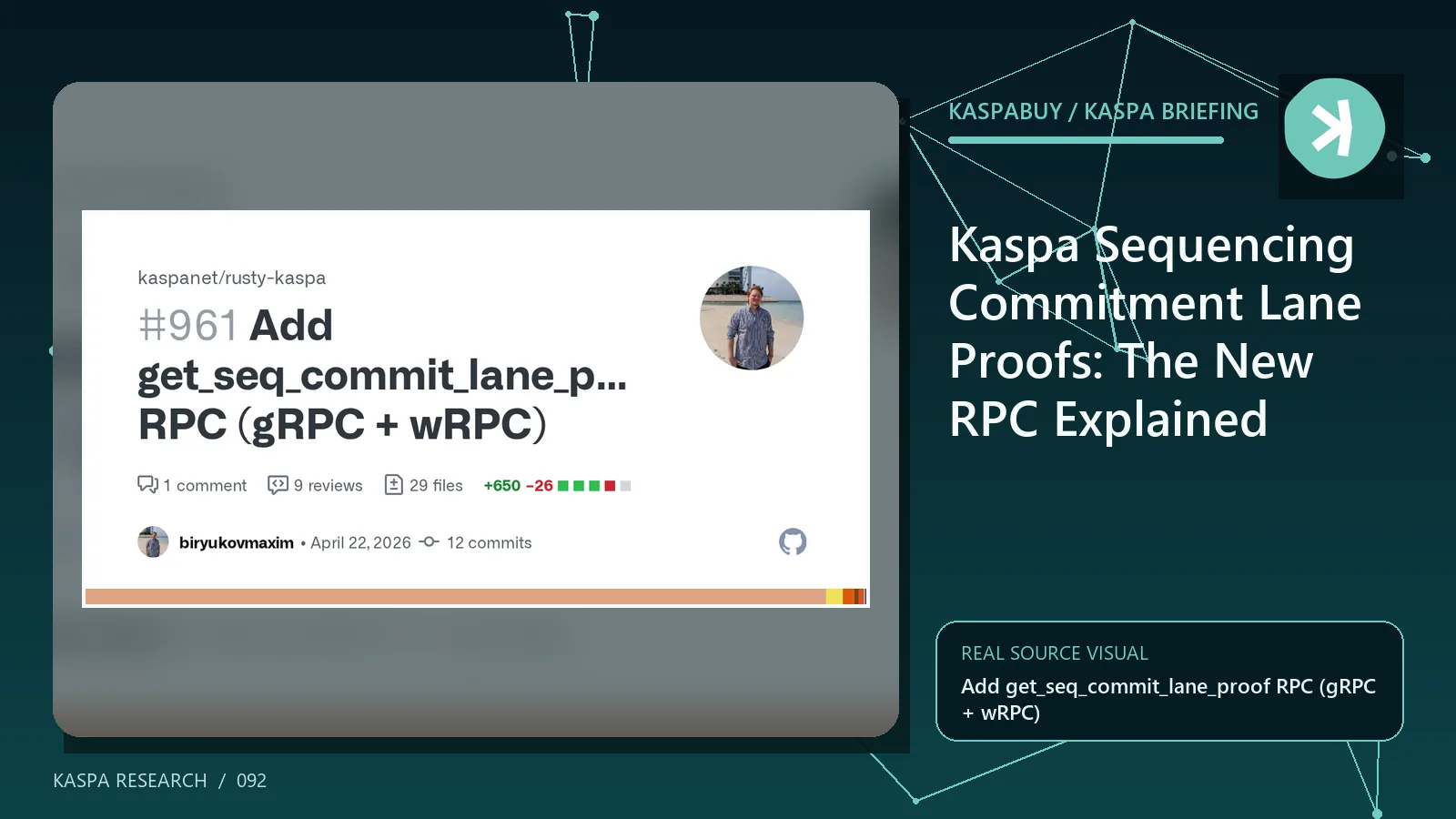
The merged Rusty Kaspa PR #961 added a focused query: get_seq_commit_lane_proof(block_hash, lane_key). Its stated goal is to return the witness required to verify a single active lane against the seq_commit in the requested header without running a full node.
This reduces data acquisition from “synchronize all consensus state” to “request the relevant authenticated witness.” It does not remove trust from proof verification. The server can supply bytes, but the client must recompute the committed result and compare it with an independently trusted header path.
What does the lane-proof response contain?
The PR description defines five logical response components.
| Field | Meaning |
|---|---|
smt_proof | Serialized OwnedSmtProof for inclusion or non-inclusion in the active-lanes sparse Merkle tree |
lane_tip | The lane’s recursive tip when the lane is present; absent for non-inclusion |
lane_blue_score | The last-touch blue score paired with a present lane tip |
payload_and_ctx_digest | The committed block-context and miner-payload branch needed above the lane root |
parent_seq_commit | The selected parent’s sequencing commitment used in the final recurrence |
Review commits also carried the KIP-21 inactivity shortcut in the response path. Native Rust groups optional lane fields so presence is coherent, while protobuf uses optional fields and an empty lane-tip representation for absence. A client should treat the schema as typed evidence, not infer inclusion merely because one byte array is nonempty.
The request takes lane_key, not an arbitrary display name. KIP-21 defines this key as a domain-separated BLAKE3 hash of the canonical 20-byte lane ID. Applications must derive it exactly as the maintained implementation does; hashing a text label or address would query a different sparse-Merkle key.
How can a client verify an inclusion proof?
The PR gives a compact verification pattern:
- deserialize
smt_proofwithOwnedSmtProof::from_bytes; - reconstruct the lane leaf from
lane_tipandlane_blue_score; - compute the sparse-Merkle root using the KIP-21
SeqCommitActiveNodehashing rules; - combine the lanes root with the inactivity shortcut and
payload_and_ctx_digest; - combine that state with
parent_seq_commit; - compare the result with the requested header’s
accepted_id_merkle_root.
The exact helper names can evolve, so production code should use the SDK corresponding to the node release. Reimplementing consensus hashing from an article risks incorrect domain tags, endian rules, optional-field handling, or tree-terminal semantics.
Verification is only as meaningful as the header anchor. If a client accepts the header from the same untrusted server without any independent consensus or checkpoint strategy, a mathematically valid proof may still be anchored to a fabricated history. Threat models should specify how headers, network identity, finality assumptions, and reorganization handling are established.
How does a non-inclusion proof work?
A non-inclusion response shows that the queried key is absent from the active-lanes sparse-Merkle state at that block’s point of view. In that case, lane_tip and lane_blue_score are absent while the proof reconstructs the same committed root.
Absence from the active set does not mean the lane never existed. KIP-21 removes lanes after a defined inactivity window, and a later transaction can reactivate a purged lane by anchoring its new tip to the selected-parent sequencing commitment. Historical continuity can therefore require inclusion, exclusion, inactivity-shortcut, and later re-inclusion evidence.
The RPC’s inclusion or non-inclusion result should not be translated into “account balance” without application rules. It authenticates a KIP-21 lane-state relation, not every higher-level state value an application may associate with that lane.
Why support both gRPC and wRPC?
Rusty Kaspa serves native and browser-oriented integrators through different transports. PR #961 added core request and response types, gRPC protobuf messages and conversions, server dispatch, service handling, wRPC routing, and client wiring. This avoids forcing each transport to invent a separate proof shape.
The integration test queried both gRPC and wRPC and asserted equal results. It covered a fresh block where the lane was absent, an unknown-block error, and an existing coinbase-subnetwork lane after a second mined block populated it. Later commits extended the test around inactivity-shortcut and IBD boundary behavior.
Cross-transport equality is valuable evidence of serialization consistency. It does not prove two independent consensus implementations agree, because both paths ultimately use the same Rusty Kaspa consensus code.
Which errors and boundaries should integrators expect?
The implementation checks that the requested block exists in the relevant consensus view and that the feature is available under Toccata rules. Review work added an explicit genesis guard, canonicality checks, shortcut-anchor handling around pre-Toccata ancestors, and an error when a required selected-parent chain is exhausted.
Clients should distinguish at least these cases:
- unknown or unavailable block;
- proof requested before the feature’s activation context;
- malformed serialized proof;
- valid non-inclusion;
- valid inclusion with unexpected application state;
- header or parent commitment that fails the client’s trust policy;
- reorganization that changes the chosen point of view.
Collapsing all of them into “lane not found” can hide a synchronization failure or an invalid proof.
What can developers build with the RPC?
The endpoint can support explorers, proof services, browser clients, bridge monitors, and based-ZK tooling that need authenticated access to one lane without a full consensus database. It is also a useful diagnostic interface: two nodes can be queried at the same stable block and their proof-derived roots compared.
The companion Rusty Kaspa v2.0.1 overview places this RPC inside the first Toccata maintenance release. For the transaction-side state model, Kaspa covenant binding explains how wallets and indexers identify covenant-controlled outputs. A lane commitment and a covenant ID solve different indexing and proving problems.
What does this RPC not prove?
It does not execute an application, generate a zero-knowledge proof, certify bridge solvency, or establish that an application operator is decentralized. It does not prove that a lane is economically active merely because a leaf exists.
The RPC also does not make an untrusted node trusted. It makes a specific response cryptographically checkable when the client implements the correct verification and has an acceptable header anchor. Security still depends on endpoint diversity, authenticated transport where appropriate, rate limits, resource bounds, and explicit reorg policy.
Frequently asked questions
Is lane_key the same as a Kaspa address?
No. KIP-21 derives a lane key from a canonical lane ID, currently based on transaction subnetwork identity. It is not a wallet receiving address.
Does a missing lane tip mean the lane never existed?
No. It means the key is not present in the active-lanes state at the requested point of view. A previously active lane may have been purged after inactivity.
Can a browser verify the proof over wRPC?
Yes, provided it uses compatible proof and hashing code and has a trustworthy strategy for the referenced header and network.
Does GetSeqCommitLaneProof replace a full node?
It replaces full-state access for this narrow proof query. It does not provide all consensus validation, mempool, historical, mining, wallet, or indexing functions of a full node.
Source and verification note
This article is based on merged kaspanet/rusty-kaspa PR #961, merged June 14, 2026. The endpoint signature, response fields, verification outline, 29-file transport wiring, 12-commit review history, and integration-test cases come from the PR description, commits, and diff. Commitment semantics were cross-checked against the active KIP-21 specification. These sources establish the RPC and its tests; they do not establish third-party client correctness, application security, adoption, or economic value.