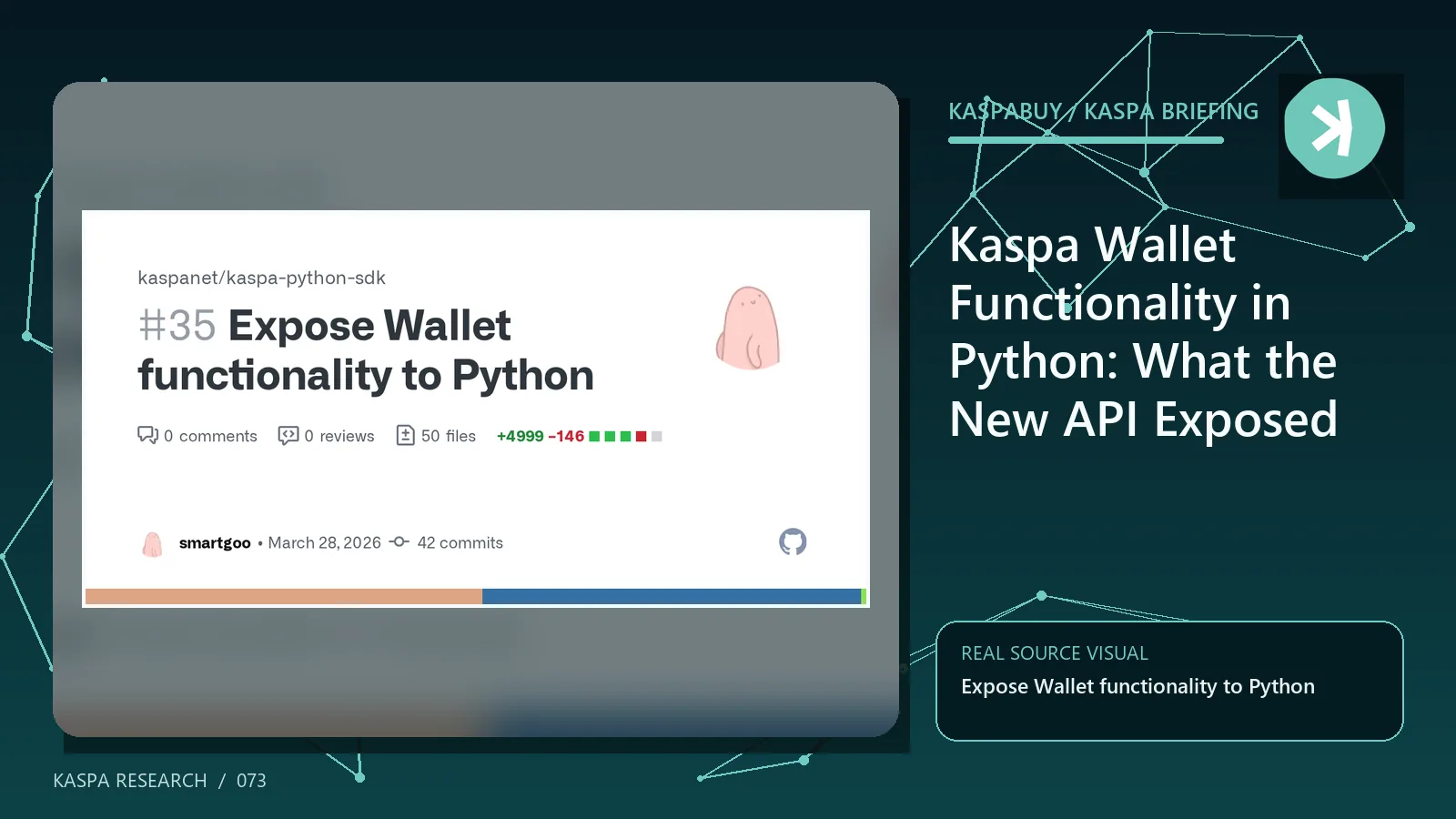
Kaspa wallet functionality in Python expanded in official SDK PR #35, which exposed a Wallet class, account operations, fee tools, events, descriptors, storage types, and wallet-specific exceptions. The 42-commit change merged to kaspanet/kaspa-python-sdk main on April 14, 2026, but a source merge alone did not prove a published package contained it.
Key takeaways
- PR #35 added Python bindings around Rusty Kaspa’s wallet core rather than reimplementing wallet cryptography in Python.
- The surface covered wallet lifecycle, private-key records, accounts, addresses, UTXOs, sending, estimation, transaction metadata, fees, and events.
- Wallet-core errors were mapped into Python exception classes instead of only generic boundary errors.
- The PR explicitly listed unfinished documentation, test, PSKB, export/import, and security-review work.
- Developers must verify the installed package version and protect secrets; a merge to
mainis not a production-readiness guarantee.
What did the Kaspa Python wallet API expose?
The official Kaspa Python SDK PR #35 introduced a Python Wallet class backed by kaspa_wallet_core. Its checklist includes wallet enumeration, creation, opening, reloading, closing, renaming, secret changes, export, and import. It also exposes descriptors and storage-related structures needed to inspect results without dropping immediately into raw Rust objects.
For accounts, the bindings cover enumeration, discovery, creation, import, activation, lookup, renaming, address generation, sends, transfers, UTXO retrieval, and fee estimation. Transaction-data getters and note or metadata replacement were included, alongside address-book enumeration and fee-rate polling controls.
Why do native wallet bindings matter?
Python is widely used for automation, testing, services, and data tooling, but wallet operations are easy to get wrong when every integrator reconstructs serialization, key handling, network events, and fee logic independently. Binding to the maintained Rust wallet core can reduce duplicated protocol code and keep behavior closer to other official SDK surfaces.
That architecture does not remove trust boundaries. Python applications still decide where secrets live, which RPC endpoint receives requests, how exceptions are logged, and who can call a send method. A convenient method is an interface to sensitive native code, not a security sandbox.
Which developer ergonomics were added?
PR #35 added typed stubs, event types, account and wallet descriptors, fee structures, storage records, and an exceptions module. It also included a substantial examples/wallet.py file intended to exercise responses across the exposed surface. Function signatures and type overrides were refined so the generated Python API could describe parameters that accept more than one representation.
The response boundary remained a work in progress in places. The PR notes that wallet_create() returned nested dictionary data through serde_pyobject, and it questioned whether nested values should become Python class instances. That is a usability and typing concern integrators should test rather than assume away.
What was deliberately left unfinished?
The pull request is unusually useful because it records its limits. A dedicated wallet documentation page, example refinement, hexadecimal return consistency, broader pytest coverage, and a security audit remained TODO items. accounts_deactivate was removed because the underlying Rust call could hang on a lock.
Python support for PSKB signing, broadcasting, and sending was also listed as unavailable at that point. Wallet export returned bytes rather than the desired hexadecimal string, while import handling still needed consistent support for both forms. These caveats mean “wallet functionality exposed” should not be paraphrased as complete parity with every JavaScript wallet feature.
How should developers handle wallet secrets and errors?
Never print mnemonics, private keys, decrypted wallet payloads, or unredacted response dictionaries. Convert expected wallet exceptions into narrow application errors, but do not catch every exception and continue after an unknown signing or storage failure. Logs should contain operation IDs and safe error categories, not secret-bearing arguments.
Use a dedicated test wallet and testnet node while validating create, restore, send, and failure paths. Pin the package version, review its release notes, and confirm that installed bindings match the API being called. The Kaspa wallet mnemonic safety analysis illustrates why small boundary checks matter even when cryptography itself is unchanged.
Did this merge create a hosted wallet service?
No. The PR added local SDK bindings and examples. It did not launch a custodial service, create user accounts on a remote platform, or promise recovery of lost keys. Applications still need their own storage, access control, backup, RPC, monitoring, and release process.
The companion Kaspa CPU Miner v0.2.7 guide covers a different developer tool that connects to a node; neither component should be treated as a substitute for node or wallet operational security.
Did the Python API affect KAS price or protocol consensus?
No consensus rule changed because Python bindings merged. Better tooling can reduce integration friction, but the source provides no measurement of adoption, transaction volume, revenue, or market impact. This development offers no basis for a KAS price prediction and is not investment advice.
Frequently asked questions
Was the Wallet class merged into the official repository?
Yes. GitHub records PR #35 as merged into the official SDK’s main branch on April 14, 2026.
Did the PR support PSKB wallet operations?
Not fully. PSKB sign, broadcast, and send methods were explicitly listed as future work in the pull-request record.
Did it include custom Python exceptions?
Yes. The change added exception scaffolding and mappings for relevant wallet-core error variants, although applications still need careful error handling.
Does a GitHub merge prove the feature is in my installed package?
No. Check the installed package version, its release tag, and its generated API. Source main can be ahead of a published artifact.
Source and verification note
This article is based on merged kaspanet/kaspa-python-sdk PR #35, the merged wallet example, and its SDK changelog. The PR establishes the exposed methods, types, exceptions, limitations, merge target, and date. It does not establish package publication, independent security review, complete API parity, production fitness, custody guarantees, usage levels, or a KAS price effect.