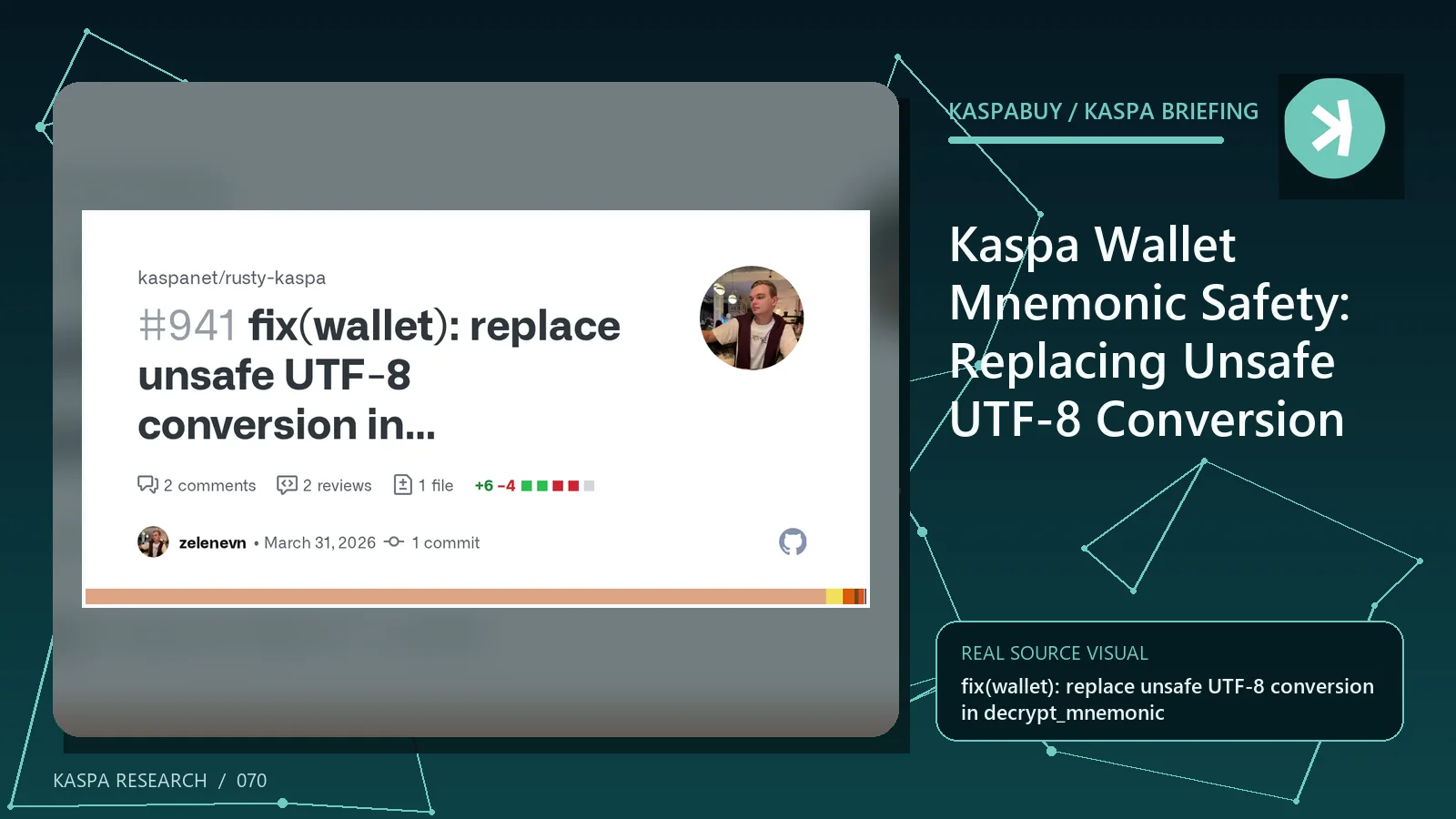
Kaspa wallet mnemonic safety improved in Rusty Kaspa PR #941 when an unchecked UTF-8 conversion in the legacy Gen1 decryption path was replaced with checked conversion. Invalid decrypted bytes now produce an ordinary error instead of violating Rust’s string invariant. The narrow fix did not change mnemonic encryption, consensus, or wallet recovery rules.
Key takeaways
- PR #941 replaced
String::from_utf8_uncheckedwithString::from_utf8indecrypt_mnemonic. - Invalid decrypted bytes now return a recoverable error rather than creating a Rust
Stringthat violates UTF-8 requirements. - The diff also propagated an Argon2 key-derivation error instead of unconditionally unwrapping it.
- The one-commit change touched only
wallet/core/src/compat/gen1.rsand merged intomaster. - The pull request did not report seed disclosure, stolen funds, an encryption break, or a KAS price effect.
What changed in Kaspa wallet PR #941?
The official Rusty Kaspa PR #941 merged into master on April 1, 2026. GitHub records one commit, one changed file, six additions, and four deletions. The file was the Gen1 wallet compatibility module, not the consensus engine or a network service.
The decrypt_mnemonic function derives a key with Argon2id, decrypts an encrypted payload with XChaCha20-Poly1305, and returns mnemonic text. Before the fix, it constructed the final Rust String using from_utf8_unchecked. After the fix, String::from_utf8 validates the bytes and returns an error when they are not valid UTF-8.
This is a memory-safety and error-handling improvement at a wallet data boundary. It does not change how Kaspa addresses, UTXOs, signatures, or blocks work.
Why was unchecked UTF-8 unsafe?
Rust’s String type promises that its contents are valid UTF-8. Safe string operations, formatters, and compiler optimizations are allowed to rely on that invariant. from_utf8_unchecked skips validation, so the caller must prove the input is valid before constructing the string.
Decrypted bytes are external data from the function’s perspective. A damaged wallet file, wrong key material, malformed legacy record, or unexpected payload can produce an error path. If invalid bytes were nevertheless wrapped as a String, later safe code would operate on a broken invariant. Rust classifies that situation as undefined behavior, not merely a display problem.
Checked conversion turns the same boundary into an explicit Result: valid mnemonic text proceeds; invalid UTF-8 stops and returns an error.
Did the patch change wallet encryption?
No. The diff retained Argon2id key derivation and XChaCha20-Poly1305 authenticated decryption. It did not change the mnemonic format, password, salt, nonce size, ciphertext layout, derivation path, or seed words.
The patch also replaced unwrap() on hash_password_into with ?, allowing key-derivation errors to flow through the function’s existing result type. That is defensive error propagation, not a new cryptographic construction.
Because this was a compatibility-path fix, readers should not generalize it to every Kaspa wallet implementation. Separate mobile, browser, hardware, Python, or third-party wallets can use different storage code. The Kaspa Python SDK v1.1.0 guide covers another software boundary, not this Gen1 record format.
What would a user notice after the fix?
On valid data, the returned mnemonic string should be unchanged. On invalid decrypted bytes, software can now display or log a controlled failure instead of proceeding with an invalid string. The exact user message depends on the calling application and how it maps the Rust error.
A clean error does not repair a corrupted backup or recover a forgotten password. It prevents one unsafe failure mode and gives higher-level code a chance to stop, report the problem, and preserve the original data for recovery analysis.
Developers exposing wallet functionality should treat errors as untrusted output, avoid printing mnemonic bytes, and never include secrets in telemetry. The related Kaspa wallet functionality in Python overview explains why a convenient API still needs strict secret handling.
What did PR #941 not prove?
The PR description did not report an exploited vulnerability, remote code execution, mnemonic disclosure, or lost funds. The change removed a path to undefined behavior, but its GitHub record alone does not quantify exploitability or demonstrate that invalid bytes routinely reached the conversion.
Likewise, a merge into master does not prove that every packaged wallet already contained the commit on April 1. Users needed a subsequent official release or build containing the merge. Security claims should identify the exact application, version, platform, and code path rather than saying that all Kaspa wallets were affected.
What safe wallet practices still mattered?
Users should keep an offline, accurately recorded recovery phrase and test restoration only in a trusted environment before relying on a backup. Never paste a mnemonic into a website, chat, support ticket, analytics form, or unverified tool. Obtain wallet software from its official release channel and verify package identity when checksums or signatures are supplied.
Developers should preserve encrypted originals before migration, fuzz malformed legacy files, test incorrect-password and truncation paths, and ensure error messages never echo plaintext. Checked UTF-8 conversion is one layer; authenticated storage, memory handling, dependency review, and secure interfaces remain necessary.
Did this fix affect the Kaspa roadmap or KAS price?
The merge demonstrated routine hardening of a legacy wallet compatibility path. It did not modify monetary policy, consensus, throughput, fees, or protocol activation. A small but useful safety fix is not evidence for a KAS price target, and this article offers no investment advice.
Frequently asked questions
Did PR #941 change Kaspa seed phrases?
No. It changed how decrypted bytes were converted into a Rust string. The mnemonic format and recovery rules were not changed by this diff.
Does invalid UTF-8 mean the password was definitely wrong?
No. The PR mentioned wrong keys and corrupted wallet data as examples, but an error does not identify a single cause. The surrounding application must report and diagnose it safely.
Was every Kaspa wallet affected?
The changed file was Rusty Kaspa’s Gen1 compatibility path. The source does not establish that unrelated wallet applications used the same function.
Should users type a mnemonic into a repair tool?
Only use a verified, trusted wallet or an isolated recovery process you understand. Never provide a recovery phrase to support staff or a website claiming to diagnose this code change.
Source and verification note
This article is based on merged kaspanet/rusty-kaspa PR #941 and its one-file commit diff. The primary record establishes the checked UTF-8 conversion, Argon2 error propagation, Gen1 compatibility scope, and merge to master. It does not establish an active exploit, seed exposure, universal wallet impact, package-release availability, recovery success, or a KAS price effect.