
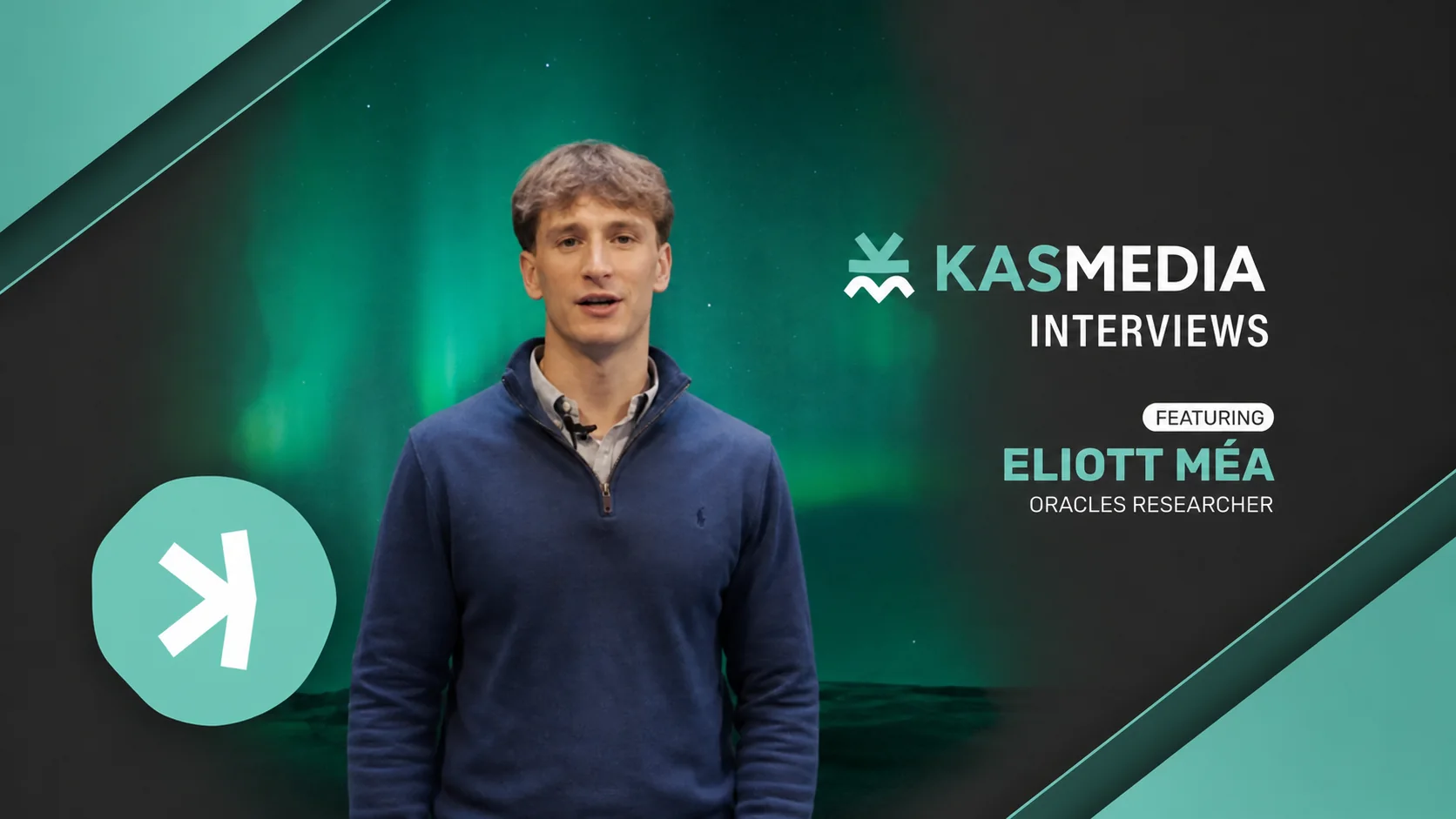
The oracle problem on Kaspa is not simply how to publish a price quickly. It is how to define, obtain and verify off-chain information when the supposed truth is fragmented across markets and can be manipulated. Eliott Méa’s December 2025 interview outlined this research problem and possible market-design directions; it did not present a deployed or peer-reviewed Kaspa oracle.
Key takeaways
- Consensus can objectively reject an invalid block, while an oracle often cannot directly prove that a reported market price is false.
- Many independent reporters do not create independent data if all of them read the same centralized exchange API.
- Median aggregation resists large outliers but can discard information, lag genuine moves and remain vulnerable to coordinated small biases.
- Méa framed “ground truth” as a theoretical no-arbitrage market price across venues, not a permanently observable number.
- Frequent batch auctions and a decentralized limit-order book were research directions; the interview said draft work still required heavy testing and academic review.
What is the oracle problem on Kaspa?
A blockchain verifies signatures and consensus rules from its own state. A lending application, derivatives market or prediction system may also need an external exchange rate, asset price or event outcome. An oracle brings that information on-chain.
In KASmedia’s interview with Eliott Méa, the central difficulty is that a price feed is not self-authenticating. A centralized exchange can publish an order-book snapshot that is mechanically valid yet economically misleading. Observers cannot prove the quote is executable without interacting with the venue, and even then liquidity can change.
The Kaspa Ecosystem Foundation’s grantee announcement identifies Méa’s scope as oracle modeling, failure analysis and possible improvements—not certification of a finished protocol.
Why is oracle honesty different from consensus honesty?
Proof-of-work consensus has protocol-defined invalid behavior. A node can recompute a transaction, block hash or proof-of-work condition and reject a rule violation deterministically. For price oracles, the value used to judge a reporter may itself be calculated from the reporters’ observations.
The interview challenges a simple “at least 50% honest providers” assumption. If a participant shifts its observation by a small amount, the system may be unable to distinguish measurement noise from strategic bias. Penalizing distance from the aggregate can also be circular because biased submissions influence that aggregate.
This does not prove that every median oracle fails. It identifies an adversarial-model question: what sources, incentives, liquidity conditions and bounds make manipulation unprofitable or detectable? A production design needs a formal model and empirical stress tests rather than an honest-majority slogan.
Why do multiple reporters not guarantee decentralization?
Suppose 100 permissionless nodes request the same centralized exchange endpoint. The delivery layer has many operators, but the information still originates from one venue. If that API is wrong, delayed or adversarial, all 100 reports can repeat the same error. Redundant transport does not create source diversity.
This distinction also matters when an analytics provider closes. The guide to Kaspa price data after Kas.fyi separates canonical ledger data, indexed views and exchange-derived prices. An oracle must document each upstream source and failure mode instead of treating every API response as an independent observation.
What could “ground-truth price” mean?
Méa proposes a theoretical framing based on no-arbitrage: simulate arbitrage across venues at a time and take the midpoint of the resulting best bid and offer. The value would separate net excess demand below it from net excess supply above it. It changes as orders, liquidity and information change.
The model rejects one exchange ticker as automatic truth. In practice, latency, fees, settlement risk and fragmented liquidity make simultaneous cross-venue state difficult to observe.
An oracle implementation must therefore specify how it timestamps observations, handles stale venues, measures depth, accounts for costs and behaves when markets disagree. “Use the median” is a method, not a complete security proof.
How might Kaspa market structure help?
The interview discusses frequent batch auctions (FBAs), where orders are grouped for periodic clearing instead of rewarding the first microsecond arrival. A decentralized exchange already has discrete block intervals, although those alone do not guarantee fair execution.
Méa’s research direction asks whether geographically distributed exchanges or miner-operated market instances could share Kaspa sequencing while improving access and reducing adversarial latency. He also discusses a decentralized central limit-order book (DCLOB) that could generate a more native market signal.
These are hypotheses with difficult tradeoffs: fragmented liquidity can worsen spreads, miners may have conflicting incentives, and software must handle reorganizations, censorship, MEV and failure. Fast BlockDAG ordering is an input to the design, not a proof that the oracle problem disappears.
What remained unproven in December 2025?
Near the interview’s end, Méa said his results were summarized in two unpublished drafts. He described one as being implemented but still needing heavy parameter testing and academic review. No production deployment, audited contract, formal proof, public benchmark or mainnet activation was supplied in the article.
The Kaspa transaction script engine cleanup is already merged code. An oracle proposal is at a different evidence stage and should not be described with the same certainty.
How should developers evaluate a future Kaspa oracle?
Start with a threat model: corrupt reporters, corrupt venues, stale data, network partitions, liquidity shocks and incentive attacks. Require explicit source provenance, timestamp rules, aggregation logic, update cadence and fallback behavior. Test gradual bias as well as obvious outliers.
Then inspect governance and recovery: who changes parameters, pauses a feed or resolves disputes? Require reproducible archived inputs, public code and stressed-market latency and accuracy tests.
Finally, separate technical progress from KAS price expectations. A robust oracle could expand application possibilities, but research publication or deployment cannot guarantee adoption, revenue or token appreciation.
Frequently asked questions
Does Kaspa already have a native price oracle?
The December 2025 interview does not establish one. It describes research and an implementation-in-progress that still required testing and review.
Would 100 oracle nodes make one exchange price trustworthy?
No. They can make delivery more redundant, but all still inherit the same upstream venue’s data and manipulation risk.
Does a median solve the oracle problem?
It can reduce the influence of large outliers, but the interview argues that it can discard valid information, lag fast moves and fail against coordinated small biases.
Source and verification note
This article is based on Nicholas Sismil’s December 18, 2025 KASmedia interview with Eliott Méa. Méa’s role and funded research scope were cross-checked against the Kaspa Ecosystem Foundation announcement. Statements about weaknesses, market truth, FBAs and DCLOBs are accurately attributed research positions, not settled protocol facts. The source itself says drafts remained unpublished and required heavy testing and academic review. No investment recommendation or price forecast is made.