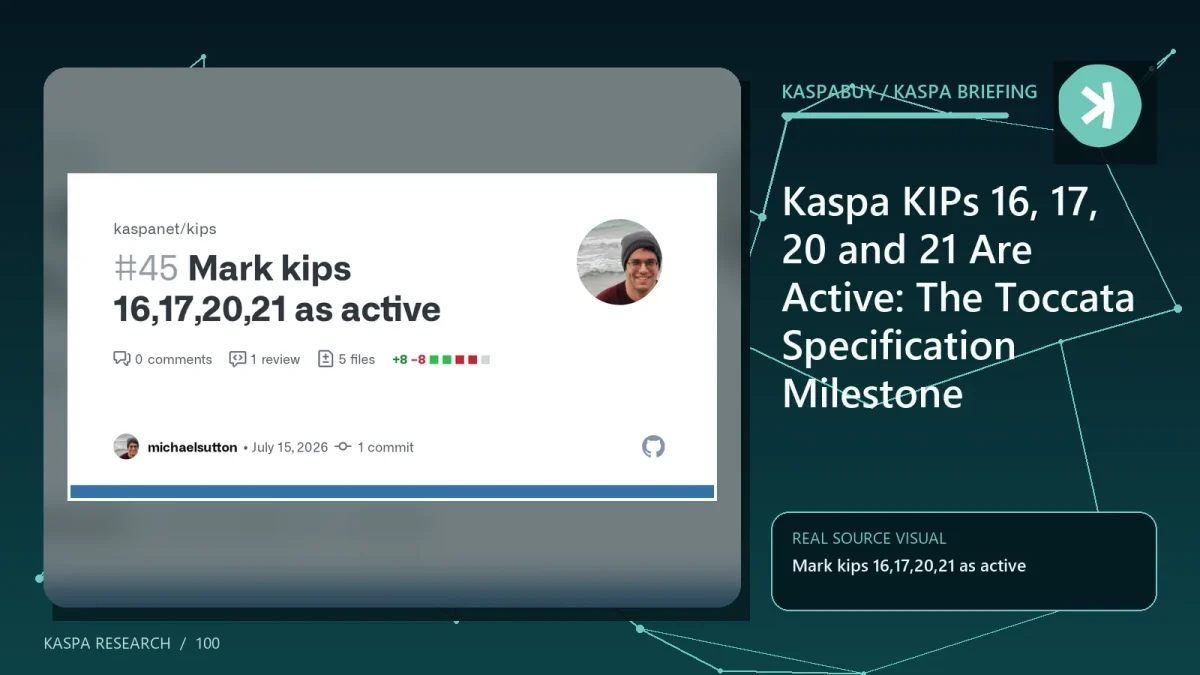
The KIP-21 inactivity shortcut adds a cryptographically committed reference to an older sequencing commitment so a verifier can cross long periods of lane inactivity in fewer steps. It is a proving and synchronization aid inside Kaspa’s Toccata sequencing design, not a shortcut around transaction validation, consensus, or proof security.
Key takeaways
- Rusty Kaspa PR #1018 added
inactivity_shortcutto the per-chain-block sequencing commitment used by the KIP-21 lane design. - The shortcut is committed beside the active-lanes root under a new
activity_root; it does not alter lane tips themselves. - The PR describes an
O(N/F)walk across inactivity spans instead of anO(N)block-by-block walk, without requiring the guest to know the exact activity-window valueF. - Pre-hardening chain blocks retain their former commitment behavior, while post-hardening blocks use the new structure.
- The optimization helps construct and verify particular witnesses. It does not make transactions confirm faster or prove that an application is correct.
What problem does the KIP-21 inactivity shortcut solve?
KIP-21 partitions a global sequencing commitment into application lanes. A lane that is active receives new tip commitments; a lane that stays quiet may eventually leave the active set. A proof system interested in one lane should not have to process every unrelated chain block merely to demonstrate that the lane remained inactive.
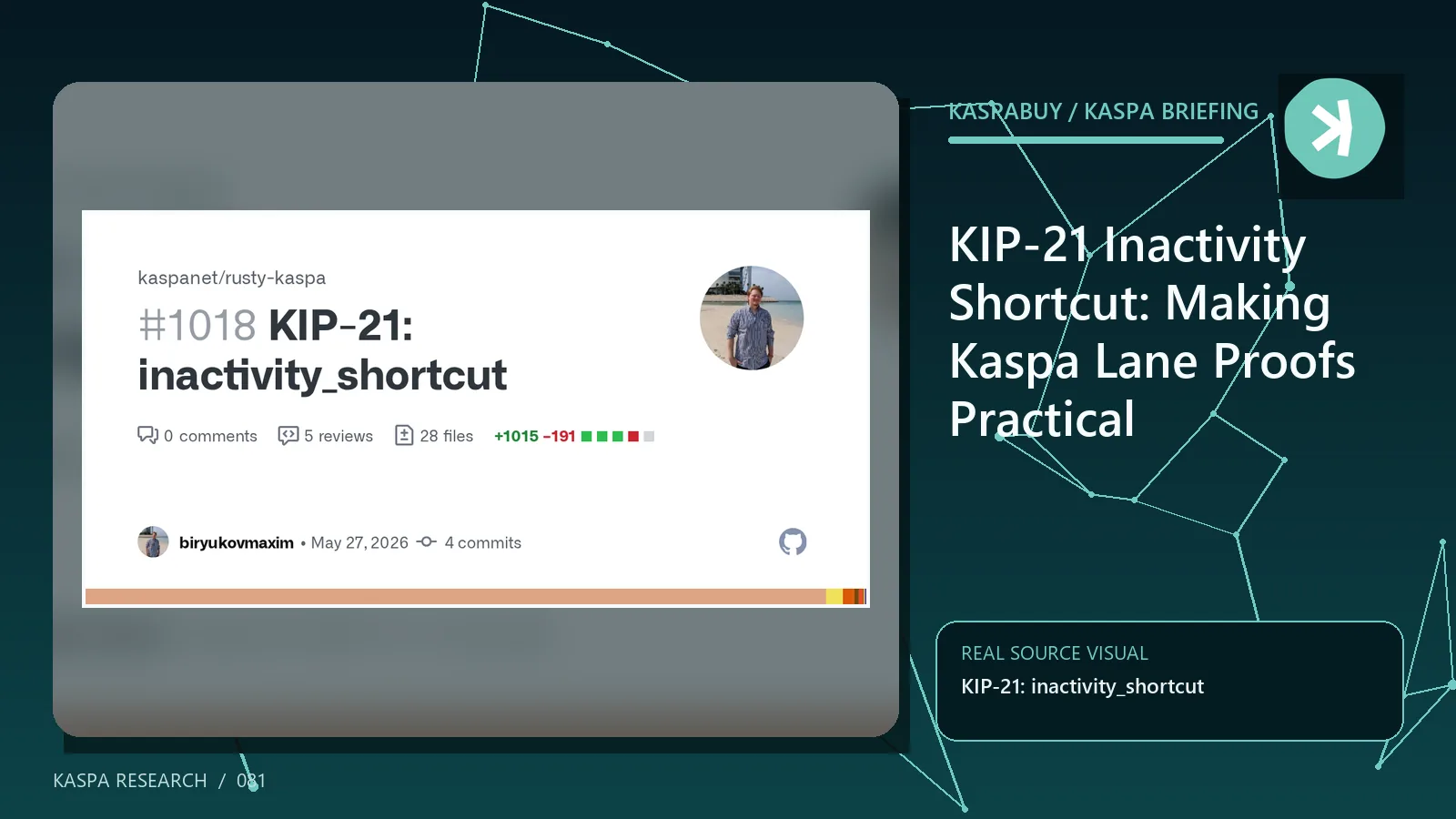
The merged rusty-kaspa PR #1018 defines the shortcut as the sequencing commitment of a selected-parent-chain ancestor satisfying the proposal’s inactivity-distance condition. In the PR’s notation, a guest can traverse a span in O(N/F) hops rather than O(N), where N is the span and F is the activity window. The important qualifier is that this is a complexity claim about that traversal, not about every part of proof generation.
Without a committed anchor, a verifier either needs a longer header walk or must trust an uncommitted hint about where the inactive interval began. Committing the shortcut lets the verifier bind that jump to the same consensus-authenticated structure used for sequencing.
Where is the shortcut committed?
PR #1018 places the value one level above lanes_root. Before hardening, activity_root is simply the lanes root. After hardening, it hashes inactivity_shortcut together with lanes_root. That activity root is then combined with the payload-and-context digest, and the result is chained to the selected parent’s sequencing commitment.
This separation matters. Lane tips remain shortcut-free, so the shortcut does not become application-lane state. Instead, it is a global aid attached to the activity commitment. The mergeset-context preimage also remains the selected-parent timestamp, DAA score, and blue score. That limits the design change to a well-defined place in the commitment tree.
Readers who want the wider architecture can compare this implementation article with KIP-16 explained. KIP-16 supplies proof-verification primitives, while KIP-21 organizes the chain data that a lane-oriented proof may need. One does not replace the other.
What changed in rusty-kaspa?
The pull request was a substantial consensus implementation, not just a new field. Its public summary records changes across sequencing-commitment hashing, consensus processing, pruning-proof application, sparse-Merkle-tree metadata, initial block download, integration tests, and simulation tests.
Notable implementation details include:
- a dedicated
SeqCommitActivityRoothasher andactivity_root_hashfunction; - a routine that resolves the shortcut block using a coinbase-lane fast path with a fallback;
- versioned Toccata SMT metadata that carries the shortcut block after hardening;
- receiver-side derivation of the anchor during pruning-point SMT import;
- tests that cross a separate ZK-hardening activation on the TN10 development branch.
The PR explicitly says the P2P v10 protocol shape was unchanged and that the IBD metadata message remained 96 bytes. Those are compatibility facts about this patch, not a promise that every node version or future protocol will keep the same wire representation.
Why this matters for proving and node synchronization
A lane-focused ZK guest needs authenticated start and end anchors plus evidence for the lane’s intervening activity. Quiet intervals are awkward because proving “nothing relevant happened” can still require walking many global blocks. The shortcut supplies a committed older point that can be followed recursively across such intervals.
The same boundary matters during pruning-point synchronization. A new node importing compact state must verify the active-lane root, the context and payload digest, the parent sequencing commitment, and the shortcut derived from an adequate selected-parent header segment. PR #1018 therefore updates both commitment construction and the data path that reconstructs it during IBD.
This is also why the shortcut should not be described as an optional index. An index may accelerate a local query without affecting consensus. Here, the value is inside the authenticated root after activation, so nodes implementing those rules must agree on it.
What developers should verify
Developers building lane witnesses should pin the exact rusty-kaspa and proving-spec revisions they target. They should test three boundaries: a lane that remains active, a lane purged after inactivity, and a proof that crosses the activation point. Tests should also cover pruning-point import, because a proof that works against a fully retained node may fail if its witness assumes unavailable historical metadata.
Artifact provenance remains useful here. The SilverScript compiler-version guide explains why generated contract artifacts should identify their toolchain. A lane proof should similarly record anchor hashes, network, activation assumptions, proving software revision, and public inputs.
Limitations: what the shortcut does not prove
The shortcut does not prove that a lane’s application logic is safe, that a ZK circuit matches its intended specification, or that witness-serving infrastructure is available. It does not reduce all proving work to O(N/F); the PR’s complexity statement concerns walking inactive spans. Active-lane updates, SMT witnesses, payload commitments, and application execution still have their own costs.
It also does not bypass consensus. A dishonest shortcut changes the authenticated commitment and should fail verification. Finally, the May 27 merge targeted the tn10 branch. A merge into a test-network branch was implementation evidence, not by itself a statement that mainnet rules had activated that day.
Frequently asked questions
Does the inactivity shortcut speed up Kaspa transactions?
No. It is designed to shorten a particular proof or synchronization walk across inactive periods. Confirmation cadence and transaction admission are governed by other protocol rules.
Must a ZK guest know the activity-window value F?
The PR’s stated purpose is to let the guest follow committed shortcuts without knowing the exact F. The consensus implementation still computes the correct anchor under the network’s rules.
Is KIP-21 only about ZK proofs?
ZK proving is a primary motivation, but the committed structure also affects consensus state construction, pruning metadata, and IBD verification.
Source and verification note
This article is based primarily on kaspanet/rusty-kaspa PR #1018, merged into tn10 on May 27, 2026, and cross-checked against the maintained KIP-21 specification. Branch, activation, complexity, message-size, and test claims above are limited to those sources. Repository code and current network release notes remain authoritative for deployment decisions.