The Kaspa Toccata Feature Guide can be reduced to six connected ideas: native covenants, transaction introspection, covenant IDs, stateful UTXO contracts, native ZK-proof verification and partitioned sequencing commitments. The June 25 Kaspa Project post accurately grouped these capabilities, but each solves a different layer and none guarantees applications or adoption.
Key takeaways
- The official Kaspa Project Toccata countdown post named six capabilities and linked the mainnet release and operator guide.
- Covenants constrain how a UTXO can be spent; transaction introspection gives scripts the information needed to express those constraints.
- Covenant IDs preserve an application lineage across changing outpoints.
- “Stateful contracts” describes controlled UTXO transitions, not a switch to an account-based virtual machine.
OpZkPrecompileverifies supported off-chain computations, while KIP-21 makes application-lane proving scale with relevant activity.- These are protocol primitives. Secure applications still require code, standards, tests, audits, wallets and users.
Why did Kaspa Project group these six features together?
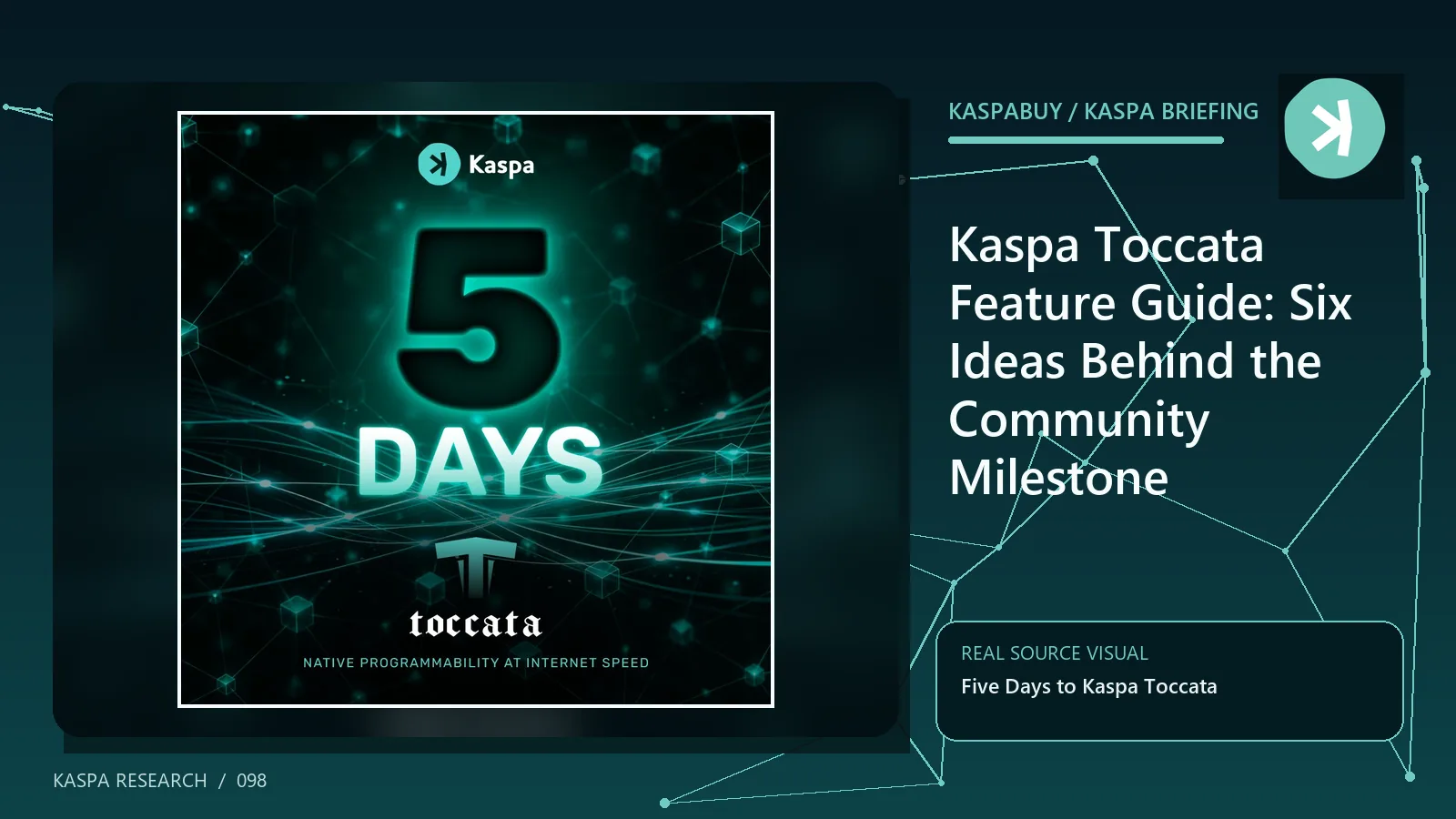
Five days before the planned Toccata activation, Kaspa Project described the upgrade as a move toward a programmable proof-of-work Layer 1 while retaining Kaspa’s BlockDAG and UTXO foundations. The post listed native covenants, transaction introspection, covenant IDs, stateful contracts, native ZK-proof verification and partitioned sequencing commitments.
The list works as a dependency graph. Introspection exposes the spending transaction; covenants enforce a transition; covenant IDs connect successive UTXOs; ZK verification checks off-chain computation; and partitioned commitments anchor lane-relevant activity.
That combined architecture explains the milestone. It does not mean every piece has the same maturity or user-facing interface. The final Toccata node upgrade checklist focused first on getting nodes and infrastructure onto compatible software because primitives are useful only when the network and its integrations preserve them correctly.
1. What are native Kaspa covenants?
A covenant is a condition on how a UTXO may be spent. An ordinary signature script commonly asks whether the spender controls a key. A covenant can also constrain properties of the new transaction—for example, which script receives a continuation output or how application data changes.
KIP-17 describes this as encoding state-transition rules in script. A counter covenant, for example, can require the next transaction to increment a value and recreate the application output under the expected locking conditions.
“Native” means upgraded Kaspa nodes evaluate these script rules at Layer 1. It does not mean the node understands a human concept such as a loan, token or marketplace. Consensus evaluates bytes and opcodes; application meaning remains in the protocol built from them.
2. Why does transaction introspection matter?
Transaction introspection is the script’s view into the transaction attempting to spend the UTXO. KIP-17 adds or consolidates opcodes for transaction version, lock time, payload ranges, input outpoints, input and output amounts, script public keys, counts and other fields. It also adds byte operations, signature-from-stack checks and hashing operations.
Without introspection, a script has limited ability to compare an old state with its proposed successor. With it, a covenant can require a particular output count, value, script, payload or authorization pattern. Substring operations allow large transaction fields to be examined without always pushing an entire field as one small script element.
Incorrect indices, byte ranges or serialization assumptions can weaken or break a contract, so negative transaction-layout tests remain essential.
3. How do covenant IDs preserve continuity?
In a UTXO system, state moves: spending destroys one outpoint and creates another. KIP-20 adds an optional 32-byte covenant_id to the UTXO entry and an output binding that identifies both the covenant ID and its authorizing input.
A valid continuation carries the same covenant ID from an authorizing covenant input. A valid genesis derives its ID from a unique input outpoint and its initial authorized outputs. This makes it possible for consensus and indexers to distinguish a genuine lineage from someone copying a familiar script and inventing the same label.
The identifier is not the state itself. Amounts, scripts, payloads and application-specific data still describe the current UTXO. The ID is the stable thread that connects those changing records.
4. What does “stateful contracts” mean on Kaspa?
Toccata does not turn Kaspa into an account-based chain with a global mutable object for every contract. Stateful behavior is built as a sequence of UTXOs. Each accepted transition consumes the previous state and creates the next state under covenant rules.
State ownership is explicit in outputs, and unrelated UTXOs can remain independent. Applications must still handle coin selection, concurrent spends, state discovery and reorganization-aware indexing.
SilverScript can help express higher-level covenant code, but a compiler does not remove the need to understand the resulting scripts and artifacts. “Stateful” should therefore be read as a programmable transition model, not as a guarantee of Ethereum-compatible contracts or tooling.
5. What does native ZK-proof verification add?
KIP-16 introduces OpZkPrecompile. A tag selects a supported verifier, and the stack supplies the proof-system-specific inputs. The initial specification covers a Groth16 path and a RISC Zero Succinct path.
This lets an application perform complex computation off-chain and ask a Kaspa script to verify a compact cryptographic claim about the result. Potential designs include rollup state transitions, bridge proofs, private credentials or computational integrity checks.
The word “verification” is crucial. Kaspa does not generate the proof, choose a correct guest program or validate an external data source. The application must bind the expected program and public outputs to the proof, manage prover infrastructure and accept the security assumptions of the integrated cryptographic libraries.
6. Why partition sequencing commitments into lanes?
KIP-21 replaces a monolithic per-chain-block sequencing recurrence with a commitment over recently active lanes. Each lane maintains a recursive tip, and the header still exposes one 32-byte sequencing commitment.
For a prover interested in one application lane, the goal is cost proportional to that lane’s activity rather than all global activity. The scheme also commits selected-parent context and mergeset miner payloads, and it purges inactive lanes after a defined blue-score window to bound the active set.
This is proof infrastructure, not an execution scheduler that guarantees unlimited throughput for an application. Lane admission limits, witness generation, data availability and application design remain relevant.
How do the six ideas fit into one application flow?
Imagine a proof-backed asset application. A covenant locks the current application UTXO. Introspection checks the proposed successor transaction. The covenant ID lets a wallet find the continuing instance. Off-chain software executes a larger computation and produces a supported proof. OpZkPrecompile verifies that proof when the UTXO is spent. A sequencing lane supplies committed activity anchors for higher-layer proving.
Every arrow needs implementation: contracts and proof programs, wallet indexing, complete RPC serialization, upgraded nodes and understandable risk disclosures. The market reaction after Toccata cannot substitute for measuring whether those components work.
What this feature guide does not prove
The six-feature list does not prove that a production DeFi ecosystem exists. It describes capabilities exposed by consensus proposals and software. Application launches, audited value, active users and reliable uptime require separate evidence.
It does not prove that all ZK systems are trustless or private. Proof-system dependencies, setup assumptions, guest-program correctness and public metadata vary. Likewise, a covenant ID proves lineage under KIP-20 rules, not legal ownership or an asset’s value.
Finally, technical activation does not cause a predictable KAS price. Markets can anticipate upgrades, trade broader macro conditions or move for unrelated reasons. Adoption should be evaluated with transparent usage metrics over time.
Frequently asked questions
Are covenants and covenant IDs the same feature?
No. Covenants enforce spending conditions. Covenant IDs give a consensus-tracked lineage to authorized outputs. They complement each other.
Does Toccata make Kaspa EVM-compatible?
No. Its programmability is based on Kaspa’s UTXO script system, covenants and proof primitives. EVM compatibility would be a separate software and execution claim.
What should developers read first?
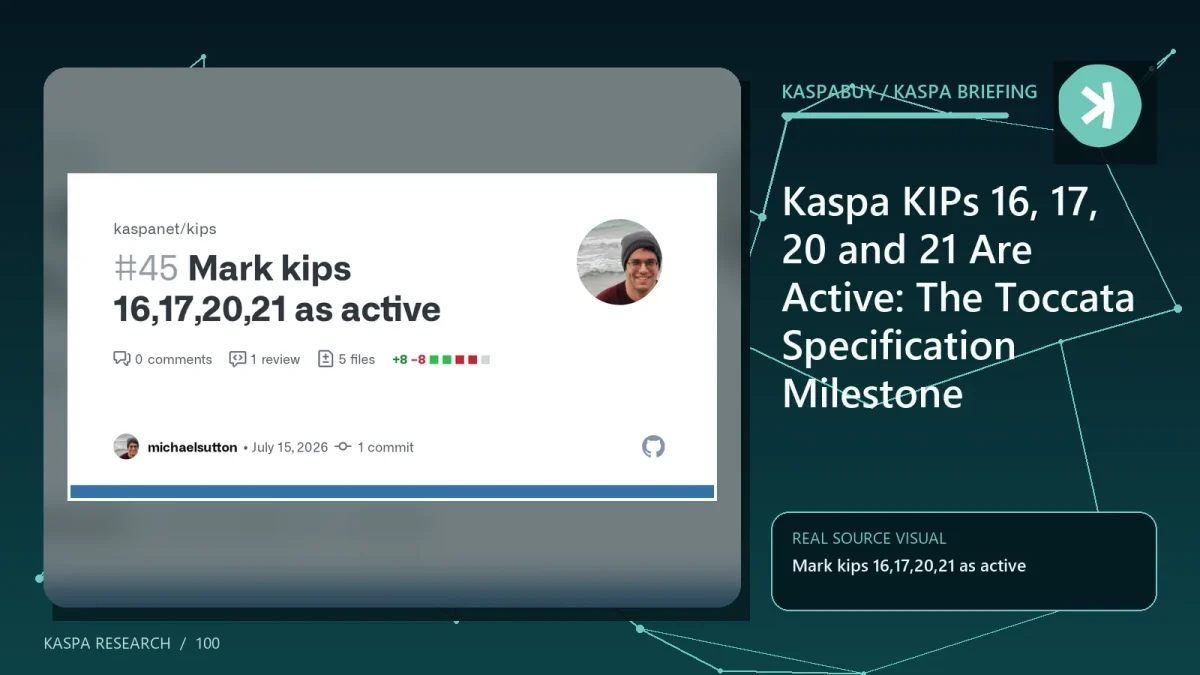
Read KIPs 16, 17, 20 and 21, then the maintained rusty-kaspa Toccata guide and exact SDK revision used by the project. Test on a non-production network before handling value.
Source and verification note
The organizing source is the official Kaspa Project LinkedIn post published June 25, 2026, which listed the six features and linked the mainnet release and setup guide. Technical descriptions were verified against KIPs 16, 17, 20 and 21. Potential applications are illustrative; they are not claims that those products were live, audited or adopted at publication.