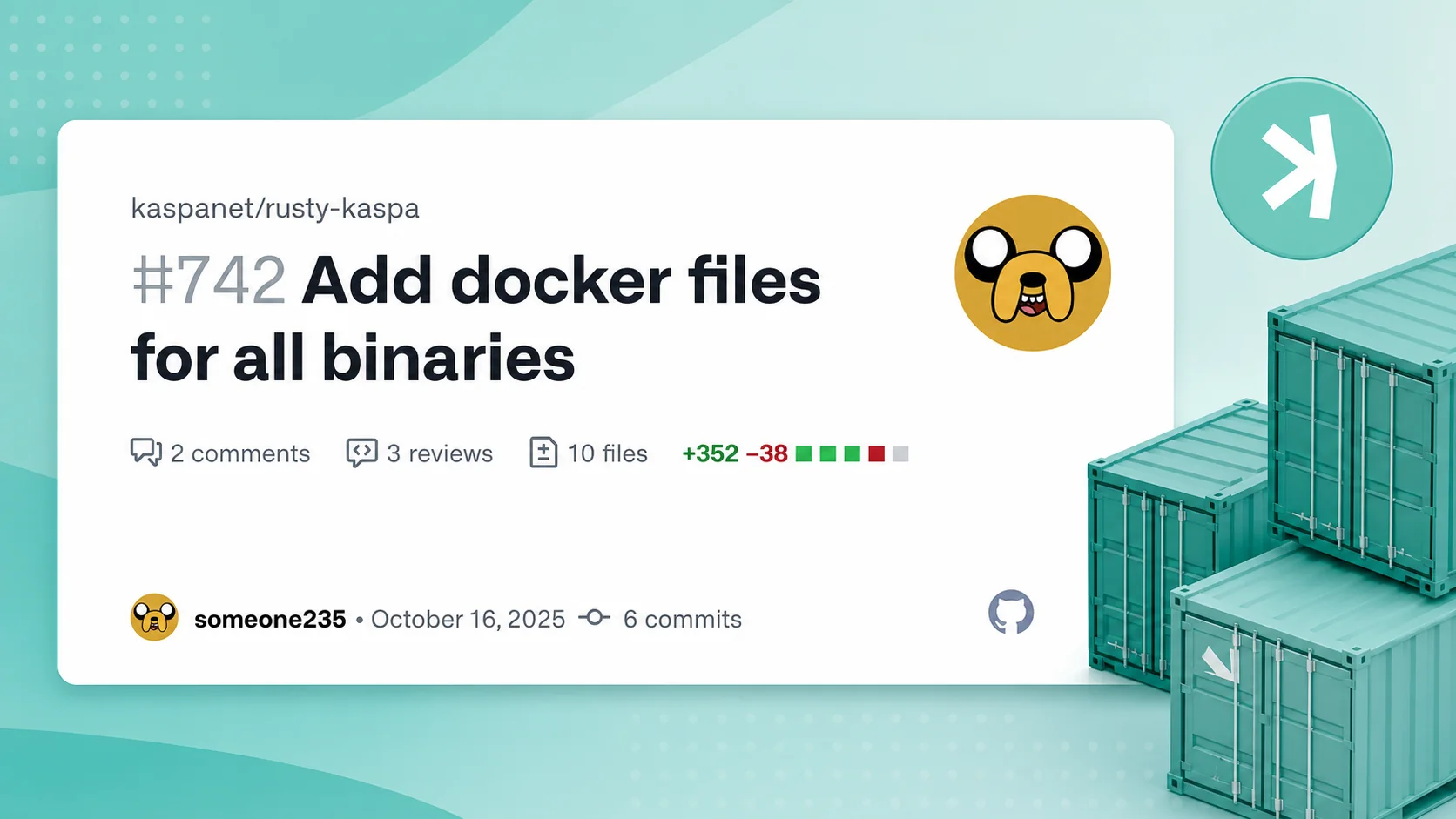
Kaspa Docker Images became easier to build from the official rusty-kaspa source when pull request #742 added dedicated Dockerfiles for kaspad, kaspa-wallet, rothschild, and simpa. The merged change also supplied a Docker Buildx helper for amd64 and arm64 images, but it did not turn containers into a managed node service or remove operator security duties.
Key takeaways
- The merged repository gained four separate Dockerfiles rather than one image containing every binary.
- A normal
docker buildcreates a single-platform image; the included shell script uses Buildx for multi-platform builds. - The script defaults to
linux/amd64 linux/arm64, requires an image tag, and only pushes when--pushis supplied. - Multi-stage builds use
cargo-chefand cache mounts to reduce repeated Rust dependency compilation. - PR #742 added build recipes, not a promise that a particular registry image is official, current, audited, or correctly configured.
What did rusty-kaspa PR #742 add?
Kaspanet merged rusty-kaspa pull request #742 on October 23, 2025. GitHub records 352 additions, 38 deletions, and 10 changed files. The patch added .dockerignore, four Dockerfiles under docker/, a multi-architecture build script, and README instructions. It also upgraded the Rust RocksDB dependency from 0.22.0 to 0.24.0 to avoid an upstream build problem identified by the contributor.
The four targets are deliberately separate:
Dockerfile.kaspadbuilds the full-node daemon.Dockerfile.kaspa-walletbuilds the command-line wallet binary.Dockerfile.simpabuilds the simulation binary.Dockerfile.rothschildbuilds the repository’s binary of that name.
That separation matters because someone who only needs kaspad should not have to compile unrelated application targets. It also produces smaller, purpose-specific runtime images and makes the selected artifact explicit during review.
How do you build a single Kaspa container image?
At the merge revision, the README documented a standard build from the repository root:
docker build -f docker/Dockerfile.kaspad -t kaspad:latest .
Replace the Dockerfile and tag when building another target. Pin the source to a reviewed release tag or commit before building; latest is only a local label and does not identify immutable source. A reproducible deployment record should include the Git commit, Dockerfile checksum, target platform, base-image digest, build time, and resulting image digest.
Each recipe is a multi-stage build. A Rust Alpine “chef” stage installs build dependencies and cargo-chef; a planner creates a dependency recipe; a builder compiles dependencies and the selected release binary; and a final Alpine stage copies only that binary plus runtime packages. tini becomes the entrypoint so the process receives container signals more predictably.
How does the multi-architecture script work?
The merged build-docker-multi-arch.sh script creates a Buildx builder and converts its space-separated architecture list into the comma-separated --platform value expected by Docker. Its documented interface is:
./build-docker-multi-arch.sh --tag myrepo/kaspad:reviewed \
  --artifact kaspad --arches "linux/amd64 linux/arm64"
The tag is required; kaspad is the default artifact; and amd64 plus arm64 are the default platforms. Adding --push sends the result to the configured registry. Without that option, the script does not intentionally publish it.
Before using the helper in automation, inspect it at the exact revision being built. Registry authentication, image signing, vulnerability scanning, provenance attestations, and retention rules remain deployment-pipeline concerns. The script is a build convenience, not a complete software-supply-chain policy.
Why can these builds be faster after the first run?
Rust projects can spend substantial time compiling unchanged dependencies. The Dockerfiles first run cargo chef cook against a generated recipe, allowing Docker to reuse the dependency layer until manifests change. Separate cache mounts cover Cargo’s registry, Git dependencies, and target directory during the final build.
That design can reduce repeated build time, especially in local development or a CI runner with persistent cache storage. It does not guarantee a specific duration: performance depends on available CPU, memory, network access, cache persistence, source changes, and emulation when the builder cannot execute a target architecture natively.
The same distinction applies to node synchronization. Container build efficiency is unrelated to protocol-level sync work. Our guide to Kaspa Initial Block Download explains a separate networking optimization merged later.
What must a Kaspa container operator still configure?
The final image starts its binary, but the Dockerfile does not encode a production network policy. Operators must decide which network and node flags to use, where persistent data lives, which interfaces and ports are exposed, how logs are retained, and how upgrades and backups are tested. Wallet secrets should never be baked into an image layer or committed in a compose file.
The merged runtime stages declare USER root. That is visible source behavior, not evidence that every deployment needs unrestricted container privileges. Evaluate a non-root runtime, read-only filesystem, dropped Linux capabilities, resource limits, and narrowly scoped volumes in a test environment. Do not expose RPC services publicly without a separately reviewed access-control design.
Containers also do not verify chain history for the operator. The Kaspa genesis-proof tooling guide covers an evidence task that remains distinct from packaging.
Frequently asked questions
Did PR #742 publish official prebuilt images?
The pull request added Dockerfiles, a build helper, and documentation to the official source repository. Its diff does not by itself establish that any image on a public registry is official. Verify registry ownership and image digests independently.
Which CPU architectures did the helper target by default?
The merged script defaulted to linux/amd64 and linux/arm64. Its --arches argument allowed a different space-separated platform list supported by the builder and Dockerfiles.
Does Docker make a Kaspa node maintenance-free?
No. It standardizes packaging. Version selection, persistent storage, networking, monitoring, backups, upgrades, and RPC security remain the operator’s responsibility.
Source and verification note
This article is based on merged rusty-kaspa PR #742, its file diff, and the README at merge commit 44d2cda. The primary source supports the four Docker targets, single- and multi-platform commands, Buildx requirement, and RocksDB change described above. Operational recommendations are clearly separated from project claims. Always inspect the current repository because Dockerfiles, base images, binary names, and command-line flags can change after October 23, 2025.