
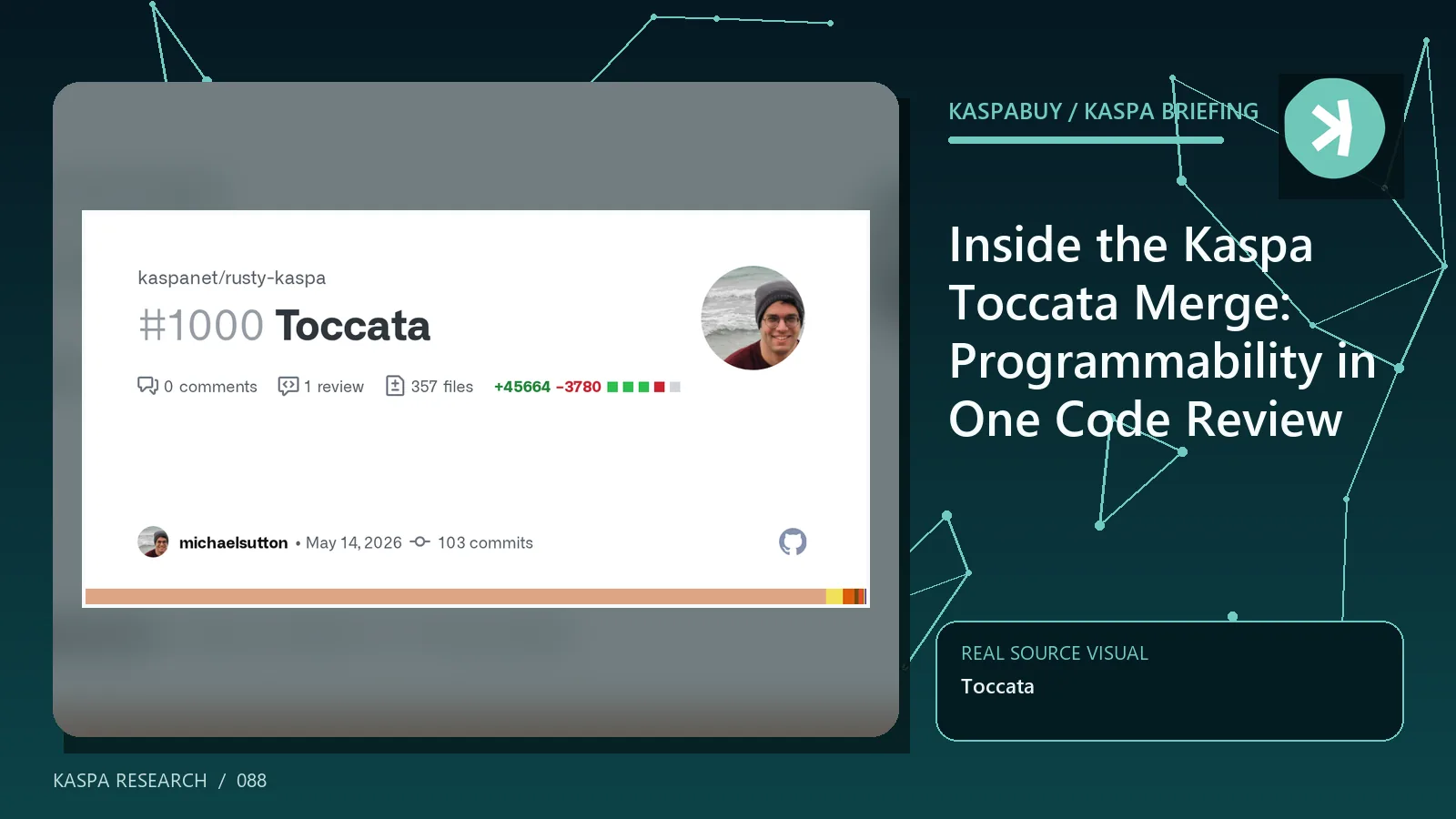
Inside the Kaspa Toccata merge, one pull request carried 103 preserved commits from the toccata branch into Rusty Kaspa’s master branch. PR #1000 integrated covenant scripting, native zero-knowledge verification, covenant identifiers, partitioned sequencing commitments, tests, storage, sync, RPC, and hardening work. It was a code-integration milestone, not the mainnet activation itself.
Key takeaways
- Rusty Kaspa PR #1000 merged 103 commits into
masteron June 2, 2026. - GitHub records 45,664 additions, 3,780 deletions, and 357 changed files in the review diff.
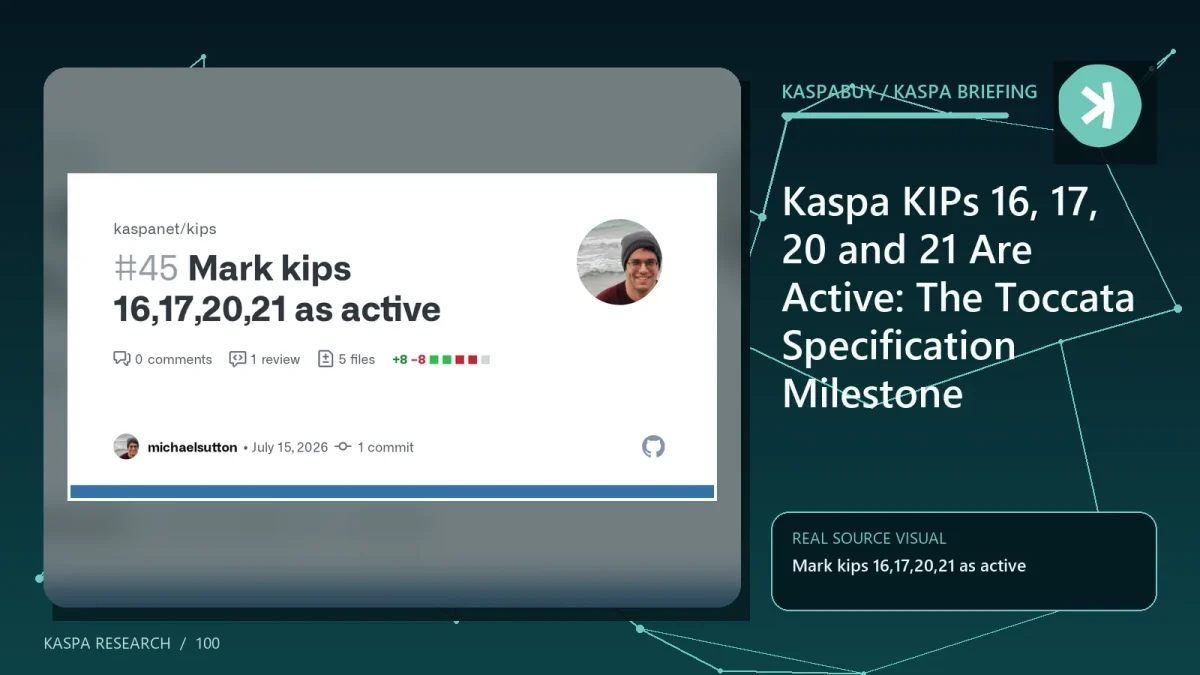
- The integrated release scope covered KIP-16, KIP-17, KIP-20, and KIP-21.
- The pull request explicitly required a non-squash merge, preserving the development history instead of collapsing it into one commit.
- Integration into
masterdid not choose a mainnet activation point or prove that operators had upgraded.
What exactly happened in Toccata PR #1000?
The official pull request was opened to merge the repository’s long-running toccata branch into master. Maintainer Michael Sutton described that purpose directly and warned that it must not be squash-merged. GitHub records the final merge on June 2 after 103 commits had accumulated in the branch history.
The scale is visible in the diff: 357 files, 45,664 additions, and 3,780 deletions. Those counts include production code, generated protocol definitions, tests, fixtures, documentation, dependency updates, and branch integration changes. They show breadth, not an independent measure of correctness or engineering effort.
The merge made the Toccata implementation part of the main development line. That is different from a stable binary release and different again from consensus activation. A node only enforces new hardfork rules when it runs compatible software and processes blocks at or beyond the configured activation condition.
Which protocol capabilities came together?
The later Rusty Kaspa v2.0.0 release notes identify four active KIPs as Toccata’s protocol core.
KIP-16: native ZK proof verification
KIP-16 defines a script precompile for verifying supported zero-knowledge proofs under consensus rules. Toccata hardening work included arity and worst-case-input checks around verifier paths. The feature supplies a verification primitive; it does not generate proofs or make an unaudited bridge safe.
KIP-17: covenants and improved scripting
KIP-17 expands transaction introspection, byte manipulation, hashing, arithmetic, conversion, and signature checks. The detailed KIP-17 explainer shows how those operations let a UTXO script constrain its successor transaction without describing the system as an unrestricted virtual machine.
KIP-20: covenant identifiers
KIP-20 adds consensus-tracked 32-byte covenant IDs to establish lineage across UTXO transitions. A valid covenant-bound output must either continue an authorized existing covenant or derive its genesis identifier from a unique outpoint and committed initial outputs. The mechanism improves identity and indexing, but the covenant script must still enforce its transition rules.
KIP-21: partitioned sequencing commitments
KIP-21 replaces a monolithic sequencing recurrence with lane-oriented state committed through one header value. Active-lane sparse-Merkle roots, inactivity handling, block context, and miner payload commitments support proofs whose work follows relevant lane activity rather than all global activity. Our guide to Kaspa ZK hardening and the KIP-21 inactivity shortcut covers an important later hardening layer.
These four components are complementary. Covenant scripts express constrained UTXO transitions; covenant IDs track lineage; native verification checks proofs; sequencing commitments provide globally anchored data for lane-oriented proving. None can substitute for the others.
Why was preserving 103 commits useful?
The PR’s non-squash instruction preserved the individual development commits. That makes it easier for reviewers and future maintainers to trace when a test, fix, refactor, or specification alignment entered the branch. The visible history includes the KIP-17 implementation, activation tests, covenant fixtures, KIP-21 state work, testnet scheduling, ZK hardening, and review follow-ups.
Preserved history is not a security proof. A commit series can still contain mistakes, and a very large merge can be difficult to review as a single unit. Its value is provenance: a maintainer can connect behavior to smaller changes, inspect original discussions, and bisect regressions more precisely than if the entire branch had become one opaque commit.
How did testing and hardening appear in the merge?
The public history contains more than feature additions. KIP-17 brought large covenant script-vector fixtures and activation tests. KIP-21 work added sparse-Merkle state, synchronization paths, lane proofs, pruning-point import logic, and reorganization-aware processing. Toccata’s final ZK hardening made hardened verifier and sequencing-activity paths unconditional under the Toccata flag while retaining targeted tests for SMT synchronization, header access, proof-arity rejection, and lane activity.
This is evidence of engineering controls: targeted tests existed, issues were corrected during review, and testnet-specific activation work preceded mainnet release. It cannot establish exhaustive coverage, formal verification, independent auditing, or safe behavior for every application built above the protocol.
Why was the merge not the activation?
Consensus upgrades have separate milestones:
- a specification defines intended behavior;
- development branches implement and test it;
- integration brings the code into the maintained line;
- a stable release packages compatible binaries and operator guidance;
- an activation parameter determines when nodes begin enforcing the rules;
- operators, miners, pools, exchanges, wallets, and indexers upgrade their infrastructure.
PR #1000 completed the third step. A separate pull request later set the mainnet activation DAA score, and v2.0.0 packaged the mainnet release. Conflating these stages can cause both technical and editorial errors: a developer can compile code from master while production nodes still follow pre-Toccata consensus.
What does the merge not prove?
The merge does not prove that a covenant application is secure, a ZK bridge is sound end to end, a rollup has decentralized operators, or wallets provide safe recovery. It also does not measure users, transactions, locked value, fees, node-upgrade share, or commercial demand.
Nor does the diff support a KAS price prediction. Repository activity is an auditable technology input. Asset prices also reflect liquidity, leverage, macro conditions, exchange access, expectations, and market-wide risk. A causal claim requires evidence beyond the timing of a merge.
What should developers inspect next?
Start with the four maintained KIPs and the v2.0.0 tag rather than treating the PR title as a specification. Review transaction versioning, activation gates, mass and fee behavior, database compatibility, RPC schema changes, and application-facing SDK versions. Pin the exact release used in tests.
For consensus-critical work, reproduce upstream tests and add application-specific adversarial cases. For integrations, test deposit, withdrawal, indexing, transaction parsing, block templates, and error paths on the designated testnet. The merge made one coherent code line available; it did not remove the need for independent validation.
Frequently asked questions
Did PR #1000 itself activate Toccata on mainnet?
No. It merged the Toccata branch into master. Activation required a separate mainnet DAA-score parameter and compatible released nodes.
Were all 45,664 added lines new consensus logic?
No. The total includes tests, fixtures, protocol definitions, storage and RPC code, documentation, dependency changes, and other integration work.
Why did Toccata need four KIPs?
They address different layers: proof verification, covenant scripting, covenant lineage, and sequencing commitments. Together they form a broader programmability and proving foundation.
Does a master-branch merge mean an SDK interface is stable forever?
No. Stable behavior should be checked against tagged releases and maintained documentation. Follow-up releases can correct errors, improve RPC, and refine compatibility.
Source and verification note
The primary source is merged kaspanet/rusty-kaspa PR #1000. Merge date, branch names, 103-commit history, non-squash instruction, file count, and diff totals come from GitHub’s public PR metadata. Feature scope was cross-checked against the official v2.0.0 release and maintained KIP documents. The sources prove integration and release scope; they do not prove activation at the moment of merge, exhaustive security, application adoption, or market impact.