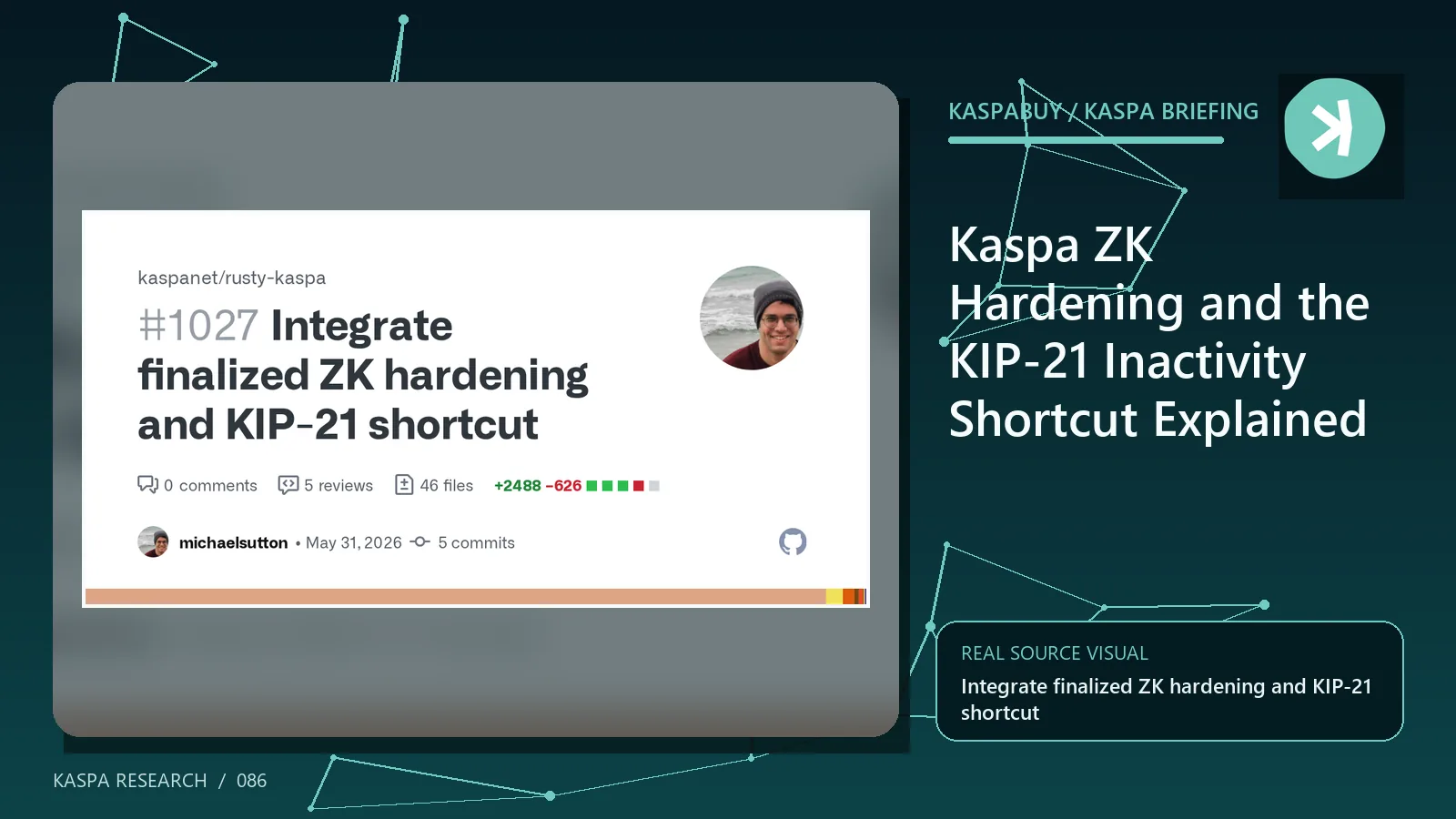
Rusty Kaspa PR #1027 integrated two related Toccata changes: stricter, better-bounded Groth16 and RISC0 proof verification, and KIP-21’s committed inactivity shortcut for lane proofs. The merge moved behavior already exercised on TN10 into the Toccata branch. It hardened validation and synchronization paths; it did not make every ZK application secure automatically.
Key takeaways
- Groth16 handling gained stricter public-input, verifying-key, proof, and trailing-byte validation plus per-input resource pricing.
- RISC0 handling gained a bound on control Merkle-witness depth so oversized paths reject early.
- KIP-21’s
inactivity_shortcutis committed beside the lanes root underActivityRoot. - The pull request finalized sparse-Merkle metadata and pruning-point/IBD behavior for the shortcut.
- The merge targeted the
toccatabranch on June 1, before mainnet Toccata activation, and folded the hardening into ordinary Toccata rules.
Why were the ZK verifiers hardened?
ZK verification has adversarial inputs by design. A node cannot assume that a proof, verifying key, field element, or Merkle witness is well formed merely because it arrived in a transaction. Every parsing and failure path needs a deterministic bound and a price that reflects worst-case work.
The rusty-kaspa PR #1027 summarizes stricter Groth16 validation and a RISC0 witness bound. Its commit history records checks for public-input arity, field parsing, extra bytes after Groth16 keys or proofs, and verifying-key deserialization that consumes script resources as data is processed.
These are not cosmetic input checks. A parser that accepts ambiguous trailing data can make different tooling disagree about the canonical object. A cost model based only on small, easy public inputs may undercharge values that trigger more elliptic-curve work. Hardening aligns rejection, parsing, and metering more closely.
What changed for Groth16?
Groth16 verification combines a verifying key, proof, and public inputs. PR #1027 checks that the number of supplied inputs agrees with the key structure, rejects unsupported or malformed field values, and disallows trailing bytes that a permissive decoder might otherwise ignore.
The pull request also prices each public input. Its benchmark work uses a high-Hamming-weight BN254 scalar to represent a more expensive multiplication path and records a resulting charge of 250,000 script units per input in that implementation. That exact number is a consensus-software detail, not a timeless estimate for application fees; developers must query the activated code and transaction mass rules they actually target.
The implementation limits hash-function handling to the supported Poseidon2 path for the relevant RISC0/Groth16 flow and meters verifying-key material. A large invalid key should not receive an unpriced opportunity to consume memory and CPU before rejection.
What changed for RISC0 verification?
RISC0 Succinct verification uses a control inclusion proof associated with a known recursion control root. Before the new bound, an oversized proof could perform many Poseidon hash-pair operations before failing. The hardening rejects a control path longer than the current RISC0 control Merkle depth.
PR #1027’s benchmark notes show the intended effect: the normal STARK case remained on the millisecond-scale test path reported by that machine, while the deliberately long control-proof case rejected much earlier after the bound. Those figures demonstrate one benchmark environment, not a general node-performance promise.
Tests also exercise malformed and trailing-seal cases. A robust verifier must fail closed for every invalid representation, not only verify known-good examples. Application teams should mirror this discipline with negative vectors generated by independent tooling.
How was the KIP-21 shortcut integrated?
The same pull request brings in the lane-proof inactivity shortcut developed on TN10. Under Toccata, ActivityRoot hashes the shortcut together with the active-lanes root. A proof guest can follow committed shortcuts across long inactive spans instead of walking the selected-parent chain one block at a time or knowing the exact inactivity threshold.
The change reaches beyond hashing. SMT metadata carries the shortcut block needed for fallback, pruning-point import derives and verifies the anchor from retained headers, and IBD passes the value through state import. The PR says the P2P v10 shape remains unchanged, while the metadata representation is finalized for Toccata.
For the full commitment model, see KIP-21 explained. The shortcut reduces the proof cost of quiet intervals; it does not replace lane inclusion witnesses or application-state proofs.
Why was the TN10 activation split removed?
TN10 had already activated Toccata and then a separate ZK-hardening point so developers could test a transition from the earlier behavior. Mainnet had not activated Toccata when PR #1027 was prepared. That allowed maintainers to make the hardened verifiers and activity-root structure the ordinary post-Toccata behavior on the toccata branch.
The PR therefore removes the temporary TN10-only zk_hardening_activation scaffolding from the main integration. It also collapses the temporary metadata variants into the finalized Toccata form while retaining tests for SMT synchronization, header access, Groth16 rejection, and lane proofs.
This branch history distinction matters when reading old logs. A TN10 build may mention two activation points, while the eventual mainnet-oriented Toccata code can present one integrated rule set. Operators should match logs and DAA parameters to network and release, not transplant TN10 values.
What should application developers test?
ZK application teams should test valid proofs plus arity mismatch, oversized verifying keys, invalid field encodings, appended bytes, unsupported tags or hash functions, over-depth control proofs, and maximum-priced inputs. They should compare Rust and JavaScript serialization and verify that both produce identical public-input bytes.
Contract teams also need transaction-level tests. KIP-17-style introspection determines which outputs a proof is allowed to authorize, so the upcoming KIP-17 explanation is a useful companion. A perfect verifier attached to a script that permits the wrong output is still an unsafe contract.
Node and proving-service operators should test a sync from a pruning point that is already inside Toccata behavior, not only an uninterrupted node upgrade. That exercises the metadata and header-segment assumptions introduced alongside the shortcut.
Limitations: what this hardening does not prove
Input hardening reduces known ambiguity and resource-exhaustion paths. It cannot prove the absence of cryptographic library vulnerabilities, circuit mistakes, compiler bugs, side channels, or application-level authorization errors. KIP-16’s third-party dependency boundary remains: scripts inherit assumptions from the selected proof system and verifier implementation.
The shortcut likewise authenticates an anchor but does not serve missing witnesses or guarantee data availability. Nor does passing repository tests equal a formal proof of consensus correctness. Independent review, reproducible builds, network testing, and careful activation remain necessary.
Frequently asked questions
Did PR #1027 add a new ZK proof system?
No. It hardened the supported Groth16 and RISC0 paths and integrated their finalized Toccata behavior.
Was the shortcut a separate mainnet hardfork after Toccata?
The PR explicitly assimilated the finalized hardening and shortcut into ordinary Toccata logic because mainnet Toccata had not yet activated at merge time.
Does strict parsing break malformed proofs that used to decode?
That is the point of canonical validation. Applications should rebuild fixtures with supported encoders and treat previously tolerated trailing or malformed data as invalid.
Source and verification note
This article is based on kaspanet/rusty-kaspa PR #1027, merged into toccata on June 1, 2026, with context from KIP-16 and KIP-21. Branch status, verifier changes, metering, witness bounds, shortcut placement, and sync behavior are limited to those primary sources. Current release code and activation parameters remain authoritative.