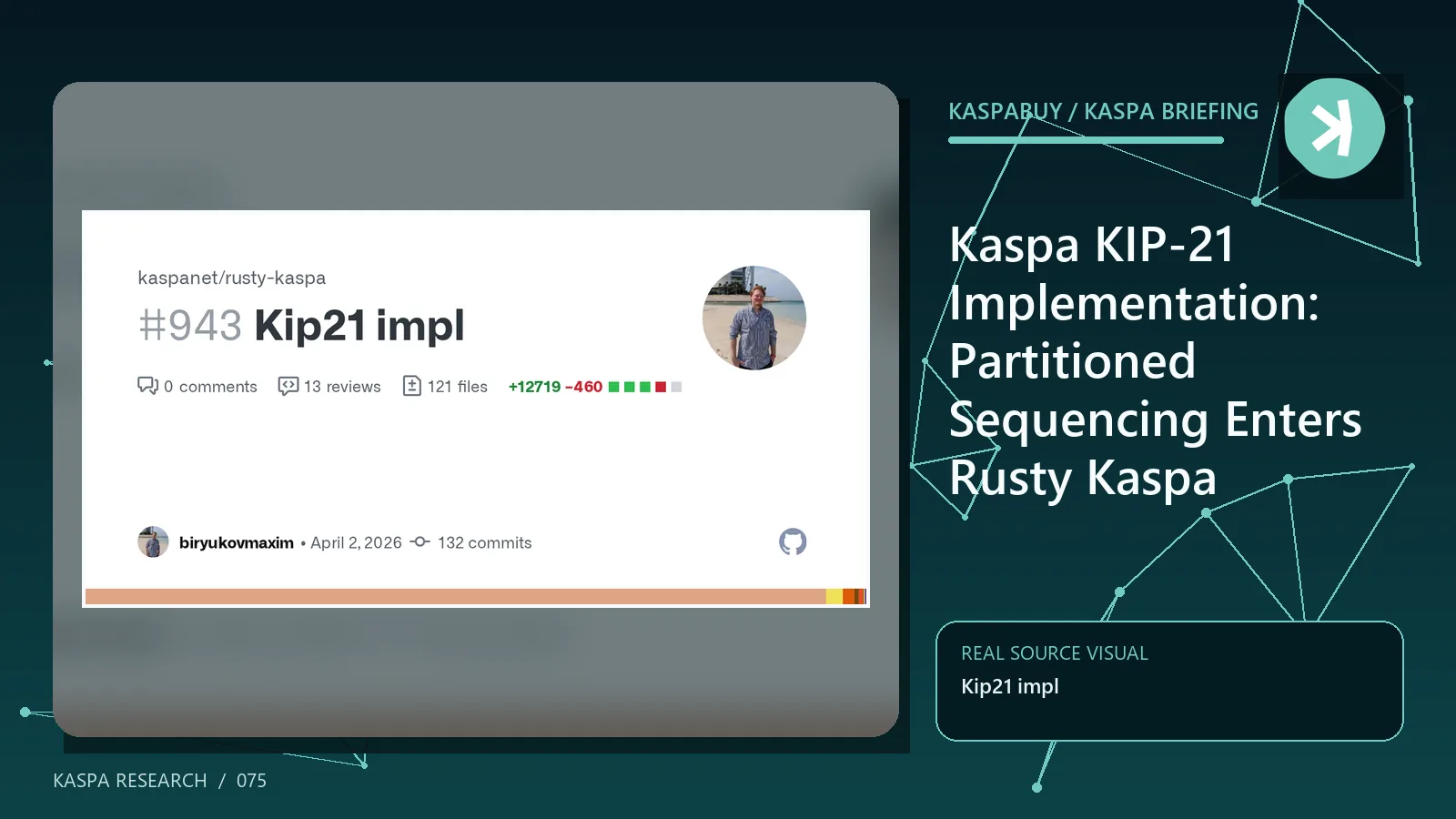
Kaspa KIP-21 implementation work entered Rusty Kaspa through PR #943, which merged into the covpp-reset2 development branch on April 20, 2026. The code introduced lane-based sequencing commitments, sparse-Merkle state, user-lane subnetwork rules, and synchronization support. At that date, the merge was preparation for testing—not proof that KIP-21 was active on Kaspa mainnet.
Key takeaways
- KIP-21 partitions sequencing state into lanes while retaining a single commitment anchored in each relevant block header.
- Lane activity commits transaction identity, transaction version, and merge index so global order can be reconstructed with witnesses.
- An active-lanes sparse Merkle tree lets a proof focus on one lane’s activity between two global anchors.
- PR #943 added state storage, reorg-aware updates, pruning-point import, P2P messages, and integration tests around the commitment.
- The merge target was
covpp-reset2; implementation on a development branch was not an April 20 mainnet activation.
What problem was KIP-21 designed to solve?
A single recursively updated sequencing history is easy to anchor but expensive for a prover interested in only one application lane: unrelated activity can still sit on the path it must process. The draft KIP-21 specification PR proposed a partitioned, lane-based commitment so lane-local proving can scale with activity in that lane rather than all network activity.
The design preserves global anchors. A lane proof begins with inclusion or non-inclusion under an earlier active-lanes root, applies the lane’s compressed transitions, and ends under a later root. Merge indices and witnesses retain enough information to relate lane-local activity to the network’s accepted global sequence.
How does the lane commitment work?
The new kaspa-seq-commit crate derives a lane key from a 20-byte lane identifier. For each accepted transaction, an activity leaf commits its transaction ID, version, and merge_idx. Leaves for a lane form an activity digest. The next lane tip combines a parent reference, lane key, activity digest, and accepting-block context hash.
That context commits a timestamp derived from the selected parent, plus DAA score and blue score. The implementation separately commits mergeset miner payloads using the block hash, blue work, and payload digest. An active lane is represented in a sparse Merkle tree by a leaf containing its lane tip and blue score.
The final state combines the lanes root with the payload-and-context digest, then combines that state root with the parent sequencing commitment. Hash-domain separation and golden tests make accidental changes to these encodings detectable.
What are user-lane subnetworks?
PR #943 added a constrained namespace for non-native transaction lanes. The code retains 20-byte subnetwork IDs but defines a user-lane form with a four-byte namespace followed by sixteen zero bytes. The namespace must not be all zero, and reserved system IDs follow separate rules.
This gives applications deterministic lane identifiers without treating every arbitrary 20-byte value as valid. It does not create an application, deploy a rollup, or execute a smart contract. Builders still need transaction rules, proving software, state logic, data access, and user-facing tooling above the commitment layer.
How did the node store and synchronize the state?
The pull request added sparse-Merkle storage with lane versions, branch versions, score indexes, reverse blue-score lookup, caches, and reversible processing. Reversible diffs matter because Kaspa’s virtual selected chain can change; a node must roll lane state backward and forward consistently during reorganization rather than treating each update as final immediately.
For initial synchronization, the implementation added P2P flow and protobuf messages for pruning-point sparse-Merkle state. Verification reconstructs metadata, checks the expected parent commitment, validates lane proofs against the lanes root, and confirms that the computed sequencing commitment matches the header anchor. Shared branch caching avoids recomputing identical sparse-tree paths for every lane proof.
What did PR #943 not deliver by itself?
The merge did not announce a stable release, activate new consensus rules, or prove production economics for a layer-two system. It also did not make every transaction a smart-contract call. KIP-21 supplies a commitment and proving substrate; execution, proof generation, settlement policies, and application security remain separate systems.
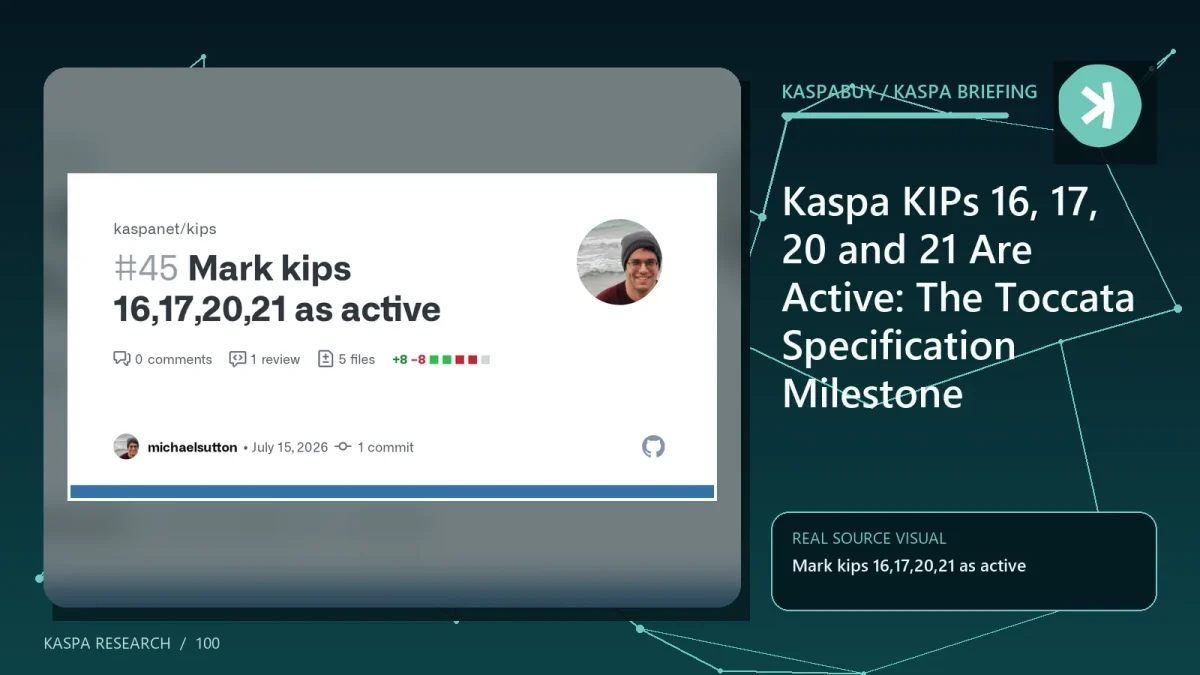
The article’s April 20 time boundary matters. GitHub records PR #943 as merged into covpp-reset2, while the companion KIP document was still a draft pull request at that time. Later documentation or status changes must not be projected backward as evidence that mainnet had already activated the feature.
How did this relate to Toccata testing?
KIP-21 sat inside a broader covenant and proving development stream. The Kaspa Toccata feature-freeze overview explains the later testnet preparation stage, while the Testnet 10 Toccata activation guide separates an activation notice from preliminary code integration.
That sequence—proposal, feature-branch implementation, integration, testnet activation, and only then any mainnet process—is the safe way to interpret repository activity. None of these engineering milestones alone supplies a KAS price target.
Frequently asked questions
Does partitioned sequencing mean Kaspa consensus is sharded?
No. KIP-21 partitions sequencing commitment state into application lanes while preserving global header anchors. That is not the same claim as splitting proof-of-work consensus into independent shards.
What is the active-lanes root?
It is the sparse-Merkle root that commits the current tip and blue-score state of active lanes, enabling inclusion and non-inclusion proofs.
Why include the merge index in an activity leaf?
It binds an accepted transaction to its position within the relevant merge ordering, helping witnesses reconstruct global sequence from lane-local data.
Was KIP-21 active on mainnet on April 20, 2026?
The cited source does not show that. It shows a merge into the covpp-reset2 development branch and associated implementation tests.
Source and verification note
This article is based on merged kaspanet/rusty-kaspa PR #943, the then-draft KIP-21 specification PR #36, the official sequencing-commitment research discussion, and the merge’s sequencing hash implementation. These records establish the architecture, code scope, merge target, and April 20 status. They do not establish mainnet activation, full application deployment, proving costs in production, adoption, security of a future rollup, or a KAS price effect.