The Kaspa Stratum Bridge Beta was a standalone bridge bundled with Rusty Kaspa v1.1.0 that accepted Stratum connections from ASIC miners and exchanged block templates with a Rusty Kaspa node over gRPC. It offered external-node and in-process modes, monitoring, and share handling, but its beta label required cautious operator testing.
Key takeaways
- Rusty Kaspa v1.1.0 identified the in-house Stratum Bridge as a beta addition, not a finished compatibility guarantee for every pool or ASIC.
- The bridge accepts Stratum mining connections, obtains block templates from a Rusty Kaspa node, validates shares, and submits candidate blocks through the node API.
- External mode connects to a separately managed node; in-process mode starts an embedded node while retaining the same gRPC-facing mining logic.
- YAML configuration supports multiple Stratum instances, difficulty settings, logging, and optional Prometheus metrics.
- The release and its source code provide no mining-profit estimate, network-adoption result, or basis for predicting the KAS price.
What did Rusty Kaspa v1.1.0 release for miners?
The March 4 Rusty Kaspa v1.1.0 release listed an in-house Stratum Bridge as BETA among broader node, synchronization, storage, and integration improvements. The assigned March 14 KASmedia report accurately summarized that addition as a way for mining pools to connect infrastructure directly to Rusty Kaspa nodes.
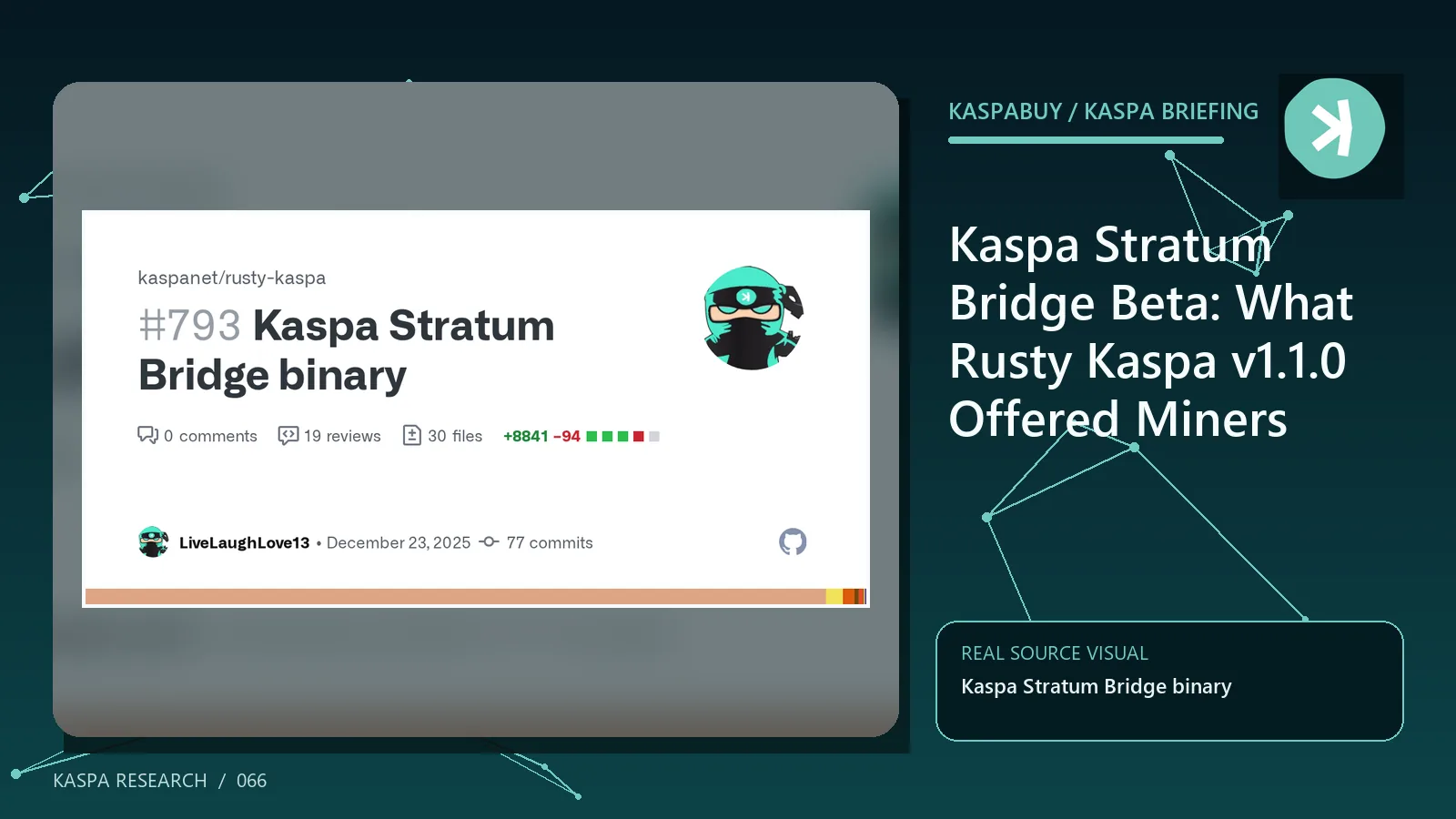
The implementation came from merged Rusty Kaspa PR #793. Its bridge is a Stratum front end: ASIC miners speak the familiar mining protocol to the bridge, while the bridge speaks Kaspa’s gRPC interface to a node. That separation lets mining software consume work without embedding Kaspa’s node RPC details.
This was tooling around mining infrastructure, not a change to proof of work, block rewards, emissions, or consensus. For the release-wide context, see Rusty Kaspa v1.1.0: VSPC, Stratum Bridge, Sync, and Storage Updates.
How did the Kaspa Stratum Bridge Beta work?
According to PR #793, the bridge listens for ASIC connections, manages per-worker jobs and difficulty, retrieves fresh block templates, and submits valid candidate blocks. It tracks accepted, stale, and invalid shares as operational signals. A submitted share is not automatically a network block; it must satisfy the network target and be accepted by the connected node.
The node-facing component waits for node synchronization before serving work and subscribes to new-block-template notifications. It also polls network and node status for console output and Prometheus. This design gives an operator one place to observe worker hashrate estimates, share rates, block submissions, peer count, sync state, and other infrastructure signals.
Metrics are diagnostic estimates rather than guarantees. A displayed hashrate can be noisy over short windows, and accepted shares do not establish profitability or future rewards.
What was the difference between external and in-process mode?
In external mode, an operator starts and manages kaspad separately, then points the bridge’s kaspad_address at that node’s gRPC listener. This separates node lifecycle from bridge lifecycle and makes independent upgrades, restarts, and monitoring easier.
In in-process mode, the bridge starts an embedded Rusty Kaspa node using the node’s normal runtime construction path. The bridge still connects to that node through loopback gRPC, so both modes reuse the same mining and statistics logic. The tradeoff is operational: one process is simpler to launch, while a failure or restart can affect both services together.
Neither mode removes the need to maintain a synchronized node, sufficient storage and memory, reliable peers, and a protected RPC boundary.
Which configuration and monitoring features mattered?
PR #793 describes a YAML configuration with global node settings and one or more Stratum instances. Each instance can have its own listening port and difficulty or variable-difficulty settings. The command line selects external or in-process mode and can pass node arguments when the embedded mode is used.
That flexibility can support several miner groups or tuning profiles behind one operator-managed service. It also raises configuration risk: the bridge and node addresses must match, ports must not collide, and difficulty settings need validation against actual hardware behavior. Operators should begin with a limited test, retain logs, confirm template refreshes, and verify accepted submissions before expanding a deployment.
The related Kaspa CPU Miner v0.2.6 compatibility guide covers different testing software; it should not be treated as evidence that an ASIC Stratum configuration will behave identically.
What security and reliability limits did the beta retain?
A bridge sits between revenue-producing hardware and a consensus node, so mistakes can waste work even when no funds are directly held. Operators should download binaries only from the official release, verify the release identity, restrict Stratum and RPC exposure with host and network controls, and never expose administrative node interfaces merely for convenience.
Beta software can contain protocol, reconnection, accounting, metrics, or hardware-compatibility defects. Prometheus should be protected if it exposes operational details. Configuration files, logs, and dashboards should not leak private endpoints or credentials. Redundant nodes and staged rollback plans can reduce downtime, but PR #793 does not document a formal audit or service-level objective.
Did the bridge change Kaspa’s mining roadmap or price outlook?
The bridge reduced integration distance between Stratum-speaking ASICs and Rusty Kaspa nodes. It could help pools test more direct infrastructure, but the cited sources do not measure how many operators adopted it, how reliably it performed at scale, or whether it changed network hashrate distribution.
Infrastructure quality can matter to a proof-of-work network, yet a beta binary is not a valuation model. Hardware efficiency, electricity, difficulty, uptime, market conditions, and pool policies remain separate variables. No KAS price prediction follows from this release.
Frequently asked questions
Was the Kaspa Stratum Bridge a mining pool?
No. It was bridge software that accepted Stratum connections and connected them to a Rusty Kaspa node. Pool accounting, payout policy, custody, and user management are separate systems.
Did miners need to run a full node?
The bridge needed access to a synchronized Rusty Kaspa node. External mode used a separately running node; in-process mode embedded one in the bridge process.
Did v1.1.0 guarantee compatibility with every ASIC?
No. The official release explicitly labeled the bridge beta. Operators still needed to test firmware, Stratum behavior, difficulty, reconnects, and share reporting for their own equipment.
Did the beta make mining profitable?
No such claim is supported. Profitability depends on hardware, energy, network difficulty, uptime, fees, and KAS market value, all of which can change.
Source and verification note
This article uses the March 14 KASmedia ecosystem report as the assigned secondary source and verifies the mining claims against the official Rusty Kaspa v1.1.0 release and merged PR #793. The primary sources establish the beta label, two node modes, gRPC interaction, share handling, configuration, and metrics. They do not establish an independent audit, universal ASIC support, deployment scale, profitability, or a KAS price effect.