Kaspa CPU Miner v0.2.6 was a testnet-focused compatibility release published on February 9, 2026. It updated the miner’s RPC schema to carry covenant bindings and covenant IDs used by TN12, refreshed Rust RPC dependencies, and repaired deployment automation. It did not make CPU mining competitive on Kaspa mainnet or activate covenants there.
Key takeaways
- The official release title identifies v0.2.6 as “Covenant-binding protos, TN12 compatible.”
- RPC outputs gained an optional covenant binding with an authorizing-input index and covenant ID; UTXO entries gained a covenant ID field.
- The miner’s Tonic and Prost stack was updated, its minimum supported Rust version became 1.88, and CI deployment received a separate fix.
- Compatibility lets test tooling understand a node’s data model; it does not itself define or activate consensus rules.
- Kaspanet describes this CPU miner as software for testnets and development networks, not competitive mainnet mining.
What changed in Kaspa CPU Miner v0.2.6?
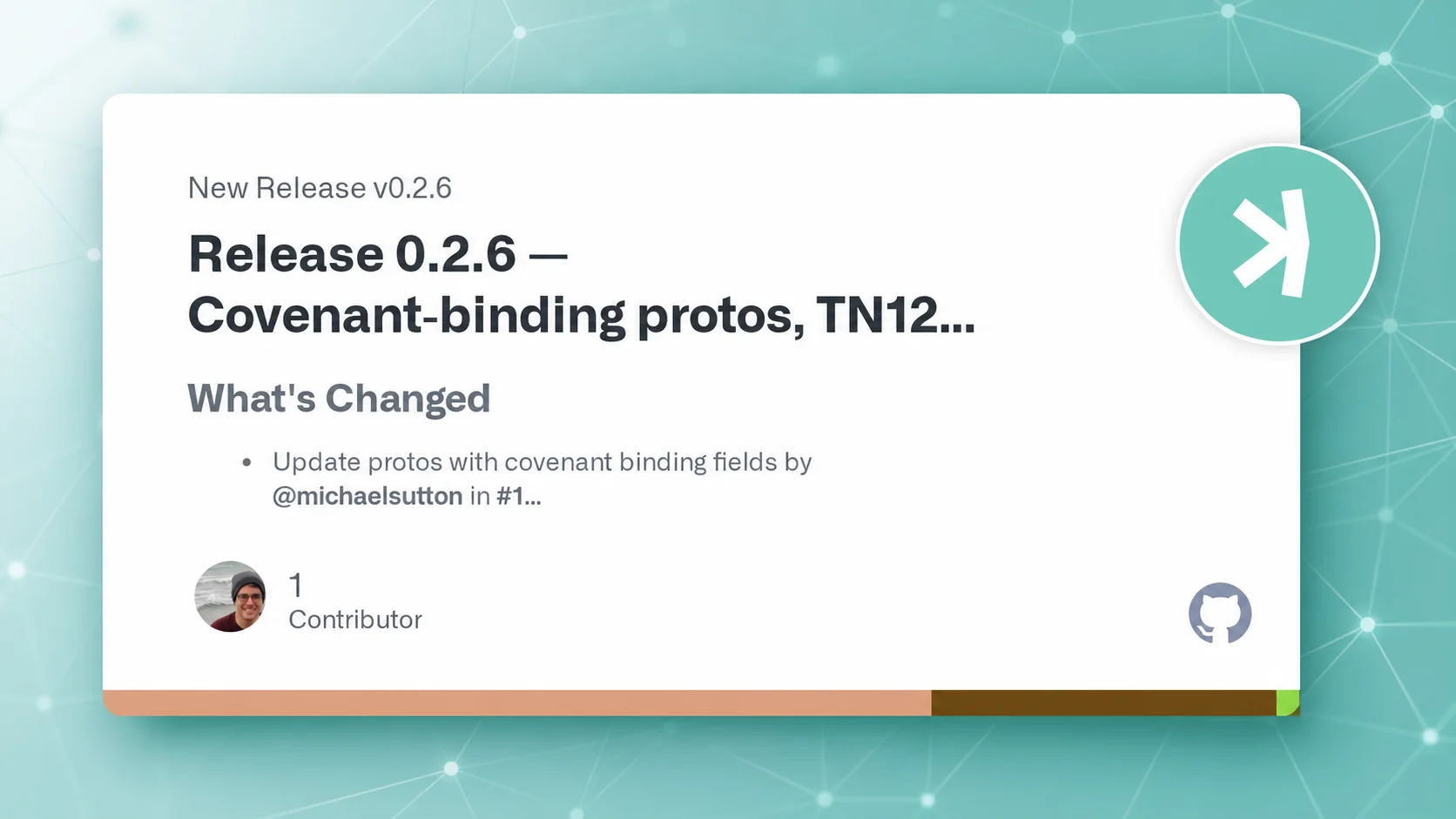
The official Kaspa CPU Miner v0.2.6 release lists two changes: updating protocol definitions with covenant-binding fields through PR #1 and fixing CI deployment through PR #2. The release provided packaged assets and linked its complete commit history.
Merged cpuminer PR #1 is the technical center of the release. GitHub records five commits across eight files, with 246 additions and 181 deletions. Much of that diff updates generated-protocol dependencies, but the important semantic change is small and explicit: the miner can decode the covenant-related fields that the matching TN12 node exposes over RPC.
That compatibility is necessary because mining software receives block templates and structured transaction data from a node. If its schema omits a newly relevant field, it can fail to decode data or silently operate with an incomplete model.
Which covenant fields were added to the RPC schema?
RpcTransactionOutput gained an optional covenant field. The new RpcCovenantBinding message contains authorizing_input, a 32-bit input index, and covenant_id, represented as a string in the protocol schema. RpcUtxoEntry also gained a covenant ID string.
In a UTXO covenant design, the ID identifies a covenant lineage, while the authorizing-input index ties a newly created output to the input whose rules authorized that continuation. The miner does not invent those rules. It has to preserve and understand the node’s serialized data well enough to participate in the test network correctly.
For a deeper look at the matching transaction-generator work, see Kaspa covenant RPC serialization. The separate KIP-16 implementation guide covers ZK verification research rather than mining protocol transport.
Why did TN12 require a matching miner release?
Testnet 12 was being used to exercise covenant and ZK-related code that was not part of the ordinary mainnet transaction model at that time. KASmedia’s February 13 report stated that TN12 participants needed cpuminer v0.2.6 together with the updated Covenant++ development branch. That is secondary reporting; the primary release independently confirms TN12 compatibility and the covenant-schema update.
A proof-of-work testnet still needs blocks. CPU mining gives developers an accessible way to produce those blocks without depending on competitive mainnet hardware economics. A miner and node must agree on RPC schemas, network selection, block templates, and accepted transaction formats for testing to be meaningful.
Compatibility does not mean every test passed, every covenant application was secure, or the same binaries were ready for mainnet. It means this release aligned one piece of the TN12 toolchain with the experimental node interface.
What build and dependency work accompanied the schema change?
The package moved to version 0.2.6 and Rust 1.88, with Tonic 0.12.3 and Prost 0.13.5. Its build script tracked imported protocol changes without forcing optional-field flags on unrelated inputs. Warning cleanup and PR #2’s deployment repair improved maintenance and artifact publishing; neither changed Kaspa’s proof-of-work algorithm.
Was v0.2.6 intended for profitable mainnet CPU mining?
No. The official kaspanet/cpuminer repository describes it as “a CPU miner for Kaspa testnets and development networks” and states that CPU mining is no longer used for competitive Kaspa mainnet mining.
That boundary prevents a common misunderstanding. A new miner version number is not evidence that ordinary computers can compete with specialized mainnet hardware. Hash rate, network difficulty, electricity cost, pool policy, and hardware efficiency determine mining economics, and this release does not supply a profitability study.
Developers can still use CPU mining for local networks, controlled integration tests, and public testnets where accessibility is more important than production competition.
What should a TN12 operator verify?
Operators should use the official release, verify the version and artifact provenance, select a testnet address, and connect to the intended TN12 node and RPC port. Logs should agree on network identity, synchronization, templates, and submissions. Testnet keys belong apart from production funds, and RPC endpoints need network controls. For failures, record both versions, the network, sanitized logs, and a reproducible configuration before assuming a consensus bug.
What did the release not prove?
Version 0.2.6 did not activate mainnet covenants, certify contract safety, validate the entire TN12 stack, or turn the tool into a wallet or ASIC replacement. Hardfork timing required separate node releases, activation parameters, operator coordination, and observed network behavior.
What were the price implications?
Compatible test tooling can expose defects earlier, but neither the release nor PR #1 includes KAS market data or a price target. A testnet miner schema update cannot guarantee valuation effects.
Frequently asked questions
Can Kaspa CPU Miner v0.2.6 mine on TN12?
The release is explicitly labeled TN12 compatible. The miner still requires a compatible, synchronized TN12 node and correct network configuration.
Does the miner execute covenant contracts?
The node enforces consensus and script rules. The miner consumes RPC data and performs proof-of-work; v0.2.6’s key change was understanding the covenant-related protocol fields.
Is covenant_id a wallet address?
No. It identifies covenant state lineage in the experimental UTXO model. It is not a receiving address or private key.
Should mainnet miners replace ASICs with CPUs?
No. The repository explicitly says CPU mining is not competitive for Kaspa mainnet and maintains this software for testnet and development use.
Source and verification note
This article relies on the official v0.2.6 release, merged cpuminer PR #1, and the repository’s current purpose statement. KASmedia’s TN12 report supplies secondary context and is labeled accordingly. The sources establish schema compatibility and testnet use; they do not establish mainnet covenant activation, mining profitability, a security audit, or KAS price impact.