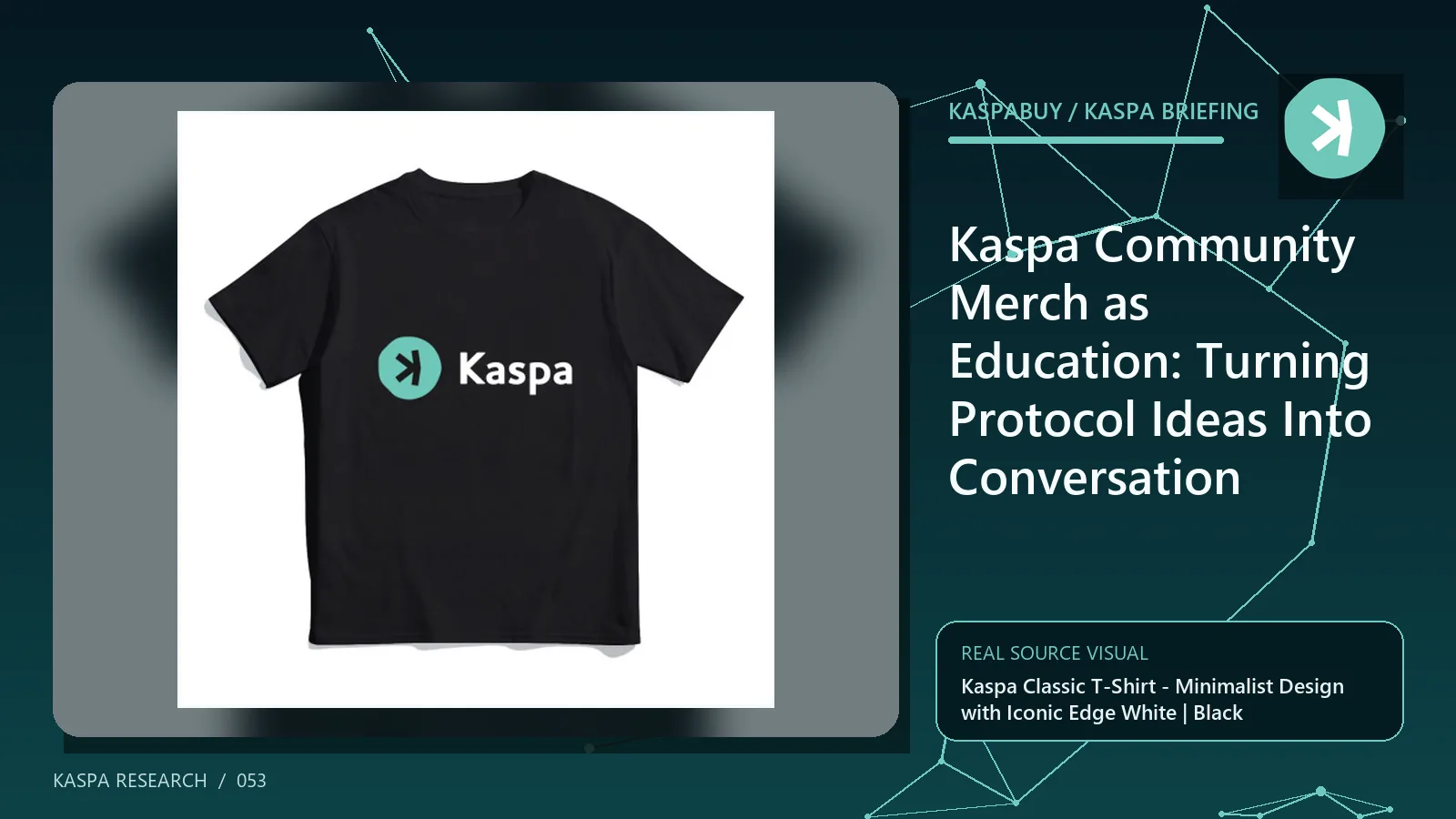
Kaspa community merchandise works best when it helps someone ask a useful question. A shirt, sticker, mug, or cap cannot explain a BlockDAG by itself, but it can open a conversation about Kaspa’s architecture, mining, payments, and open participation. The important part is keeping that conversation accurate, accessible, and connected to reliable technical sources.
Key takeaways
- Merch is a communication prompt, not proof of a technical or financial claim.
- Good Kaspa designs connect visual identity with accurate, plain-English education.
- Merchant materials should answer practical questions: what KAS is, how payment works, and where a customer can verify an address or transaction.
- Community expression should remain independent while distinguishing personal designs from protocol documentation and official reference channels.
- The most useful call to action is “learn more” or “verify,” not a price prediction.
Why can Kaspa merch be educational?
The official Kaspa Ecosystem Communications Initiative describes an ecosystem of builders, miners, educators, merchants, researchers, and community contributors. It proposes communication that stays grounded in architectural reality while making participation easier across regions and languages.
That framework gives community merchandise a sensible role. Physical items create what the document calls “human context”: a way for technical ideas to show up in ordinary life. Someone may notice a Kaspa design at a meetup, in a mining room, at a checkout counter, or during a video call. The item creates attention; the person wearing or displaying it supplies the explanation.
This distinction matters. A product should not imply that it is a protocol specification, an investment endorsement, or evidence that a feature is live. It can point people toward documentation and help them remember the question they wanted to investigate.
What makes a responsible Kaspa design?
A responsible design starts with architectural reality. If the theme is BlockDAG, the supporting description should explain that Kaspa orders blocks through a directed acyclic graph rather than offering a generic “fast blockchain” slogan. If the theme is mining, the copy should identify Kaspa as proof of work without promising a mining return. If it refers to an upgrade, it should name the proposal or release and link to a primary source.
Three practical checks help:
- Is the claim specific? “Proof-of-work BlockDAG” is more informative than “future of crypto.”
- Can the claim be verified? Link to Kaspa’s repositories, specifications, release notes, or public network tools.
- Is the source status clear? Separate official documentation, independent reporting, and community opinion.
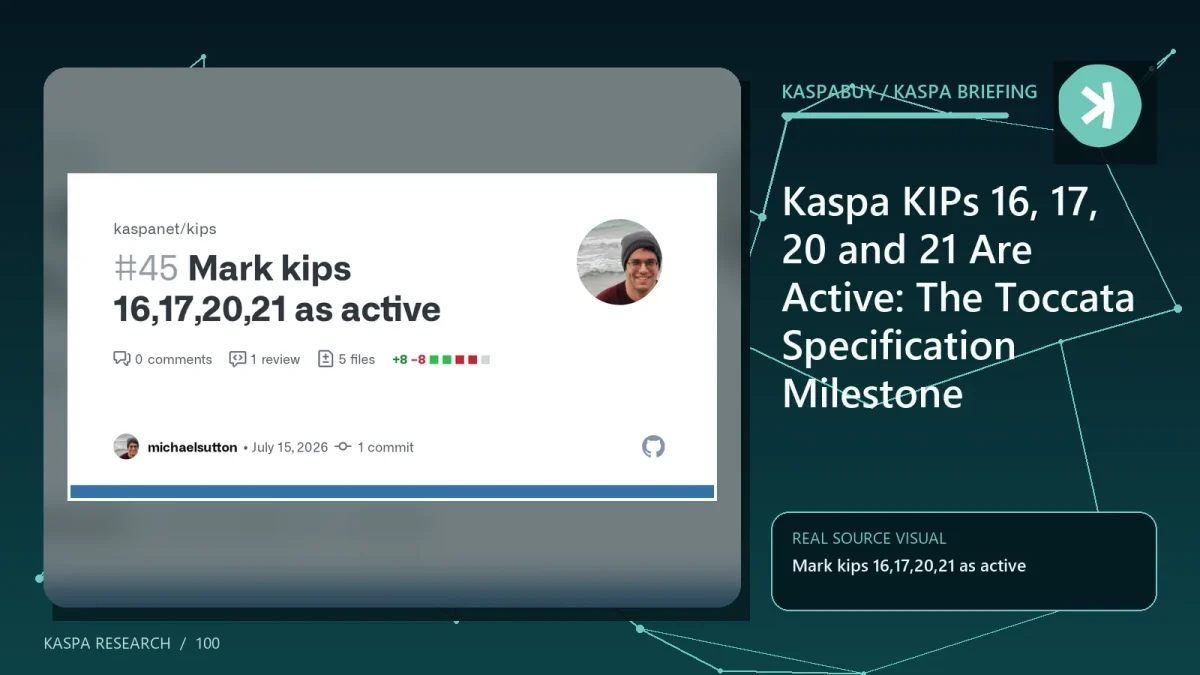
Feature-specific designs need the same discipline. An explanation of native proof verification, for example, should distinguish reference implementation, test activation, and mainnet status. The Kaspa KIP-16 implementation guide demonstrates those boundaries with primary sources.
How can merchants use Kaspa materials at the point of sale?
Merchant materials have a narrower, practical job. A customer needs to know whether KAS is accepted, which network and asset are involved, how to scan or copy the payment address, and how confirmation will be recognized. A small sign or sticker can signal availability, but the checkout interface must provide order-specific details.
For that reason, a Kaspa Accepted Here sticker is the beginning of the payment flow, not the payment instruction itself. The order should still show the exact KAS amount, a valid kaspa: address, a QR code where available, and a status updated from on-chain data.
KaspaBuy’s earlier overview of Kaspa payments in online commerce provides context for why merchant communication and checkout design must work together. The physical message creates awareness; software handles precision.
What should Kaspa merch avoid?
Avoid designs or product descriptions that present a price target, guaranteed adoption, risk-free mining, or an unaudited application as settled fact. Those claims are not required to celebrate the community, and they age badly when conditions change.
It is also wise to avoid suggesting that every community product is official. Kaspa is decentralized, and independent creators are part of that culture. Clear labeling protects the buyer and the wider ecosystem. “Community-designed” can be a strength because it tells the truth about where the work came from.
Finally, keep educational links current. Network software, developer tools, and terminology evolve. A QR code pointing to a maintained documentation page is more durable than printing a long, version-specific explanation on the item itself.
How can one conversation move from a visual to verified facts?
When someone asks about a Kaspa design, a useful answer can follow three layers:
- Structure: Kaspa is a proof-of-work BlockDAG network.
- Meaning: Its architecture is designed for fast confirmation while retaining open participation and proof-of-work security assumptions.
- Human context: People build wallets, run nodes, mine, accept payments, create educational media, and organize communities around it.
This mirrors the communications document’s structural, narrative, and human-context layers. It prevents a conversation from jumping directly from a logo to a speculative conclusion.
The same method works at technical events. A builder can use a familiar visual item to begin, then move to demos and limitations such as those documented in the Kaspathon 2026 builder report. A wearable such as the Bitcoin the Turtle #470 T-shirt can provide community context without replacing a protocol source.
Does educational merch affect the KAS price outlook?
Merch can improve recognition and make technical conversations easier, but it does not provide a valuation model. Sales, event visibility, or social attention do not prove network usage, security, liquidity, fee demand, or future returns.
The responsible link is indirect: accurate education may help people evaluate and use tools, while real adoption must be measured separately. No product, campaign, or communication framework supports a guaranteed KAS price outcome.
Frequently asked questions
Is Kaspa merchandise official documentation?
No. A product can reference Kaspa concepts, but protocol behavior should be verified through official code, specifications, release notes, and network data. Independent merch should be labeled clearly.
Can a shop use a sticker as a Kaspa payment address?
It should not. A general sticker can announce acceptance, while checkout should display the correct address and amount for that order. Reusing static payment instructions can create accounting and privacy problems.
What is the best Kaspa merch for education?
Choose an item that fits the setting and gives people room to ask questions. Stickers work for merchant visibility, shirts and hoodies work at events, and desk items can prompt conversations among builders. Accuracy in the accompanying description matters more than product type.
Source and verification note
This article is based primarily on the public Kaspa Ecosystem Communications Initiative, prepared by Chad Ballantyne of Rhubarb Media. The document proposes communication coordination and explicitly says the initiative is not a governing body, protocol authority, or gatekeeper. Merchandising applications in this article are editorial inferences from its educational, visual, community, and merchant-support sections; product links do not establish technical or financial claims.