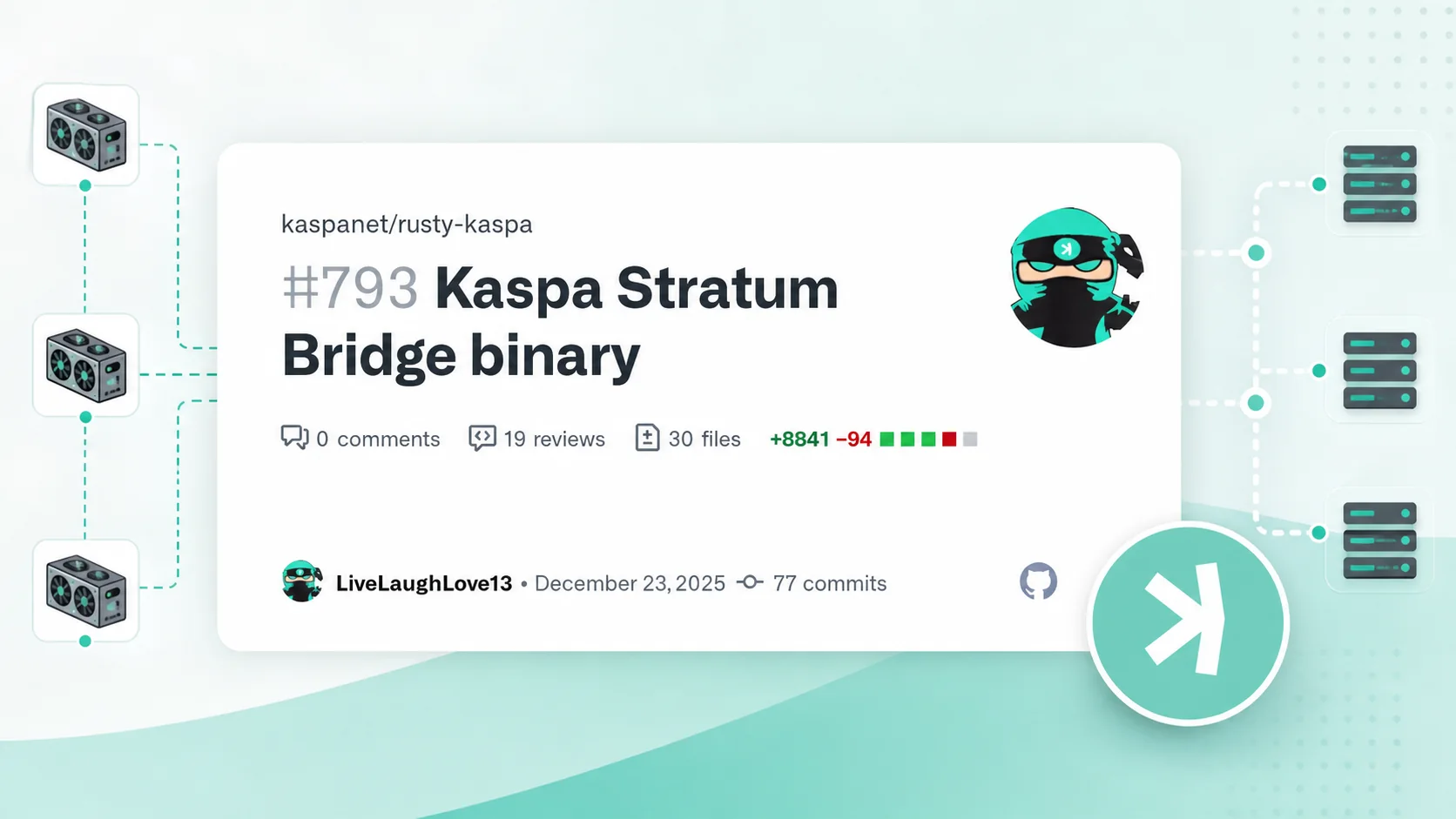
The Kaspa Stratum Bridge binary entered Rusty Kaspa through merged pull request #793 on January 12, 2026. It accepts Stratum connections from ASIC miners, obtains block templates from a kaspad node over gRPC, validates mining submissions, and forwards found blocks. The bridge connects two interfaces; it does not replace Kaspa consensus or guarantee mining returns.
Key takeaways
- Rusty Kaspa PR #793 merged 77 commits into
master, with 8,841 additions across a 30-file diff. - The bridge translated between ASIC-facing Stratum sessions and Rusty Kaspa’s gRPC node API.
- External mode connected to a separately operated
kaspad; in-process mode started an embedded node but still communicated with it over loopback gRPC. - YAML configuration supported multiple Stratum instances, difficulty settings, variable difficulty, logging, and optional Prometheus ports.
- Operational statistics improve observability, but do not prove profitability, consensus safety, or pool-scale reliability.
What is the Kaspa Stratum Bridge binary?
Stratum is a common work-distribution interface used by mining hardware and pool software. Rusty Kaspa exposes node functions through its own APIs. The new stratum-bridge component sat between them: it listened for miner connections, requested a current Kaspa block template, constructed work, evaluated submitted shares, and sent valid block candidates to the node.
PR #793 added the bridge crate, configuration example, documentation, client and share handlers, hashing logic, health checks, Prometheus instrumentation, and node-lifecycle support. GitHub’s large diff total includes generated lockfile changes and extensive new component code; it should not be read as a quality score.
The architectural boundary is useful. Miner firmware does not need to speak Rusty Kaspa gRPC directly, and the consensus node does not need to implement every miner-facing session detail.
How does work move from a node to an ASIC miner?
The pull request documents a four-stage path:
| Stage | Interface | Responsibility |
|---|---|---|
| Rusty Kaspa node | gRPC | Reports sync state and supplies block templates |
| Stratum Bridge | Internal logic | Converts templates into jobs and tracks workers |
| ASIC miner | Stratum TCP | Performs proof-of-work and submits shares |
| Bridge back to node | gRPC | Validates and submits found block candidates |
The bridge subscribed to new-block-template notifications and waited for the node to report synchronized before serving normal work. Its API wrapper retried selected transient template errors and logged acceptance or rejection details for block submissions.
A share can meet a worker or pool difficulty without meeting the full network target. Share counts estimate contributed work; only a network-valid submitted block becomes a Kaspa block candidate. That is why accepted shares, stale shares, invalid shares, and found blocks are reported separately.
What were external and in-process node modes?
In external mode, the operator started kaspad independently and configured the bridge’s kaspad_address to match the node’s gRPC listener. This separation allows independent restarts, permissions, resource limits, and monitoring. It also requires the operator to keep addresses, ports, and startup order aligned.
In in-process mode, the bridge parsed normal node arguments and started a Rusty Kaspa core inside the same process. The bridge then connected to that embedded node through gRPC on the configured loopback address. Mining and statistics logic were shared between modes; only node lifecycle differed.
An embedded node simplifies one deployment unit, but a crash or resource problem can affect both functions. An external node provides isolation at the cost of another service to manage. Neither mode changes the consensus rules applied to a submitted block.
How was the bridge configured and observed?
The PR used a YAML configuration with a global kaspad_address and one or more instance sections. Each instance could define a Stratum port, fixed or variable-difficulty behavior, logging, and an optional Prometheus endpoint. Command-line options selected the configuration file and node mode; supplying node arguments could imply in-process mode.
Console tables reported worker and instance hash-rate estimates, difficulty, shares per minute versus target, accepted/stale/invalid counts, blocks, and elapsed time. Background tasks queried network hash rate, difficulty, peer count, synchronization, server version, tips, and mempool state for display and metrics.
Metrics need interpretation. Short-window hash-rate estimates fluctuate, low share difficulty can inflate counts, and stale rates depend on latency, job updates, hardware behavior, and configuration. Prometheus makes trends visible; it does not validate the correctness of every estimate.
What should an operator secure before deployment?
Keep the node’s gRPC listener private unless remote access is intentionally protected. Bind management and metrics ports to trusted interfaces, apply host firewall rules, restrict configuration-file permissions, and segment public Stratum traffic from node administration. Do not expose a wallet key simply because the bridge and node share a machine.
Monitor synchronization, peer status, template age, stale and invalid shares, reconnects, file descriptors, CPU, memory, and network bandwidth. Test clean shutdown and restart behavior before connecting a full miner fleet. Pin the exact binary and configuration reviewed, because a long feature-branch history can contain assumptions that change in later releases.
Storage remains a separate concern. Operators planning large archival infrastructure should compare the Kaspa RocksDB presets guide rather than assuming a mining bridge optimizes the node database.
What did this merge not guarantee?
It did not guarantee that every ASIC firmware dialect was compatible, that a deployment could serve an unlimited number of miners, or that measured hash rate would produce a profitable return. It also did not turn the standalone bridge into a hosted pool with accounts, payouts, fraud controls, customer support, or service-level guarantees.
Mining economics depend on hardware efficiency, electricity, cooling, uptime, network difficulty, fees, and KAS market price. Software integration is only one input. Kaspa’s use as a payment network is another topic; our KaspaBuy instant crypto payments overview explains the consumer-facing side without treating mining infrastructure as merchant adoption.
Frequently asked questions
Does the bridge mine KAS by itself?
No. It distributes work to connected miners and relays their submissions. Proof-of-work is performed by the mining hardware.
Is an external kaspad required?
No. The PR documented external and in-process modes. Both used the same gRPC-based Kaspa API layer for mining operations.
Does Prometheus reporting prove a miner’s profitability?
No. Metrics describe operation and estimated work. Profitability requires costs, network conditions, rewards, downtime, and market data outside the bridge.
Source and verification note
The primary source is kaspanet/rusty-kaspa PR #793, merged January 12, 2026. Merge date, branch, commit count, changed files, and diff totals come from GitHub metadata; architecture, modes, configuration, and metrics come from the PR description and reviewed files. This article does not certify miner compatibility, production security, pool readiness, or economic performance. Operators should verify behavior against the exact release and hardware they intend to use.