
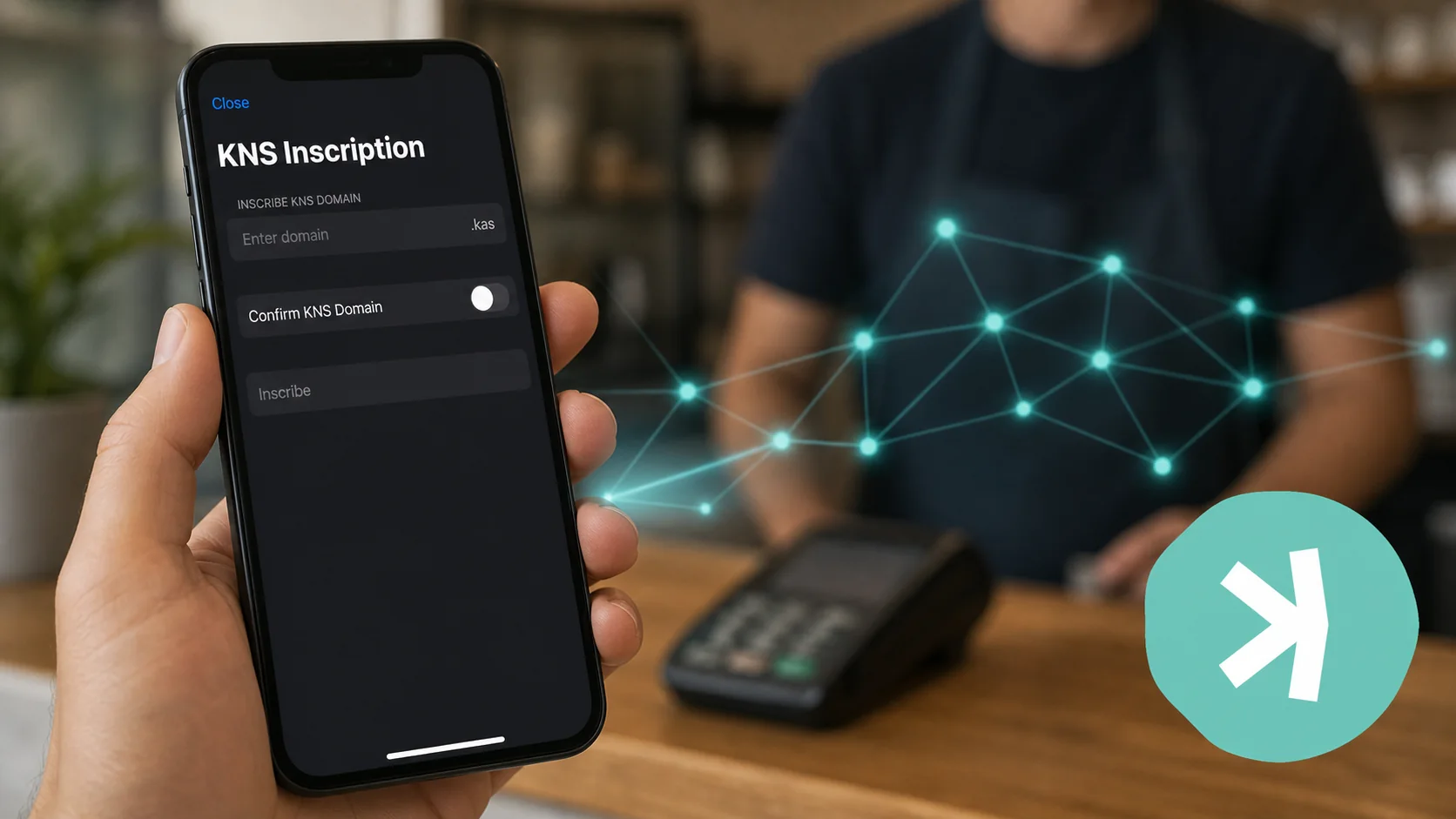
Kaspa Name Service on mobile reached a practical milestone in June 2025 when Kurncy Wallet added support for sending and receiving assets through inscribed .kas names. The integration made human-readable identifiers usable inside a phone app, but users still needed to verify name resolution, destination details, asset type, and wallet provenance before paying.
Key takeaways
- Kurncy Wallet’s update supported
.kasnames for KAS, KRC-20 tokens, and KRC-721 assets. - KASmedia reported more than 26,000
.kasnames inscribed by mid-June 2025. - Kastle supported name interaction through its browser extension, with mobile work discussed separately.
- Kasway was testing
.kasintegration for point-of-sale use. - Human-readable names reduce copying friction but introduce a resolution layer that users must verify.
What changed for Kaspa Name Service on mobile?
KASmedia’s June 23 ecosystem report said a Kurncy Wallet mobile update allowed users to send and receive KAS with an inscribed .kas domain. The same integration supported KRC-20 and KRC-721 assets. Before that milestone, name use was more closely associated with browser-based tooling.
The report also described direct management of .kas names in the app, including saving destinations in a contacts list and displaying a verification indicator. As of mid-June, it counted more than 26,000 inscriptions. That figure is a historical snapshot from the cited report, not a current registry count.
How does a human-readable Kaspa name help?
A standard Kaspa address is designed for machines and cryptographic validation, not memory. It is long enough that users usually copy, paste, scan a QR code, or select a saved contact. A .kas name gives a person a shorter identifier that a compatible service can resolve to payment information.
That can improve usability at a merchant counter, in a mobile contact list, or when sharing a donation destination. It can also reduce some copy errors. It does not change the underlying UTXO transaction: the wallet ultimately has to construct a transaction to a valid destination resolved from the name.
What does “inscribed” mean in this context?
The KNS project uses Kaspa data to record name ownership and association. The source described a name as permanently recorded on the BlockDAG and usable as a wallet identifier. Users should distinguish that project-level naming protocol from a native consensus address format. Not every Kaspa wallet is required to understand .kas names, and integration behavior depends on the resolver and wallet implementation.
This distinction helps with troubleshooting. If a conventional address payment works but a name does not resolve, the problem may sit in the naming service, indexer, wallet integration, or network configuration rather than Kaspa consensus.
Which wallets and payment tools were involved?
Kurncy supplied the highlighted mobile implementation. The report said Kastle users could also interact with .kas names through its browser extension and that a Kastle mobile integration was planned. Kasway, a Kaspa-oriented point-of-sale project, was testing name support.
These integrations had separate release cycles and security models. A name resolving in one wallet did not prove identical support in another. Users needed to check the exact app version, selected network, asset, and destination preview before confirming a transfer.
For broader checkout context, see our guide to Kaspa payments for online commerce. A web store can use dedicated order addresses even if the public-facing brand also owns a memorable name.
How should users verify a .kas payment?
Treat the resolved address as security-sensitive. Obtain the name through an authenticated channel, confirm spelling and Unicode characters, and inspect the wallet’s resolved destination. For a first payment, send a small amount and verify receipt through an independent channel before transferring more.
Do not trust screenshots as proof of ownership. Names can be imitated in social profiles, and visually similar characters can mislead users. Wallets should make resolution results clear, warn when a name changes destination, and preserve enough transaction detail for the sender to audit what was signed.
Users should also verify they are sending the intended asset. KAS, KRC-20, and KRC-721 support in one interface does not make those asset types interchangeable.
What could .kas names mean for merchants?
At a physical counter, a short business name can be easier to communicate than a raw address. It may fit naturally on a sign, receipt, QR display, or staff workflow. The Kasway testing mentioned in the source points toward that merchant use case.
However, good accounting often favors a unique address or invoice reference per order. A reusable name can be a convenient entry point while the payment application still generates order-specific destinations, monitors the exact UTXOs received, and reconciles the fiat quote. Merchants should not sacrifice reconciliation simply to gain a memorable identifier.
Community merchandise can serve the same educational role. A Kaspa “Accepted Here” sticker can signal payment support, while the checkout or counter display provides the exact verified destination for that order.
What should wallet developers test?
Test successful resolution, nonexistent names, expired or reassigned records if the protocol permits them, network mismatch, stale caches, Unicode ambiguity, offline behavior, and resolver failure. The confirmation screen should show both the human-readable name and the resolved address. Logs should avoid leaking seed phrases or private customer data.
Developers should also define trust boundaries: which indexer or resolver supplies the result, how freshness is established, and what happens when providers disagree. A friendly name is valuable only when the path from name to signed transaction remains auditable.
Frequently asked questions
Is a .kas name itself a normal Kaspa address?
It is a human-readable identifier resolved by compatible KNS tooling. The wallet still needs a valid underlying destination to construct the transaction.
Did every Kaspa wallet support .kas names in June 2025?
No. The cited milestone concerned particular integrations, led by Kurncy mobile and supported in other forms by named ecosystem tools.
Can a merchant reuse one .kas name for all orders?
It may be possible, but unique per-order destinations usually provide clearer reconciliation and payment monitoring. The naming layer and the accounting model solve different problems.
Source and verification note
The primary source is KASmedia’s June 23, 2025 report, Move Over: Kaspa Will be a Top Five Coin, especially its “Kas Wallets are Live on Mobile” section. It links the contemporaneous Kurncy, Kastle, and Kasway updates. Users should verify current app releases and official project documentation before relying on name resolution.